
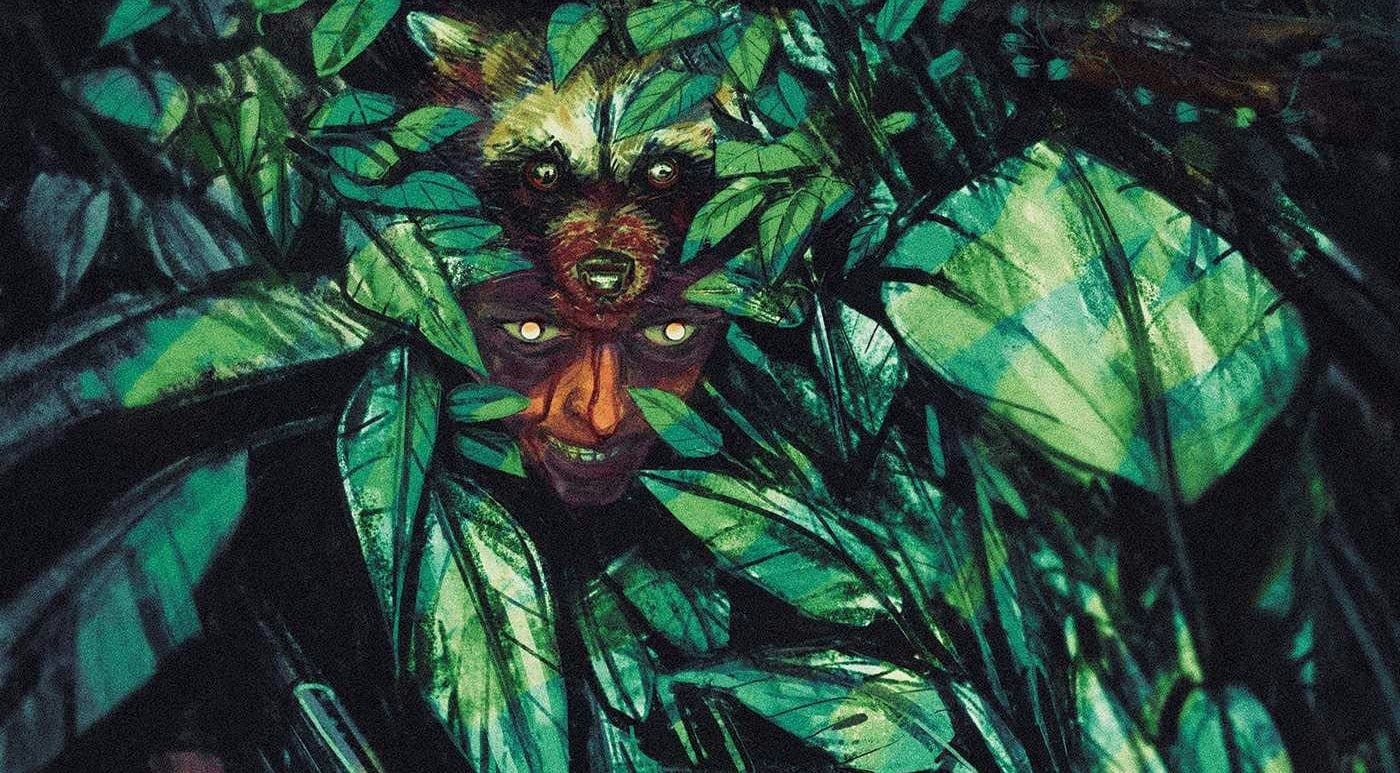
The Voice Said Kill is a ruthless, deeply moving crime-thriller comic from the wonderful creative team of Simon Spurrier and Vanesa Del Rey. Set deep within the Louisiana bayou, and following a Wildlife & Fisheries agent on the worst day she could possibly imagine, it’s cut-throat and exciting in all the best ways, shifting and evolving with the same chaotic energy that informs the mysterious, violent ecosystem surrounding our characters. One of the best comics in the genre that I’ve read in years, its propulsive energy and brilliant, tense atmosphere will keep you on the edge of your seat the entire reading experience. With the trade paperback launching in spring of this year from Image Comics, The Beat sat down with writer Simon Spurrier to discuss the creative process behind the The Voice Said Kill and the alluring qualities of the wilderness as a place to tell gritty, complex stories.
This interview has been edited for clarity and brevity.
JARED BIRD: The Voice Said Kill launches March 25th, 2026 from Image Comics. To those unfamiliar, how would you describe The Voice Said Kill?
SIMON SPURRIER: It is a swampland crime thriller. That’s the one-line version. The slightly longer version; It’s the story of a heavily pregnant Wildlife & Fisheries agent in the Louisiana bayou who has to take over the running of the park all on her own as a consequence of the rest of her team being sent home with what appears to be food poisoning. She’s having a day from hell, during which she’s forced to confront a dangerous, unpredictable individual out in the swamp. She has to make a split second decision, one that’s completely out of her comfort zone, something she would never normally do. It’s a moment of violence and instant regret, and the choices she makes in the immediate aftermath are the trigger for everything that happens thereafter.
It’s the sort of story whereby a butterfly effect, brownian motion, everything that could and should have been easily solved bubbles outwards constantly, becoming more and more chaotic. Extraneous elements enter the picture and before she knows it, this poor, strong, wonderful woman is embroiled in schemes involving alligator poachers, moonshiners, drugrunners from out of town, and other larger than life components that she’d far rather not be part of. It’s the story of how she deals with this, how she stays alive and confronts all these threats. There’s an investigative element, there’s a survival element, and it’s the type of crime story that plays with the tropes and conventions of the genre. There is a murder that needs to be solved, but I love the Fargo-esque sense that all these well-laid plans fall apart because of one thing that goes wrong, so it all goes spinning off in various different directions. It’s Fargo meets Deliverance with a dose of Apocalypse Now, with large parts of the story dedicated to an excursion into the wilderness and the journey back.

BIRD: What led to the creation of The Voice Said Kill?
SPURRIER: That’s a very good question. I always slightly struggle with answering these types of questions because generally speaking, ideas for stories that I write come to me bit-by-bit, accumulating into a big dust cloud based on things I’ve read, seen and characters I find interesting. Occasionally, and this is only the second or third time this has ever happened to me, a story will drop into my mind fully formed, and that’s what happened here. The first thing that came to me were the makings of the plot, which is unusual given that you never want to be beholden to a plot. That’s a very murder-mystery way of thinking where you end up without giving your characters much leeway to be characters, they end up having to run on rails without getting the chance to be a bit more human or stochastic. The fun part once I had the plot was considering how to then fuck with it, make it feel less predictable, and surround it by motivations and characters with dramas and drives which inform it and enrich it without making it feel like everything’s running on rails.
The initial plot speaks very centrally to the idea of leaving no ripples. When you encounter something awful, and intervene in something awful, we – as a consequence of Hollywood – believe in a binary of justice having to be served, everything neatly tied up. I believe there’s something quite nice about a very human sort of hero, whose reaction to intervening in something awful is to just leave it alone. Let sleeping dogs lie, leave no ripples, leave no footprints. That’s what I needed from a central character, which led to some interesting thoughts to do with parenthood and responsibility. If you’re a parent like myself, this question of when to pick your battles is something you’re constantly thinking about. Very long story short, as the consequences of having the basics of a plot, the necessities of all the other elements created themselves. It had to be set in a wilderness, where human beings have the illusion of being in control, but are not. It had to revolve around a central character who resented ideas of authority whilst themselves having a kind of authority, who had experience of being othered.
I wanted to explore the setting of a poverty-stricken, sidelined community filled with wrong-headed motherfuckers who all thought they could assert their dominance over anyone else, including the environment itself. Before you know it, you’ve got the bayou, a character who’s heavily pregnant and anxious about the role of her life with her child, who comes from an impoverished background. The story required me to be writing about this wonderful woman quite distinct from myself, and it is not my place to write from, to or of her perspective, so there are some things we do not approach or discuss. I can speak to experiences of othering and parenthood and the desire to leave no ripples in life. It was really interesting to engage my writing chops by exploring someone so different from me but with resonances I can really relate to and emphasize with. I hope the readers can too.
BIRD: Sometimes if the character feels quite separate from you, it can be hard to connect as a writer, so you have to find an emotional ‘in’ that is the root of the actions they take and emotions they feel throughout the story.
SPURRIER: Exactly. You have to be sensitive, you have to find the balance, and be aware of the fact that whereas you can discover some interesting universal human experiences and feelings, you’re coming at them from a different perspective to the character you’re writing. You have to do it, otherwise every character you write is a Mary Sue version of yourself! No one wants to read about me. You’re more than allowed to write characters who aren’t similar to yourself, the writer, you just have to be conscious of not claiming to understand the exact specifics of that character’s background, and instead focusing on elements that are universal feelings.

BIRD: What’s it been like to work with Vanesa Del Rey on the book?
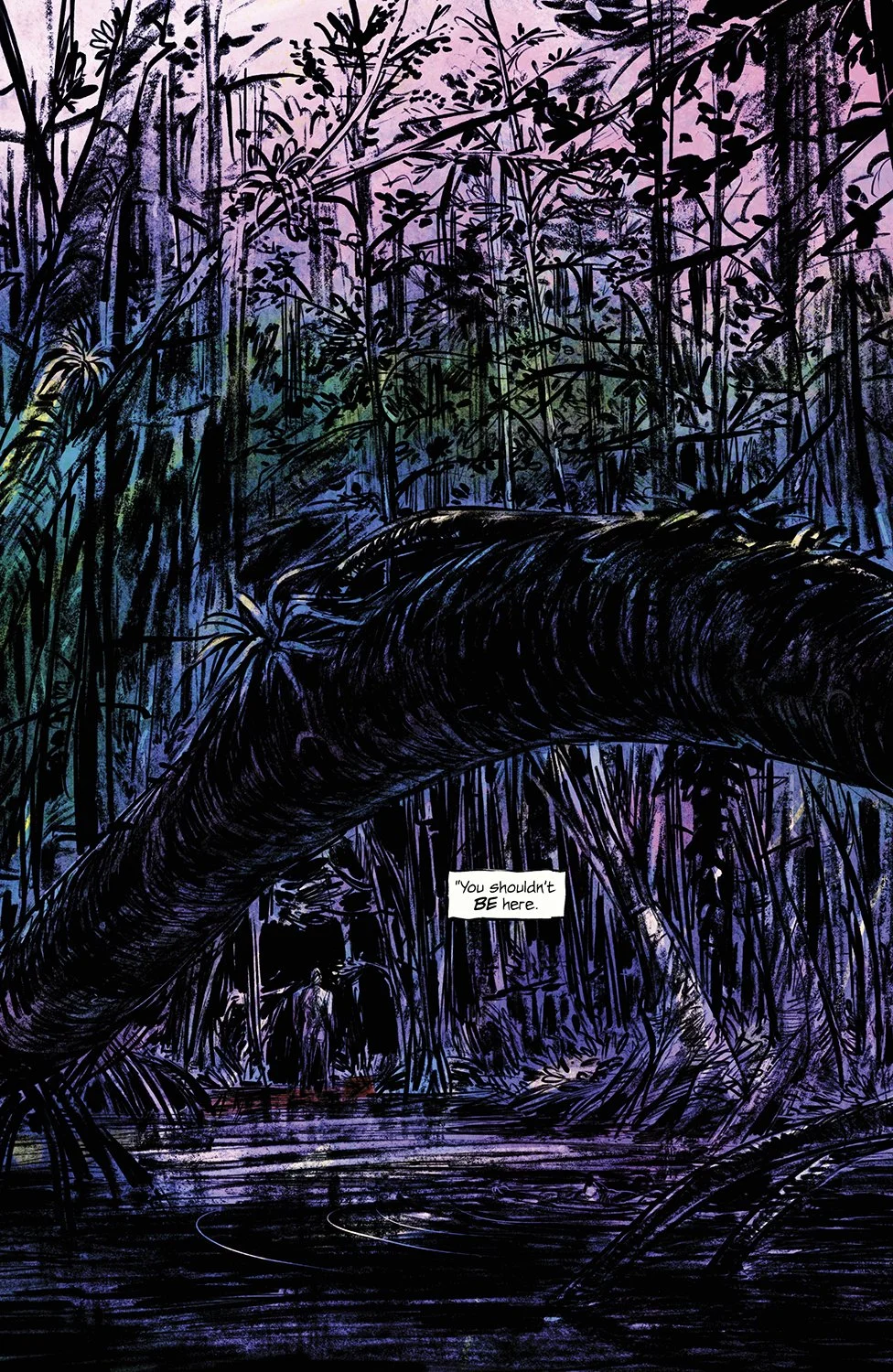
SPURRIER: She’s amazing. There’s a version of The Voice Said Kill that’s a right-down-the-barrel, very clean, crisp crime thriller. I would be quite proud of that. However, something to do with the nature of the story, the way that chaos is such an important element, with the story taking these unusual turns, where things happen that are unplanned for, where someone falls down and injures their head, or something breaks at the wrong moment, makes it a key part of how that world works. It felt important to find an artist who peddles in chaos, and Vanesa Del Rey really does. She’s brought a sense of psychedelic ecstasy to all the right places, the feeling of this natural and untameable world that’s chaotic and kind of sacred. You can be in any space and be visually overwhelmed by it, and there’s many people in our story who occupy these spaces and don’t feel that sacredness, who think they can go traipsing around this wilderness and control it utterly and they’re completely mistaken and learn very quickly. It’s only because our central character knows to tread carefully, to treat this place with respect, knows that you take nothing but memories and leave nothing but footprints, is that she knows how to survive it.
Vanesa Del Rey has come in and elevated this relatively clean story in a way that is totally unique to comics. She’ll have a couple of pages with people sitting and talking, and the lines break down and become totally impressionistic, and it becomes more about how they feel towards each other and the words they’re saying and the tension crackling between them. Then suddenly you’re out in the bayou and everything is crisp and clean but teeming and you feel like you’re in a fever dream. Maximising the potential comics have to elevate and give primacy to mood and tension using the artist’s pen and the ability to render something in a very specific style. I used to be a crime novelist and that’s just not a tool that you have. Everything you present to your reader is in the form of perceived information, you’re decoding constantly, whereas in a comic book it’s a mixture of perceived and received information, where the reader is decoding the words and the kinetic flow of words on the page whilst devouring the received information from the drawings on the page. It utilises the brain in a very unique way, engages the emotion so that every beat lands emotionally, and it’s beautiful. It’s a privilege to work with someone who is so unusual and I mean that in the very best way.
BIRD: Something that I love about the artwork in The Voice Said Kill is the difference between warmth in a pleasant way and warmth in a suffocating sense. The campfire heat is calming and soothing whilst the bayou is muggy, overstimulating and overwhelming.
SPURRIER: Vanesa’s the best at that. I’m preaching to the choir here but very few mediums can do that. Maybe in a film, or some forms of animation, but you very rarely see stories that are truly exploring sensory reality in a synesthetic sense. We have this tool box, why do we feel restricted to clean lines and clean storytelling when we have an artist who can make people feel sweaty and itchy?

BIRD: An aspect of The Voice Said Kill I appreciated is Marie’s unique status as a pregnant woman, which isn’t something you see explored very often, especially not in crime fiction. What inspired that creative choice?
SPURRIER: Having had two kids and seeing my wife carry around these little lives. In a slightly cheating way, it becomes a visual shortcut to investing a character with strength and vulnerability. Those two things in the same place at the same time are best typified by a heavily pregnant woman. I’ve watched my wife enduring extraordinary things as a consequence of being the mother of my children. I will never stop being loudly amazed by the fortitude, perseverance and tenacity of women with kids, whether they’re biologically carried or not. Any mother is an extraordinary creature. As a parent who overthinks everything, I’m very aware of the anxieties that go with the impending and recent arrival of a child, and the continuous presence of a child. At every stage of that journey you’re not only dealing with the reality in front of you but perpetually interrogating the future, perpetually worrying about what will happen to them.
I worry genre is a little guilty of packaging, simplifying reality into stories that are a little less useful than they could be. It felt right to me that this very capable, very smart heroine should also have this slightly unexpected aspect. In terms of plot, it impacts her ability, or at least that’s how a lot of people will think of a law enforcement individual who’s waddling around with an enormous baby belly. I think it’s the opposite, and it makes her a far more formidable character. All those ingredients went into it, and as I said before, when I was working out the most useful expressions of the ingredients of the recipe I was making up on the fly, that presented itself as the perfect solution.
BIRD: It’s quite striking to me because oftentimes a pregnancy is presented as an impediment to a character’s role in the narrative. With Marie, it’s a sign of her tenacity and strength that she’s still going, but it also informs those moments when she pulls back out of desire to leave no ripples.
SPURRIER: The stakes are automatically higher, and you can interrogate that in any number of ways, but you can get to Bill Hicks if you go down that road. She’s a great character, ultimately, and there’s some plot elements that happen as a result of the realities of being a pregnant woman physically and mentally that inform the plot in various ways, so it was the gift that kept on giving.

BIRD: How did you approach adopting the unique voice and identity of the Louisiana bayou, which is so distinct it’s formed a subgenre in and of itself, for The Voice Said Kill?
SPURRIER: Same as anything, lots and lots of research and sensory meditation. I took a trip out there for another reason, which was very useful and I put a lot of that into the story. Oddly enough, the more useful trip I took was to Bolivia, staying out in the deep jungle for a few nights. We have, again, this Hollywood-inspired view of what it means to be in the wilderness. For instance, I was rewatching Predator the other day, and having spent some time in the jungle, you become aware that they’re just sort of walking along paths. There are no paths. If you’re trying to get from A to B in a section of the jungle where no one else is, it will take you days, because there’s just no paths. I took notebooks on both of these trips, and in both cases I wrote down some sensory impressions. In Bolivia it was supposed to be a couple of lines every day, and within two days it was around 3000 words of the most purple prose you’ve ever read, going on about how ‘the jungle is a beautiful machine in which nothing exists except through the death of something else.’
It’s true, and one can very easily get overwhelmed by the indulgent sensory impressions of these places. Utterly wild and self-consuming and merciless, and by a human metric, very cruel. It’s wrong to apply a human metric, and that’s the problem, as we anthropomorphise everything. If you can stand back and watch – we can’t, as the observer effect dictates – but if you could, you would see this exquisitely tooled clockwork system where the death of one thing causes the life of another, the decay of this causes the blossoming of that, round and round, constantly forever repeating ad nauseum. It’s only when humans, with their consciousness and big clumsy bodies and need to get around, start penetrating these places that it all goes wrong. If you’re a crime writer or reader, that’s when things start getting interesting. There’s a balance there.
It is a seductive place to tell stories. The bayou, any sort of ‘wild’ space, especially if it’s the sort of place where people live adjacent to it, as is the case with Louisiana or the Amazon, has this really interesting sort of tension. The humdrum quotidian needs of humanity, and often the needs of humanity that are slightly unshackled from ethics, because people who live on the edge of wilderness will always feel the temptation to live off-radar, including criminality and lawlessness. It all writes itself, it all works very nicely, you just come to the point where the lowest common denominator tension in this world, in human terms, between people who think the wilderness is unconquerable, and people who think they can do whatever the fuck they want. What people don’t realize is that the entire ecosystem is connected, and the actions of someone miles away can have an impact all over. That’s something I’m trying to distill into The Voice Said Kill, that you can’t tell where ripples end.

BIRD: Something you talk about repeatedly is the human and emotional impact events in The Voice Said Kill can have, something a lot of crime fiction bows away from. The characters react emotionally, not just in accordance with the plot that’s being followed. Do you think that’s important to emphasize in a narrative like this?
SPURRIER: I think it’s an important thing for me to emphasize in The Voice Said Kill. To say that’s always the right approach would be disingenuous, because there are types of stories that a dedicated fan thereof would argue benefit from a more rational, didactic and less chaotic approach. My contention is that when we talk about genre we often talk about the familiar, comforting sensation that the frightening, chaotic world we inhabit can be compressed into neat little units that have their own preoccupations, conventions, and rules and generally speaking, their own neat conclusions. That’s compelling and quite comforting. We go through life in this chaotic haze, and here’s a nice story where evil exists and somebody does something awful, but someone comes along to investigate it and eventually evil is defeated. The crime is punished, justice is seen to be done. Those same broad ideas can apply to any genre you care to speak of. You can see why that would be so seductive, and why in the case of crime fiction, the reality is that a dedicated reader will read a good book today, but read a shit book tomorrow, because the need to keep digesting this alluring, seductive mythology of a simple universe is lovely. It’s a nice dream to have, a lovely escapist fiction.
However, because I’m a bit of a prick, and because I believe that’s a dangerous illusion to start to believe – there’s questions about whether this is a useful paradigm, a useful thing to teach our children, dominos that fall in all sorts of interesting and frightening directions – but for me, it’s more interesting to tell something that has all the components of a crime story, which then does not give you the simple answer. I know that people won’t enjoy the story unless there’s some form of neat resolution, but let’s not pretend it’s some sort of triumph of good over evil, let’s just pretend that it’s a solution. Ripples were made, a tsunami washed to shore, a civilisation washed away, but somebody gets to walk away, and that’s enough for me.
BIRD: It’s a conclusion to this particular series of events but not necessarily resolving any of the underlying factors that led to this.
SPURRIER: Precisely. We start with our central character defining what her stakes are. She lives in a world that’s full of crime, death and chaos but her stakes are ‘I will look after my unborn baby’ and that’s that. Can she do it? Tune in next month, readers! That’s how I think, in this case, the story has to go. I write many other kinds of stories, including superhero narratives, where if I start getting ethically grey, a decent chunk of the readership will get fed up with me. Me being me, I tend to do that anyway, but you have to allow yourself a little bit of fun. I do genuinely worry, especially when it comes to superhero fiction, that we are creating the world we have dreamed, where kids are growing up thinking the world is divided between good people who care about nothing but being good and can unilaterally elect themselves to be arbiters of what’s good and express it by punching people, and anybody that does something deemed to be evil, whether breaking a law or violating some ethical code, is doing it because they are fundamentally evil, rather than a need that can’t be recognised. I think that’s fun, entertaining bullshit, that creates a readership of fundamentally apathetic people who cannot recognise there are shades of grey in the picture. When I sit down to write a creator-owned comic with a crime comic, it’s a chance to present this concern.

BIRD: I loved the surreal, almost nightmarish touches of mysticism bleeding in through the corners of the series. What was the biggest challenge when introducing those elements to The Voice Said Kill?
SPURRIER: Very personally, the biggest challenge was not letting them dominate, because I come from the background of worldbuilding and I’m a very cheerfully unashamed mythical nut. I could bore you for hours with scholarly bullshit about the historicity of the old testament and the wild fluctuations of early christianity. I have thoughts on magic and could speak relatively articulately on mysticism, occultism and similar recondite guff. For me the temptation is always there to go racing off into these metaphysical realms. However, when you try to tell a recognisably real crime story, if you introduce one esoteric element too many, people throw up their hands in disgust. It is a violation of the rules, we are telling a story that is about mortality and how you live your life in the real world, and if you come at me with elves and ghosts and psychic happenings it ceases to have any critical internal logic.
It was important that it be harmonious to the sense of place and mood. All the way through we’re speaking in a language that’s purely visual, the sense of sacredness and impossible psychedelic spaces that one encounters when out there in the wilderness. The cheat code we use to get there is the suspicion that some sort of psychotropic substance has been involved. That’s fairly obvious from the get-go, and that allows you to say that when elements of this buttoned down narrative begin to verge on the unnatural or supernatural, maybe that’s why. These people are probably taking things, that’s okay, and they’re in this utterly transformative location that does lend itself to sensory overload and those sorts of flights of spiritual fancy. I think it’s all earnt, and I won’t spoil twists in the tale, but it all gets resolved quite nicely.
BIRD: You have to give the reader plausible deniability about some of the esoteric aspects.
SPURRIER: That’s a fantastic way of putting it.
BIRD: What would you like readers to take away from The Voice Said Kill?
SPURRIER: Where to begin? Hopefully, they will be left with the sense of the magnificence and strength of the central character. If that’s the takeaway, then we have succeeded. The possibilities inherent in any number of neatly boxed off things they’re intimately familiar with are far more than they expected. By neatly boxed-off things, I mean things like ‘the crime genre’ or ‘the comic book medium’. I would like it if The Voice Said Kill is the thing that comics-curious people from the crime prose readership picked up and enjoyed. It’s sort of frightening, and I tried very hard to encourage readers of crime fiction to come across. There should be a porous membrane between the two mediums, with the storytelling instincts the same in both, but they bring very different things to the table. It should be a question of why are readers of crime prose so resistant to coming across and reading comics. I suppose part of that is because of the nature of the comic book direct market, which involves going to a comic book store, which is quite a big commitment for something you’re not used to. Even picking up the collected edition in the bookstore takes a moment of boldness and bravery to commit to. I hope that if and when that happens, people go away feeling suddenly aware of all of the things we’ve talked about, and the way this magical medium can evoke mood and atmosphere in a way a novel or a movie simply cannot. I hope that in terms of the crime genre, this slightly circuitous approach to tying up the mystery via a succession of escalating pratfalls and chaotic moments is satisfying in a way that makes people realise crime fiction doesn’t need to be a series of ‘and-then’ causes and effects. Mostly I hope people read it and think it’s a really moving story about a single small life being caught up in a much bigger series of machinations than she wants to be in or gives a fuck about, and she wants to escape it and go back to her quiet, ripple-free life. I think in a word as complicated and frightening as the one we live in, it’s quite a laudable goal. To leave no ripples is quite a wonderful thing.
BIRD: What other works of yours would you recommend to readers who enjoyed The Voice Said Kill?
SPURRIER: That’s a difficult one, because it’s the first time I’ve written anything like it. If people enjoy the writing, I would steer them towards Cry Havoc, an Image Comics book I did a number of years ago about the intersection between folklore and the military. It sounds wild but it’s quite beautifully done, with Ryan Kelly on art. It’s told in three sections across one woman’s life, and to differentiate them we used different colorists. For the big worldbuilding stuff I’m known for, I would go for Step by Bloody Step, a completely silent comic with the incredible Matias Bergara. It’s a Persephone-seasonal myth seen through the eyes of a little girl protected by a giant as they walk through this teeming wonderful world. John Constantine: Hellblazer and Damn Them All are both occult-preoccupied thrillers featuring sneaky, clever bastard main characters in a world where to one degree or another, magic and mythology are present. Those are the closest you’ll probably get to The Voice Said Kill. They all have their own things, and I like to play with the form that makes the most of the tools it has.