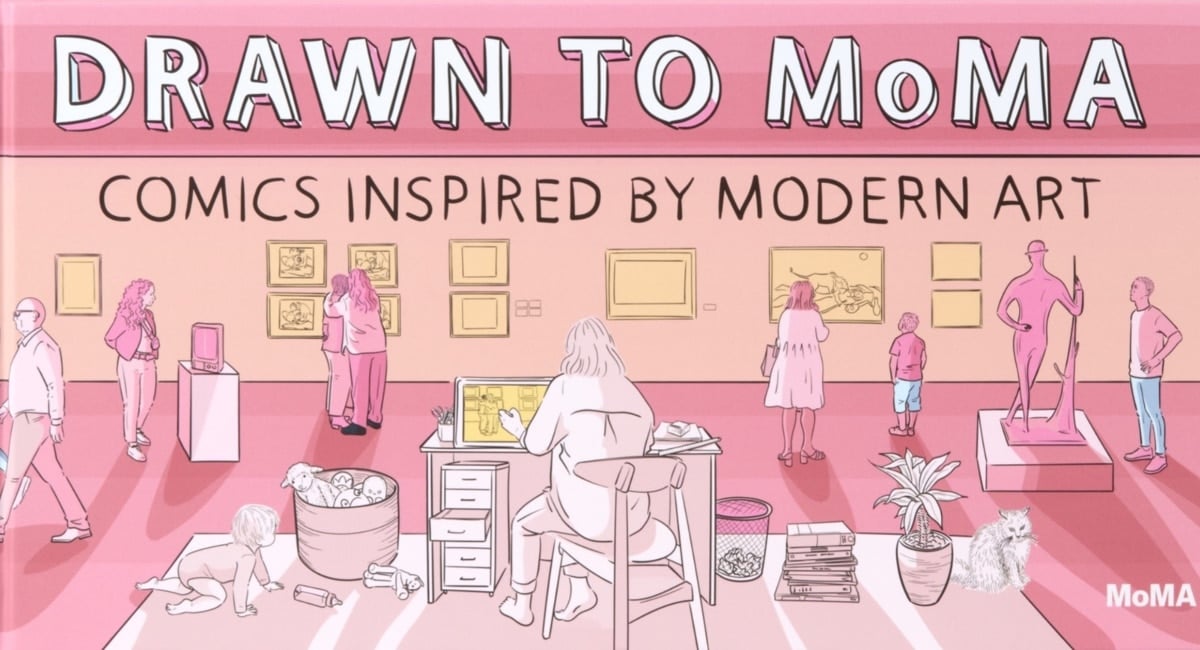

Edited by Alex Halberstadt, Senior Writer, Creative Team and Arlette Hernandez, Associate Educator, Interpretation, Research, and Digital Learning, Drawn to MoMA is a vibrant anthology of comics inspired by cartoonists’ visits to New York City’s Museum of Modern Art, with a preface by Walter Scott, collectible foldout poster by Chris Ware, and art by Scott, Ware, Roz Chast, Liana Finck, Jon Allen, Gabrielle Bell, Barbara Brandon-Croft, Jessica Campbell, Ted Closson, Ali Fitzgerald, November Garcia, Anna Haifisch, Mari Kanstad Johnsen, Patrick Keck, Lee Lai, Ellen Lindner, John Vasquez Mejias, Danica Novgorodoff, Tommi Parrish, Ben Passmore, Weng Pixin, Anna Sarvira, Bishakh Som, Karl Stevens, and Erin Williams.
Read the official description of the collection below:
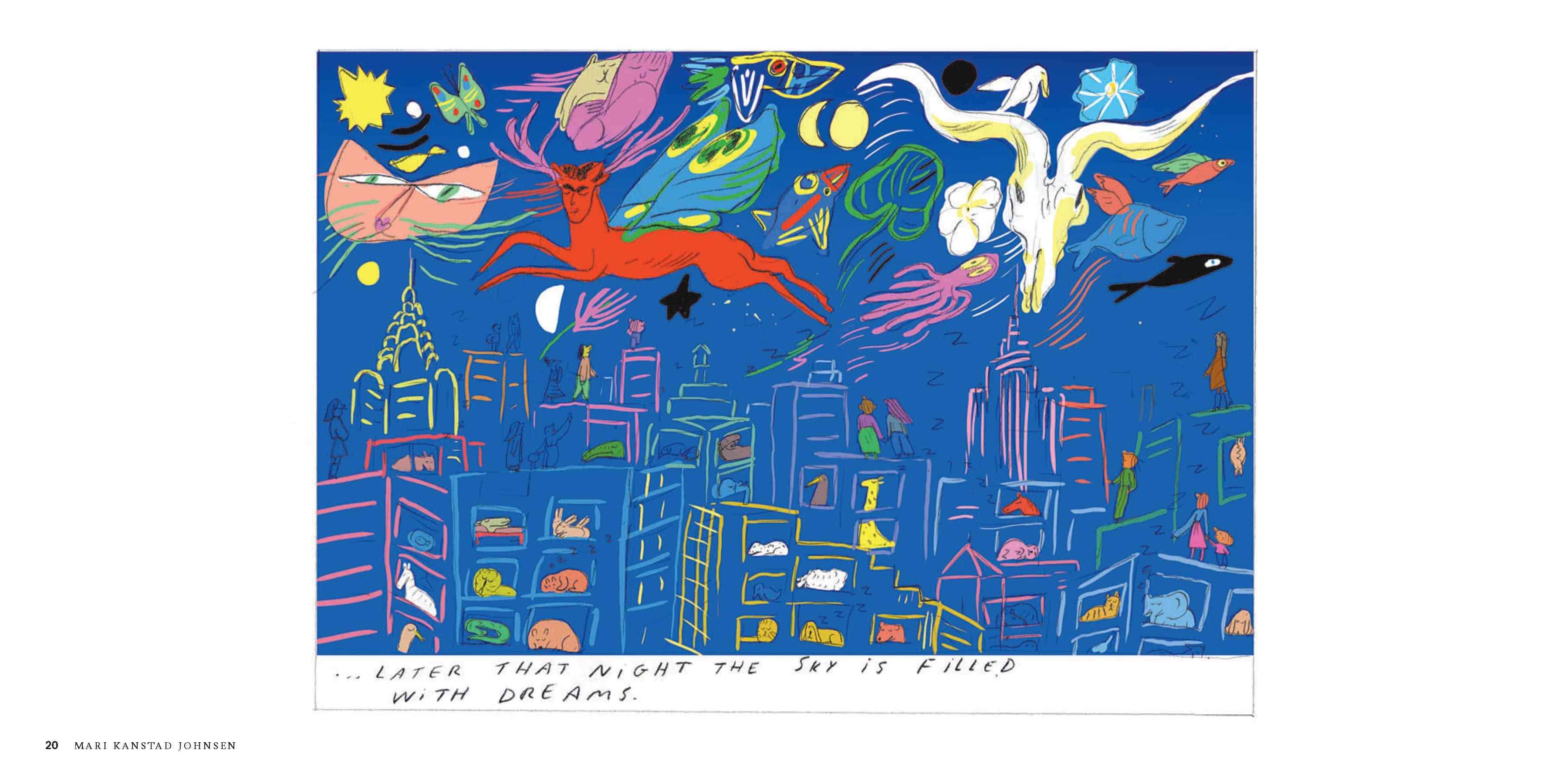
Have you ever left a museum feeling inspired or delighted? Has an artwork ever made you laugh? Cry? Think differently about the world? For the contributors to Drawn to MoMA, art has done all this and more. Since 2019, The Museum of Modern Art has commissioned cartoonists and illustrators to craft stories about their experiences inside and outside the museum. Gathered here are twenty-five hilarious, moving, and thought-provoking selections from the series by such acclaimed graphic artists as Gabrielle Bell, Roz Chast, Walter Scott, Tommi Parrish, Mari Kanstad Johnsen, and Chris Ware—whose work is presented as a collectible foldout poster. Each in their own style, they recount visits to MoMA, explore favorite artworks and artists, and meditate on love, friendship, and the struggles and rewards of life as a creator.

The Beat caught up with editors Halberstadt and Hernandez over email to discuss bringing the collection to life, what the curation process was like, and how Drawn to MoMA may bridge the gap between comics and other art.
OLLIE KAPLAN: How does the Drawn to MoMA anthology embody the “Art for All” philosophy?
ALEX HALBERSTADT & ARLETTE HERNANDEZ: The phrase “Art for All” encapsulates many different concepts, but the one idea we continually come back to is this: we can all make meaningful connections to art. Sometimes, these connections emerge organically—think about the last time you saw an artwork that stopped you in your tracks. At other times, what inspires connection is not so much the experience of seeing an artwork but witnessing it through the eyes of another. This requires vulnerability, a willingness to listen and share, and to be known. All of the artists who have contributed to the series—in all its iterations—have left a part of themselves on the page.
KAPLAN: As is noted in the preface, comic book art was historically viewed as less than fine art because it’s art meant to be consumed by the masses (relatedly, don’t get me started on a Charles Dickens tangent). How does Drawn to MoMA aim to bridge that divide, if at all?
HALBERSTADT & HERNANDEZ: The truth is that Drawn to MoMA can only do so much to change the culture around how comics are perceived. To make meaningful changes, there has to be a larger shift in the culture of who gets to define what “fine art” means, and in how that process occurs. That said, one of our hopes for the series is to show the intimate connection between “fine art” and comics. The artists in this series are thinking about their craft as deeply as the modern artists whose work we exhibit on the gallery walls, and often are working in conversation with these artists.

KAPLAN: What does this anthology say about the role of the critic—and the critic as artist?
HALBERSTADT & HERNANDEZ: We think there are as many critical perspectives in this book as there are stories. As editors, we wanted to encourage conversations between the different stories, but also highlight a throughline that runs through each of them, which is the ethos of irreverence. You might even call it fun.
KAPLAN: How did you curate which artists or moments from MoMA’s history to include?
HALBERSTADT & HERNANDEZ: The selection process for the series is as wide-ranging as the styles contained in the anthology. It’s quite common for us to sit down and begin a conversation by discussing a recent graphic novel that inspired us, or a zine we stumbled on while exploring comix stores like Desert Island. From there, the conversation unfolds into questions we’d love to hear perspectives on, hidden stories an artist could bring to life, themes explored within our galleries, or even calendar events that might invite reflection on experiences like motherhood or queerness.
KAPLAN: What were the biggest editorial challenges and rewards when curating this anthology?
HALBERSTADT & HERNANDEZ: It’s probably no surprise that the biggest editorial challenge was the fact that we were limited to choosing only 25 stories from more than 50 Drawn to MoMA features. Another challenge was reformatting these web-first stories into print. We were so fortunate to work with Kayla E., creative director of Fantagraphics and author of the new graphic novel Precious Rubbish. Kayla helped us see this series in a new way, bringing so much care and creativity to a challenge that initially seemed insurmountable.
KAPLAN: What do you hope readers take away from Drawn to MoMA that they wouldn’t from a traditional museum guide or exhibition catalog?
HALBERSTADT & HERNANDEZ: Unlike an exhibition catalogue, which is usually organized around the vision of the curatorial team, Drawn to MoMA is a more polyphonic project. We offered contributors a fairly open-ended prompt—both in terms of perspective, style, and subject matter—so the result is varied, unruly, and sometimes internally contradictory. We find that pretty exciting.
So much of our collaboration has been about creating a dialogue around art, and we felt that the next step for the Drawn to MoMA series was to create a new conversation in the form of a printed anthology. During the early stages of production, we continually wondered about what iit would feel like to flip through pages of illustrated stories all about art. How would these stories speak to one another, allowing a reader to immerse themselves in different sensibilities and worlds? We also wanted to celebrate the incredible work of the artists who have contributed to this series in a tangible way, by helping these stories find a new home beyond the web.

KAPLAN: Has MoMA explored comics or graphic storytelling in its exhibitions or archives before this project? What role did that history (or lack of history) play in this project?
HALBERSTADT & HERNANDEZ: In 2007, MoMA opened the exhibition Comic Abstraction: Image-Breaking, Image-Making, which explored the ways in which artists have borrowed and adapted the visual language of comics, cartoons, and animation. Several of the works in the exhibition referenced comic elements, like the gutter between panels or the visual representation of sounds like explosions. This exhibition was a major inspiration for a series of features published on MoMA’s Magazine in September 2021: How to Make Comics, which we produced in collaboration with comics scholar Chris Gavaler.
KAPLAN: Can we expect any more volumes?
HALBERSTADT & HERNANDEZ: We sure hope so!