
By J. D. Harlock
Dubbed the “David Bowie of Comics” by his esteemed peers, Bryan Talbot has been acclaimed for his coveted ability to consistently put out wholly original graphic novels, each in a completely different style and subgenre. Every time he’s pulled this off, he’s reshaped the comic book fandom’s perception of his creative prowess. To me, no graphic novel has altered this perception of his stripography more than his underappreciated urban-fantasy farce, Cherubs!
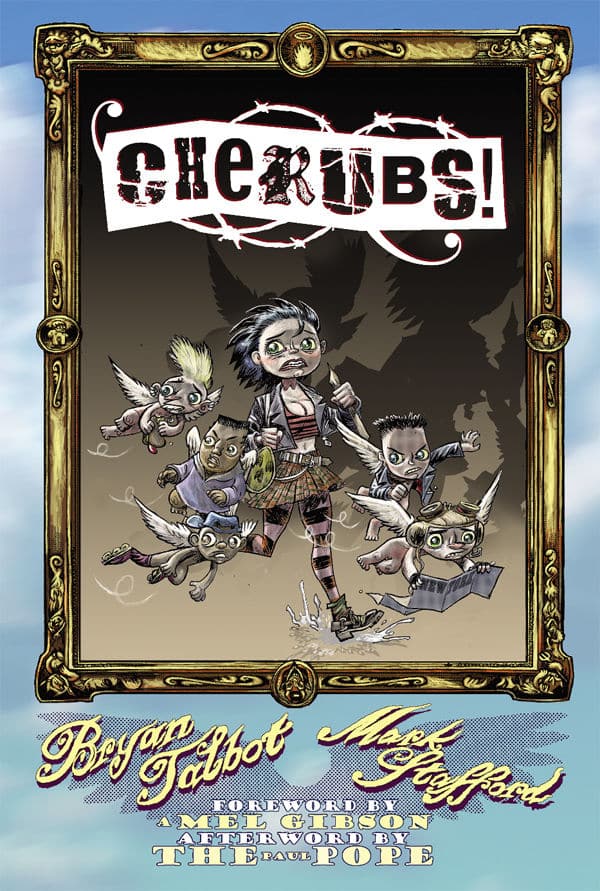
Cherubs! is a British graphic novel told in two parts over 200 hilarious pages. The first part, Cantica I, was released by Desperado in 2007, before a collected edition that included Cantica I and Cantica II was released by Dark Horse Comics in 2015.
In Cherubs!, Talbot, a creator so quintessentially British, tackled a story so utterly American that it ended up rivaling the best of what American adult animation had to offer at the time, with the plotting of irreverent British action-adventure comedies like Monty Python and The Holy Grail or The Hitchhiker’s Guide to the Galaxy. As such, any attempt to relay Cherubs! premise will always read like a fever dream, but it goes a little something like this:
After the archangel Abaddon commits the first murder in Heaven as part of a pact with Lucifer, the titular cherubs are blamed for the crime. Now, forced to go on the run, they must track down Abaddon to clear their name, and on their way, they have to make it out of Limbo, navigate New York City’s supernatural underground while launching their music career with their human friend Mary, and finally descend the nine circles of Hell to foil Abaddon’s plans to instigate the apocalypse.
Even though Talbot is first and foremost an artist who has been as acclaimed for his art as for his writing, he did not illustrate the graphic novel. Cherubs! was a dream team collaboration between Talbot and the stalwart of the British Indie comic book scene, Mark Stafford, who is easily one of the best cartoonists currently active in the UK.
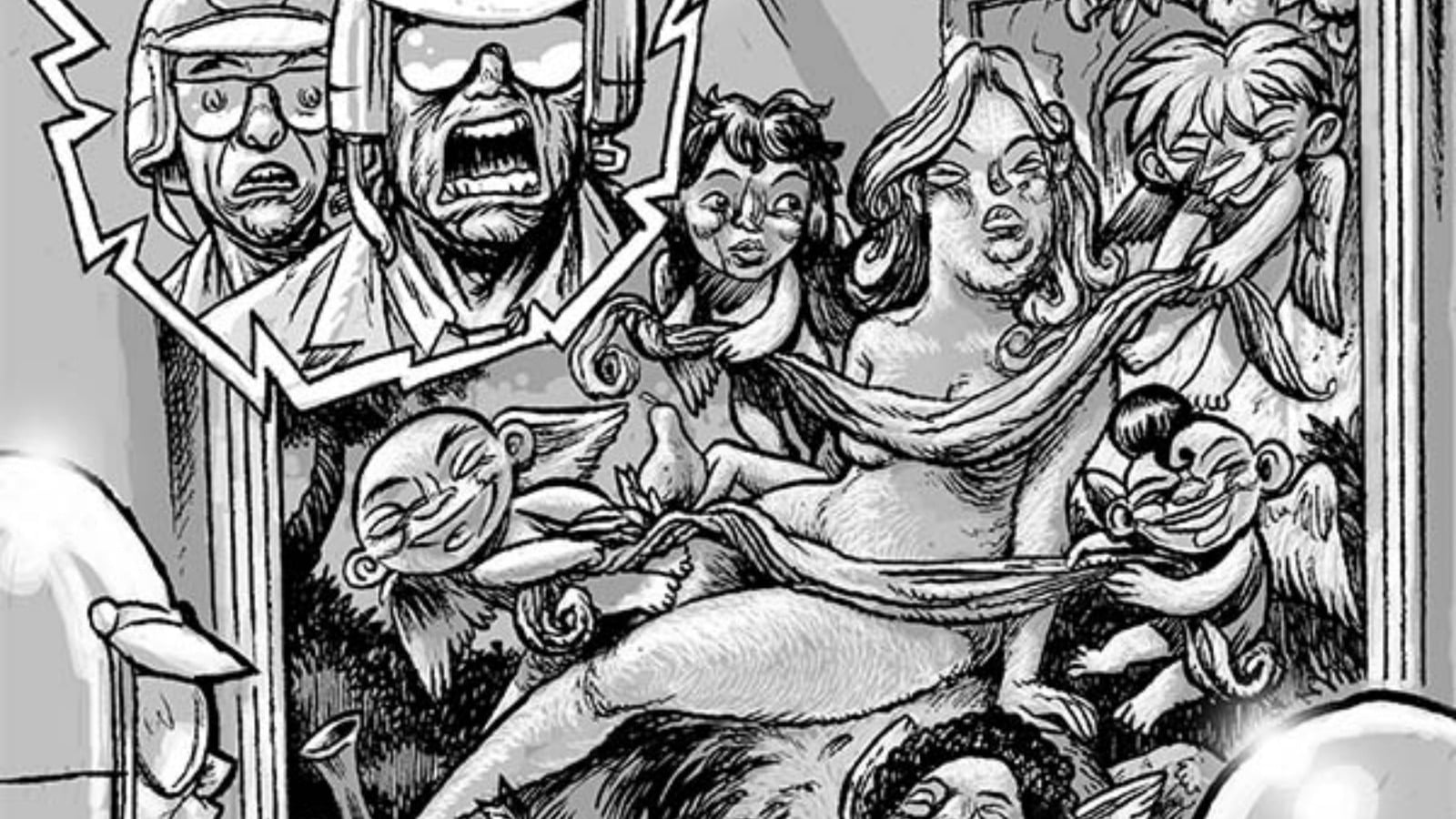
Stafford’s distinctive style makes this book special and perfectly complements the unique blend of influences from which Talbot drew inspiration. Stafford’s art captures the irreverent, fast-paced humor Talbot wanted to take from animation and recreate in graphic novel form. Everything from the backgrounds to the characters to the pop culture references is painstakingly translated by Stafford from Talbot’s rollicking script, and you would have a blast on rereads just from trying to spot every little in-joke crammed there.
This is all to say, if you’re a fan of American adult animation and want to read something similar in structure to their long-form film adaptations like The Simpsons Movie or South Park: Bigger, Longer, and Uncut, I can’t recommend Cherubs! enough. It’s been slept on for too long, and it’s about time that it’s recognized for the wonderfully quirky good time it was always intended to be.
Recently, I had the pleasure of sitting down with Talbot and Stafford in March for an exclusive, in-depth discussion on the development of their cult classic Cherubs!, and hopefully, this will shed light on the sheer blood, sweat, and tears that went into one of the funniest graphic novels ever produced!
J.D. Harlock for The Beat: In hindsight, a collaboration between you two is such an odd pairing, considering the clash in styles and tone. Who would’ve thought that it would end up being a match made in heaven! So, how did you two even become acquainted with each other in the first place?
Mark Stafford: I think that would have been 1984-1985 when he took over the art on Nemesis the Warlock for The Gothic Empire arc in 2000AD. I loved his ultra-rendered version of the disembodied Torquemada. I lived just around the corner from Fantasy Bookshop in Pokesdown, Dorset, and would find nuggets in their quite random collection of weird tat.
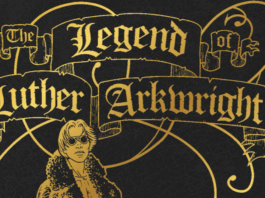
Around the same time, I was buying old issues of Knockabout and such, and he kept turning up in things like ‘Cold Snap‘, the short story he did with Alan Moore for the 1985 Flying Pig benefit comic Food for Thought. I liked his stuff immediately, but I wasn’t fully aware of his legacy. The Adventures of Luther Awkwright would pop up as a reference in interviews with other artists and writers in fanzines, and I wondered what the hell that was….
Harlock: Well, I’m sure you’ve become familiar with it since! And, how about you, Bryan? How did you first come across Mark’s work?
Bryan Talbot: He showed it to me! I think it was in the early ’90s that Mark joined the Comics Creators Guild. It used to convene once a month at the London Sketch Club in Chelsea, and that’s where I met him, this young guy with amazing dreadlocks. We got on immediately, and I seem to remember going for a pint or two with him around this time, when he gave me some of his self-published comics, which I still have.
Harlock: By any chance, do you remember what you showed him, Mark?
Stafford: These would have been photocopies of my strips, largely one-pagers, and laser copies of paintings. I took an A4 plastic sleeve portfolio with me nearly everywhere in those days, and would force it upon strangers. ‘Look! I do things!’
Harlock: You certainly do, Mark!
Talbot: I really thought they were great. Otherwise, this conversation wouldn’t even be happening! They were different from the bland styles of most of the stuff around then. His work was distinctive, inventive, funny, sometimes unnerving, and sometimes outrageous, but always done with panache.
Harlock: Had you kept in touch since the Society of Strip Illustration days?
Talbot: Yes, we’d often meet up if I was visiting London, or at comic events. Since Alice in Sunderland, I usually have my graphic novel launches at The Cartoon Museum in London, where Mark was Cartoonist in Residence for many years, and we’d usually go for a curry together afterwards. Cherubs! was our only attempt at a collaboration.
Harlock: So, how did the idea for Cherubs! come about?
Talbot: In the year 2000, I was asked to script a web animation series by a short-lived American company. I’d been vaguely thinking of the story after doodling a few cherubs while trying to get a pen to work, and this commission made me focus on it. I’d only written the basic plot and the first two five-minute instalments before they decided against running a continued story in favour of producing self-contained humour shorts. It was only about four years later that I realised that it would make a fine graphic novel and wrote the script for the first half.
Harlock: And, why Mark as your choice of artist? I would’ve assumed you’re more than capable, and, thankfully, so was he!
Talbot: Oh, I never considered drawing it myself as I didn’t think that I could do the sort of streetwise cartoon style that suited the story. I immediately realised that Mark was the ideal artist for the project. His visceral style and very dark sense of humour avoid any notion of “cuteness” that most other cartoony artists would have brought to it. It took us three years, between other work, me scripting and doing the page layouts, and Mark doing the finished artwork.
Harlock: Considering how many plot threads, characters, settings, jokes, pastiches, and pop culture references it juggles, I would assume that you had your work cut out for you scripting this.
Talbot: Yes, after making notes on scenes and lines of dialogue, I collected everything and worked on the structure until I knew it was solid, going through several drafts on A3 sheets of paper before I began typing the script. Complicated individual scenes often required working out with rough mind-maps to ensure all the information required of the scene appeared in a logical and clear order. The real difference between Cherubs! And the scripting process for other graphic novels was done in two distinct phases, only starting the writing of the second part after Mark had finished drawing the first. However, I had already had it very roughly plotted out.
Harlock: The influence of American animation is something that struck me on a first read. It’s really what separates it from every other British graphic novel I’ve read till now. Not just because it isn’t quintessentially British, as your other works have been, but because the plot, setting, characters, humor, and pop culture references come off as distinctly American. I’m unsure if these were ever popular in the UK, but Cherubs! was so similar in style and tone to the cartoons that came out.
Talbot: That’s correct. For atmosphere, I had in mind animated shows like The Simpsons and South Park, but Cherubs! is ultimately a different kind of story from the episodic shenanigans that these cartoons indulge in. It’s a full-length comedy-adventure and the influence of both Monty Python and The Hitchhiker’s Guide to the Galaxy becomes apparent in the overall narrative, if not the approach to it. And, of course, the cherubs’ style of “dudespeak” is most definitely influenced by Bill & Ted!
Harlock: Since you handled the page layout in addition to the scripting, was a workflow developed for the illustration process?
Talbot: Yes, I composed the page layouts for Mark in batches of 10, just before he needed them to draw.
Stafford: For Cherubs! I worked in a brushy, cartoony style, with Gustave Doré and Hunt Emerson at the back of my mind. Bryan would include a lot of visual reference with his scripts and suggestions about films and paintings that would prove useful. There’s obviously a ton of pop culture references that turn up in there, so I was looking up all sorts.
Harlock: Did you ever consider coloring it? Needless to say, Mark’s coloring is sublime!
Talbot: It is! However, budgetary and time constraints meant it wasn’t even an option.
Stafford: Not to mention my computer power at the time, I could barely handle 300 DPI grayscale without the PC making an audible protest. It is what it is, and I think we got a lot of atmosphere out of what we had.
Harlock: Mark’s famed for his hand lettering, a lost art form in the modern comics industry, but the speech bubbles are digitally lettered.
Stafford: It was lettered by Nate Pride, who was gigging for Desperado at the time, working from Bryan’s very particular balloon arrangements. I’ll hand-letter most of my own work when I can, but this was my first real pro gig, and I had enough on my plate, so I was fine giving up that particular responsibility. There’s a lot of dialogue; I think hand-lettering the thing would have extended the workload by months and probably given me RSI, even before we got to corrections.
Harlock: Seems like it was a smooth production process overall. Were any major obstacles encountered?
Stafford: There was just the little matter of Michael Jackson, the King of Pop, dying. He was in the script for the second volume, getting possessed and exorcised, as a major plot point, until the inconvenient sod carked it, and we had to scramble to rejig that bit.
Harlock: Being familiar with both your stylistic preferences, that comes off as an unusual choice to me. I recall a similar occurrence happened earlier in Bryan’s career with Lady Diana and her portrayal in Heart of Empire. The portrayal wasn’t flattering, to say the least, and Heart of Empire was released not long after her untimely death, but no self-censoring took place. What was your thought process here, especially since Jackson hadn’t had the first of numerous public re-evaluations yet?
Talbot: Absolutely. It was before everyone found out what a creep he was, though he’d been considered weird by many people for a long while. At the time, there was an outpouring of grief from his fans, so we thought it would be kinder to change the character. Mark came up with Smiley Virus and even rewrote a few panels to fit.
The big difference between this and the Lady Diana character was that those scenes in Heart of Empire were already drawn, inked, lettered, and coloured, and the book was taking me so long, because it’s over 300 pages long and very detailed, that I wasn’t about to rework everything to fit. She was a crucial plot device. Victoria’s visit to her in Bedlam is how she discovers information about her brother. Replacing Michael Jackson with another pop star was a simple substitution. Incidentally, there wasn’t a single objection to my depiction of Diana as a madwoman.
Stafford: We went with a Miley Cyrus clone in the end, which was my suggestion after I’d read about this massive Disney pop princess phenomenon. Of course, a few years later, she gleefully destroyed that stage of her career with the ‘Wrecking Ball’ video and the twerking and such, which rather dates that bit.
Harlock: I’d have to disagree there, Mark. Off the top of my head, there are more pop stars than I care to count that have taken her blueprint and run with it since she first came down the assembly line. Recently, she even reprised her iconic role for the 20th anniversary, much to the joy of the legions of screaming fans around the world after scoring some of the biggest radio-friendly hits of her career in the lead-up to this.
Personally, I’m a fan of her Plastic Hearts era, and I wouldn’t be surprised if she agreed with our assessment of her stint with Disney. Anyhoo, speaking of annoying fictional characters, each of the Cherubs is obnoxiously distinct, but in a good way. How’d you settle on these five, and why’d you pair them up with a human?
Talbot: These baby-looking cherubs are as old as the universe itself, but their characterization drew on the Kid Gang subgenre that you’d see in works like The Famous Five, or more recently, Stranger Things. Mary was their guide on Earth because I needed a method of quickly introducing them into the New York supernatural underworld.
Harlock: So, I have to ask, why was the antagonist Archangel Abaddon modeled after you, Bryan? Picked up on that as I reread it!
Talbot: Was he?! You’d better ask Mark!
Stafford: Well, I don’t remember consciously modeling Abaddon on Bryan. Of course, it was remarked upon by others who saw me working on it, so it was hard to keep that visual echo out as the book progressed. A lot of characters in the book were modeled after the likes of Walter Matthau and so on, so I was in that mode. As far as I know, Bryan hasn’t committed any murders, though, and his plans for instigating the apocalypse have been largely unworkable, so the resemblance is skin deep.
Talbot: Mark’s mention of Matthieu reminds me of one of my favourite scenes. It’s only two pages long, but it’s a simultaneous pastiche of the opening scenes of The Bride of Frankenstein, Waiting for Godot, and The Terminator! Mark has a brilliant sense of visual humour, and he added to the scene by drawing the two hobos as Walter Matthieu and English character actor Wilfred Bramble!
Harlock: That brings me to self-styled White Magician Eroom Nala, who worships the Great God “Snakey.” Eroom somehow figures out that the Center of Evil is at the Waldorf Hotel by drawing lines on a map of the city connecting the five offices of the Pile-veet Hemorrhoid Company into a pentagram. It’s a clear reference to what Sir William Gull pulls in From Hell, and I have to admit it got an ugly laugh out of me during each read. As far as any of you know, has Alan Moore commented on it?
Talbot: Not as far as I’ve heard.
Stafford: I have no idea, myself, either, but I doubt it. He’s soured on the whole comics scene. It comes from a place of love, though, and I do like drawing that face…
Harlock: Besides the Michael Jackson self-censor, were there any major revisions or changes to the script that occurred?
Talbot: Mark requested a musical finale. I hate musicals! Though it does really fit in with the thread about the cherubs being part of the choir invisible and their ability to spontaneously burst into song. Mark even scripted some of the song lyrics. It also enabled me to finish the book with a view of the audience, containing several of the characters we’ve seen during the story.
Stafford: The stanza about not letting the bastards grind you down was mine, I believe. There’s a Dunning-Kruger part of my brain that reckons writing the lyrics for a musical would be a doddle. Money for old rope. It’s probably for the best that I don’t test out this theory. Anyway, it was a bit of a technical nightmare trying to fit it all in, all those fairies in formation. Bloody hell, it’s coming back. I had to learn how to do a double-page spread to pull this finale off!
Harlock: And what a finale it was! It ties up everything in a satisfying little bow, but in its own unique, Cherubs!-y way! Still, I’m curious. What would’ve been the original ending otherwise?
Talbot: It was the scene directly before the musical finale—the culmination of the Dante’s Inferno pastiche that comprised most of the second half of the story, but ending it on the musical set piece nicely rounded it off and left our celestial rug rats in a new and enjoyable situation where they wouldn’t be bored. The whole starting point was that they were bored witless in Heaven.
Harlock: It’s honestly a shame it took around seven years for the second half to be published, but it also came out with an entirely different publisher.
Talbot: Initially, we were offered a deal by independent publisher Desperado, who, at the time, were operating as an imprint of Image. We thought that having it come out from an Image imprint would get the book the attention it needed. As the story is structured in two distinct halves, Desperado offered to publish the first as a four-part series, before a trade paperback collection.
Unexpectedly, to Mark and me at least, Desperado split from Image shortly before publication, then put out the first part, Paradise Lost, in one volume with no publicity whatsoever, resulting in poor sales and the end of the run. Four years later, Desperado returned the rights to us. I offered it to Dark Horse, who accepted to publish the whole story in one hardback graphic novel. We thought this was brilliant!
Harlock: Were follow-ups ever planned?
Talbot: Part of the story concerns the cherubs’ fight to get their new friend Mary out of the clutches of Frankie Dracula, the son of the original, and his vampire gang. It’s mentioned in passing that they already defeated his dad the last time they were on Earth, in Venice during the Renaissance. That would have been the next story if the first had taken off.
Harlock: An interesting choice of setting!
Talbot: I love Venice and always wanted to do a story set there.
Harlock: Did you see this as a potentially long-running series, or did you just have the prequel in mind?
Talbot: No, just that. If it had really taken off, more would have probably materialized.
Harlock: Have you ever considered other collaborations with Mark since then?
Talbot: Nope, simply because I never had an idea for another story that would suit Mark’s style. Cherubs! was a perfect marriage of art and story.
Harlock: Twas! And, how about you, Mark?
Stafford: Well, never say never, but probably not. I’d happily do something small and quirky with Bryan, or contribute to a larger work if he wanted, but I can’t see another big project like Cherubs! happening, given that he seems to have three books on the go at any given time. The man’s a graphic novel machine!
Harlock: If it ever finds its audience, would you ever consider cocoloring for an anniversary rerelease?
Talbot: That would be up to Mark!
Stafford: Leave it alone! It is what it is, presented in glorious monochrome! That said, if fans want another colour cover, we could talk…
Harlock: Finally, Bryan, you’ve mentioned to me your plans on creating an annotated commentary for Cherubs! à la Grandville Integral. Can we expect to see that coming out anytime soon? Even with a reread under my belt, I don’t think I’ve caught half of all the references crammed into these two volumes!
Talbot: I’d love to find the time, but it’s a little redundant now that the book is out of print. If a publisher is interested in printing a new edition, I’d do it in a heartbeat!