

To adapt a story from one medium to another medium is to willingly venture into the mind of the original creator and live there for a while. Gou Tanabe understands this well as his stay in the mind of H.P. Lovecraft has produced some of the most accomplished adaptations of the author’s work. Tanabe showcases a deep, meticulous understanding of the things that made Lovecraft’s writing so terrifying. Fears of the unknown, the human body’s reaction to corruption and forbidden knowledge, and an awareness of the Old Ones are all things that define the brand of horror the legendary author built his legacy on. Tanabe is fluent in all of them.
This is evident in his adaptations of The Call of Cthulhu and At the Mountains of Madness. The slithery, tentacled, and aquatic horrors that he’s captured with these stories and others have given the original prose a series of images that can easily become the standard when thinking of the aesthetics of Lovecraft’s imagination. Somehow, Tanabe has managed to dig deeper into darkness for his latest adaptation, The Colour Out of Space. It’s enough to separate the story from the rest and might be his best work yet.
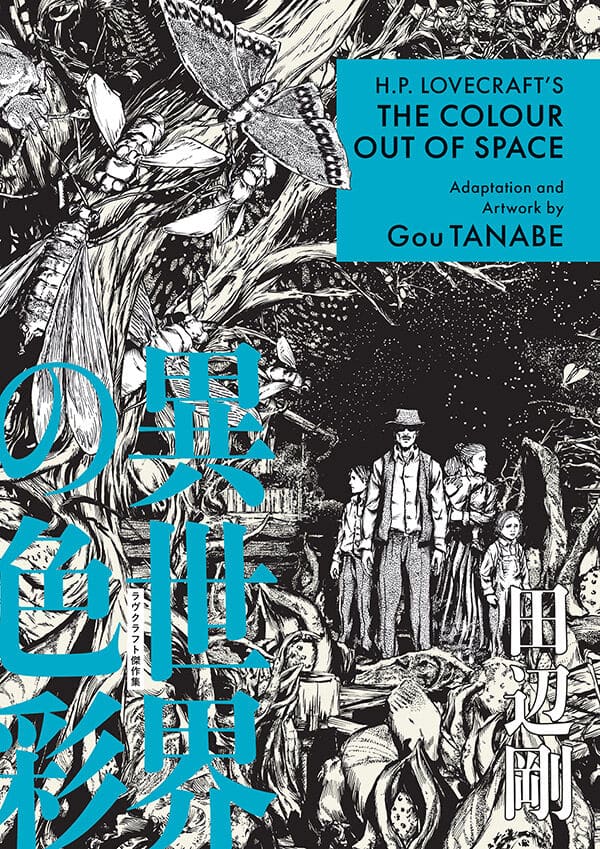
The Colour Out of Space centers on the fallout of a strange meteor crash in the small fictional town of Arkham, Massachusetts, specifically on the farm of one Hammi Gardner. The meteorite has some strange physical properties. It carries a substance with its own color inside it that infects every living being in its vicinity. As is common in other Lovecraft stories, the narrator unearths the tale by talking to someone who witnessed it all, someone that suffered through it.
Academics from Arkham University come to study the meteor, but they reach an unfavorable conclusion rather quickly: full scientific understanding of it is out of their reach. This phenomenon is simply too alien for them to grasp. As the academics start retreating from the site, Hammi and his family are left to fend for themselves, seeing their crops and their livestock become infected by the strange colour that bleeds from the meteorite. The Gardner family follows.
Tanabe has already proven to be a master of facial expressions locked in terror and disbelief. They’re on full display in Colour Out of Space, along with a disquieting sense of confusion and melancholy that pervades throughout. The Gardners had their small plot of land besieged by both an unknown substance and a mass of people that wanted to study it. A weariness hangs over them and Tanabe makes sure it comes through in every panel.
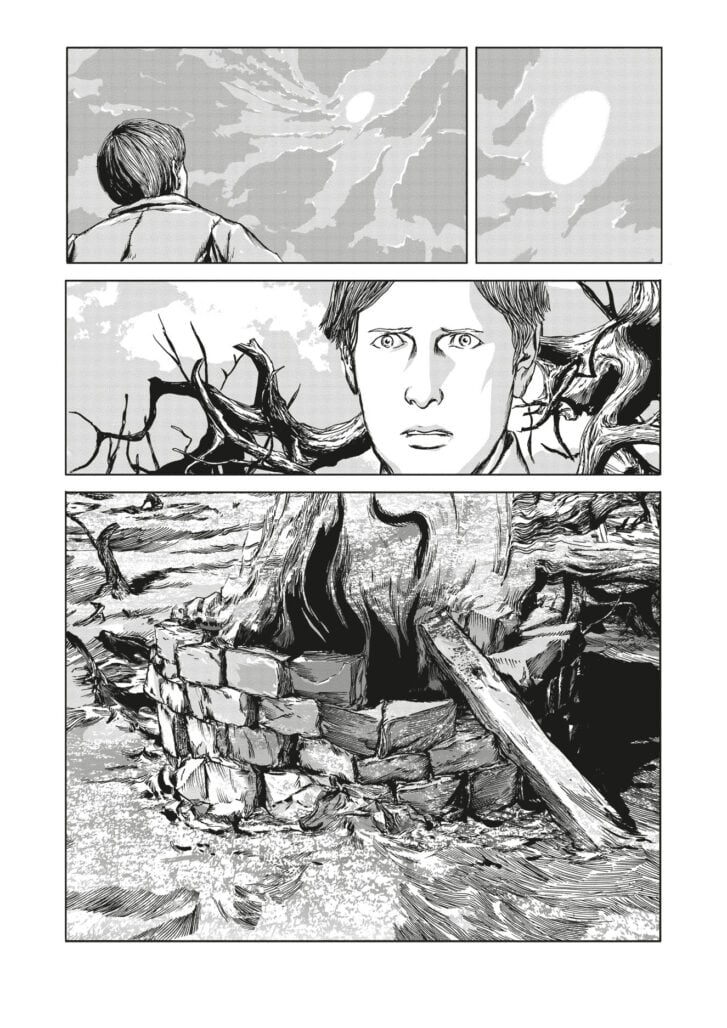
Given the nature of the story, Tanabe is also able to imagine a different variation of body horror that isn’t tentacle-heavy or amphibian for a change. This time around, it’s all about decay and hollow bodies.
The colour alters everything in its vicinity with indiscriminate force, allowing for different textures and tones to guide the story. It establishes a kind of sickly, alien feel that’s represented through the slow and methodical corruption of the land. This paves the way for an environmentally conscious take on Lovecraftian horror, to an extent. It comments on the dangers of soil manipulation and how humans can turn the land they inhabit into a rapidly decaying corpse, depleted of richness and life.
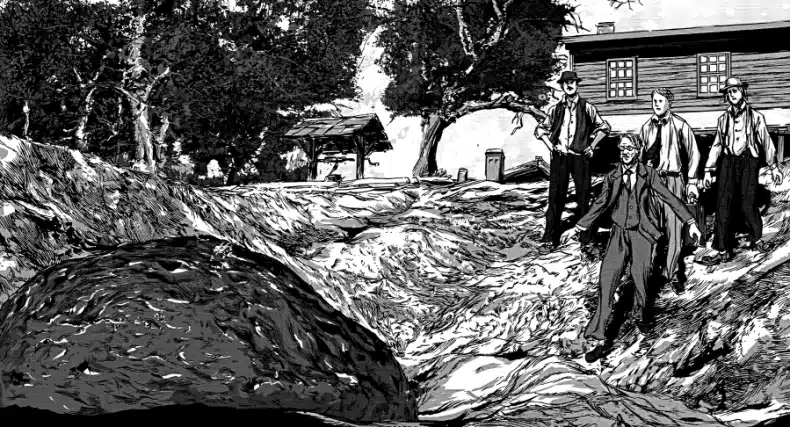
Of note is Tanabe’s design choice for the titular colour, an important decision to get right given the book is in black and white. As such, Tanabe went with an oversaturated white that produces a bright silver-like shine (which is reminiscent of the illustration that accompanied the 1927 story in the pages of Amazing Fantasy). It’s quite the achievement as it is easy to distinguish from other shades of greys and lighter tones. It feels appropriately otherworldly and menacing. It looks like something that’s eager to infect anything in its path, something with an agenda.
The Colour Out of Space is one of Tanabe’s most complex and nuanced works, which is why it should be in the running as the artist’s best to date. It’s hard to imagine a more comprehensive adaptation of the story, even with the excellent Richard Stanley version already out there (which features an excellent Nic Cage performance). Tanabe shows Lovecraftian horror in an entirely different light, and it makes the wait for his next book all the more difficult.