

Nathan Ballingrud’s Crypt of the Moon Spider imagined a 1920s America in which a giant arachnid’s webs were being used to lobotomize people and manipulate their memories. The institute that specialized in this treatment was located on the moon, where one Doctor Cull would task his staff with procuring the necessary spider silk for his procedures. Things go terribly wrong, and the consequences are cosmic.
This is part one of Ballingrud’s Lunar Gothic Trilogy, a series of novellas that explore the nature of memory and the psychological entanglements they create when it comes to love, crime, and mad science. It’s hard to categorize these stories in a way that do them it any justice. They elude strict genre classifications, other than the larger strands of horror and sci-fi that course through them. Book 2, Cathedral of the Drowned, just made any efforts at categorization even more difficult in the best way imaginable.
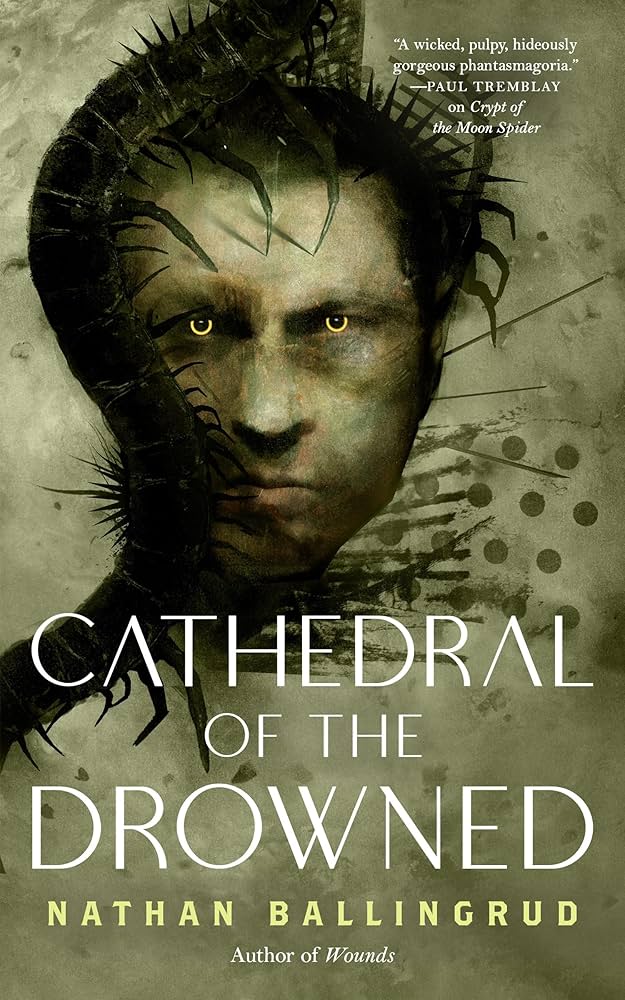
Cathedral of the Drowned is quite a feat of novella-length storytelling. It builds on the mysteries of the first book while doing a considerable amount of worldbuilding in just over 100 pages. New characters are introduced along with a new enlarged creepy crawler that’s capable of generating unique nightmares of its own.
The story picks up after things go south on the psychiatric moon institute that Doctor Cull ran. The spider’s presence suddenly comes back with a force, disrupting the black-market trade that got built around the strange webs it produced. In comes Goodnight Maggie, a crime boss that trafficked in the web out of Red Hook in Brooklyn thanks to her contacts at the institute.
Maggie’s now struggling with getting access to the raw material, and she’s just learned that her lover, who was sent to Cull for treatment, has become another victim of the institute’s cruel science. All of this leads to The Bishop, a huge telekinetic centipede that brings Maggie’s lover into the mix to further its agenda. It lives in a sunken cathedral that was once a part of a catholic space mission to evangelize other worlds.
There’s a lot packed into this second part of the Lunar Gothic Trilogy. Multiple story arcs conspire to lay the groundwork for even more terrors and threats to close out the series. And yet, the narrative never feels rushed or overstuffed. Ballingrud keeps control of his novella by making sure that characters and plot move forward simultaneously, not by having one be at the mercy of the other.
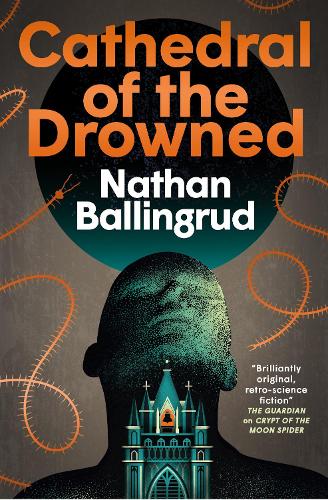
Goodnight Maggie, Doctor Cull, The Bishop, and even the Moon Spider all contribute to making their worlds feel alive and populated by dark things. Ballingrud expertly weaves in lore through dialogue in a way that doesn’t come off as blatant exposition to achieve this. It’s very Bradbury in this sense. Like the legendary writer himself, Ballingrud finds ways to push the plot through character work, effectively killing two birds with one stone. It’s not a case of either/or, as it so often happens in many genre offerings as of late. Everything works in tandem, holistically (something that can also be appreciated in Ballingrud’s first novel The Strange).
Cathedral of the Drowned is also a great example of how to keep certain influences from taking over. The Gothic Lunar Trilogy is very much a work of cosmic horror. Given this, it would’ve been easy to succumb to Lovecraft in the process of creating its monsters and their environments. Ballingrud is careful not to become another victim of this. Some of his influences can be traced to the pulpy horror books of old, but there’s more than enough imagination here to set his books apart. This isn’t a place for Cthulhu. Other creatures move behind the fabric of reality in these stories.
With one book left in the series, titled Kingdom of the Conqueror Worm (set to release in October of this year), Ballingrud has set the stage for what is sure to become one of the most impressive sci-fi horror tales of the 21st century. Cathedral of the Drowned is a masterclass in worldbuilding and lore expansion in shorter works of fiction. It’s an invitation to imagine dark things with an eagerness to tell their stories. Spiders and centipedes prove to have that capacity in these books. Now we wait to see how the worm tells its story.