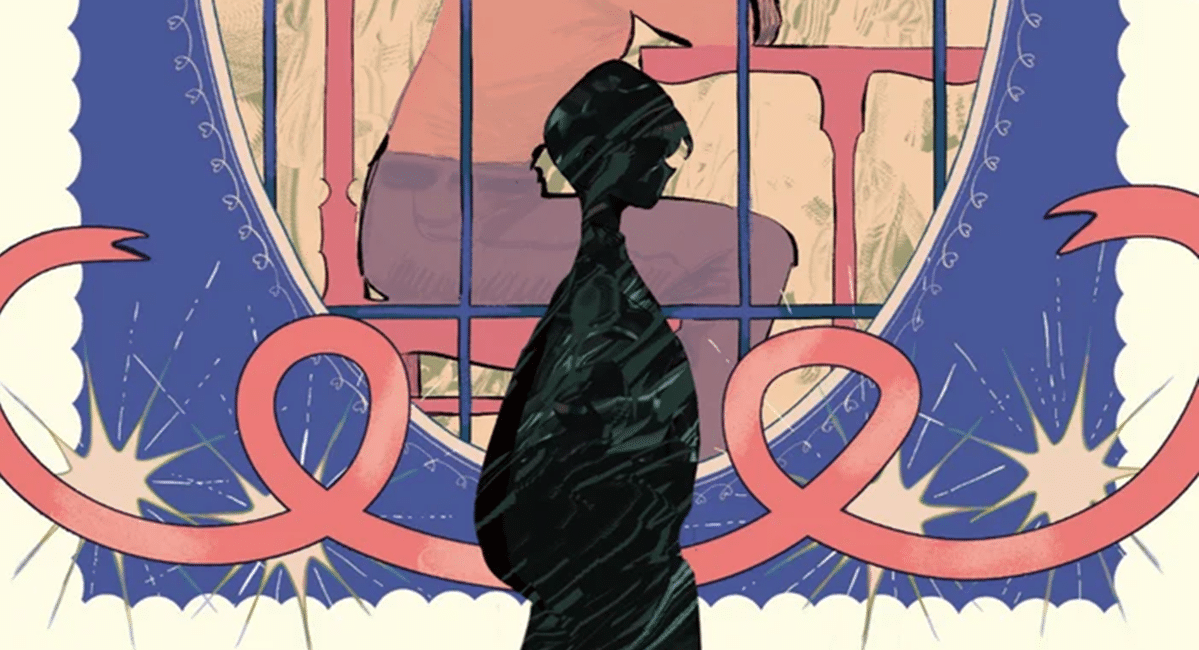

 The Fool, The Absolute Mad Woman.
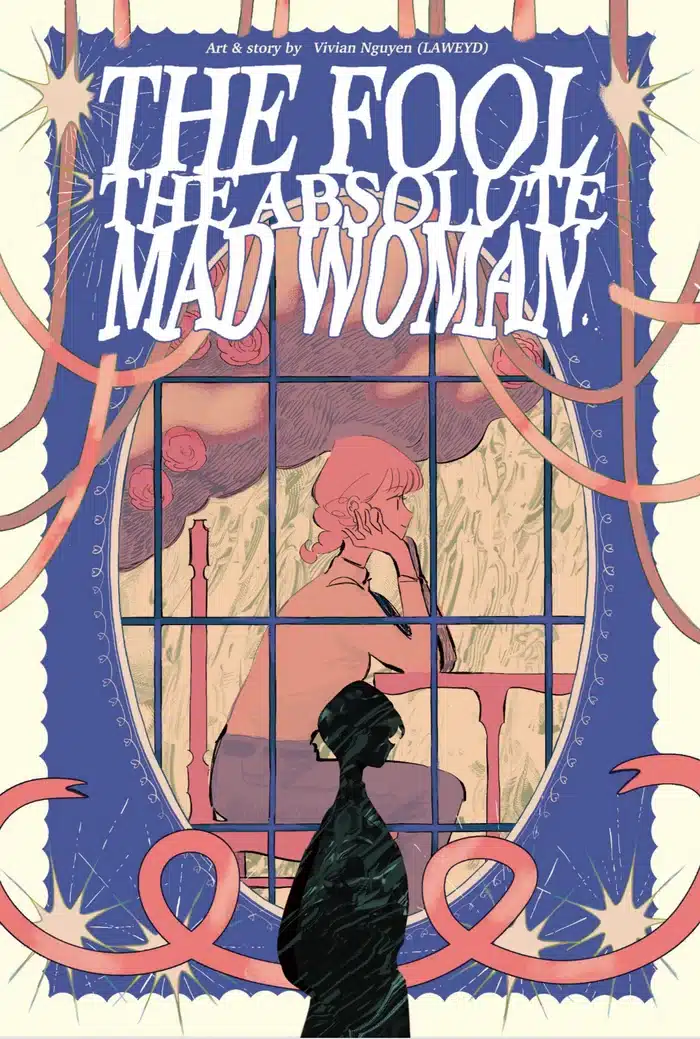
Creator: Vivian Nguyen
Publisher: Self-Published
Publication Date: August 2025
The thing about The Fool, The Absolute Mad Woman. is it a work of occult literature. There is a degree to which this is obvious from the base premise of “A woman creates a lover through mystical means.” Indeed, the book goes further along with the mysticism, with author Vivian Nguyen delivering a tarot reading early on in the tale of sapphic longing to guide the path the story would ultimately take.
However, when I use the word “occult” in the context of The Fool, The Absolute Mad Woman., I do not simply mean its mystical connotations. Rather, I refer to the origins of the word, meaning “Hidden.” The core of Nguyen’s comic is actively hiding from the reader for the vast majority of it. This is a common practice within literature, wherein the pleasure of reading the story is trying to understand just what kind of story this is.
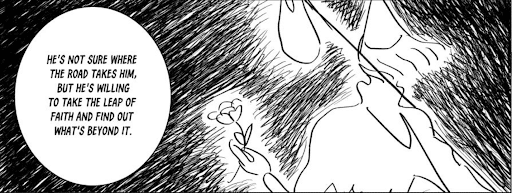
The title, certainly, gives the reader some expectations. In Tarot, the Fool represents the beginning of something, but also recklessness and, well, foolishness. Quoting Rachel Pollack, “We’d all like to be the Fool—sometimes. Act spontaneously, without doubt or fear. Not care what anyone thinks of us. Not worry about what happens next. But would you want to act so freely all the time? What about jobs, relationships, family?”
Paired with the Emperor (which Nguyen situates as in the past to the Fool’s future, noting “You have a clear goal in mind and while you do listen to other people’s advice, by the end of the day you will end up following what your heart tells you.”) and the Six of Wands (the present, which is noted to mean slow down with your plans), we see someone who is on a collision course with destiny.
Alea, our heroine, is not framed within the story as a figure of malice or suspicion, even as she does some rather questionable, arguably mad actions. And yet, there’s a sense of unease within the world of The Fool, The Absolute Mad Woman. This is mainly found within Nguyen’s use of shadows and framing. Consider, for example, how long it takes for the reader to see the object of Alea’s love, Kaitlynn. Over sixty pages—roughly a third of the book—of obfuscated faces, done by panel borders, text boxes, and props, before the reveal.
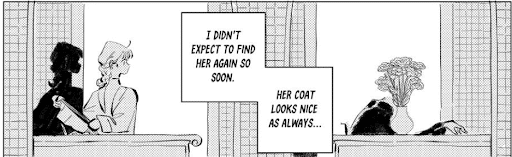
And even then, it’s telling that the face we see isn’t Kaitlynn, but the homunculus Kait. Even then, the sequence building to the reveal is a showstopping 11 pages, each one luxuriating as the tension builds, hiding the full nature of what has been created, putting to mind a monster in the reader’s mind rather than a human being. The first page is a full page spread (only two pages prior to the reveal have multiple panels in them) wherein Kait’s fashionable heels jut out of the darkness, as if created by it. There is no solid blacks on this page. Everything is crosshatched with implications. Alea is small in contrast to the leg of her creation. Further emphasized by the “BAM” that is perfectly centered on the top of the page in large, bold letters.
In the next page, we cut to a close medium shot of Alea, her back turned to the reader. Everything is stark white, barely any black is on the page. The horror of creation has finally dawned upon our young ingénue. This is further emphasized by the next page, which goes even closer to Alea’s face, which is now even whiter than white. Her creation, still unnamed (as Alea is until the reveal), exists solely in shadow.
The next page is a blank page of pure white. A contrast to the original Short Box edition of the comic, which moves straight in to the next page, depicting Kait’s feet as they approach Alea’s. Another change between original publication and its physical release is the removal of the star in the following page, instead opting for a pure blackness. The impact of these small choices is subtle, but nevertheless haunting. We are being disjointed from the typical experience of reading sequential art, forced out of the narrative for occult reasons that make the reader uncertain as to what’s to come.
Nguyen adds another page, this one an exterior of the mansion Alea lives in. It seems normal, at first. A house surrounded by trees in the middle of the day. But then, you look closer. You see that the trees aren’t trees at all, but instead swirls recurring over and over each other, providing the illusion of foliage. You see that there are no clouds in the sky, not even the smallest hint of a shadow. Looking even closer, and you can see that the nature of shadows has shifted from crosshatchings to dots. And all the lights inside the house are turned off. Oh god, what is happening in that house.
Which brings us to the first of two pages within this sequence to have panels. There are six panels total on the page, each one evenly sized and vertical. The panels are structured as two rows of three. They show the preparation of a meal. Only three panels on the page have people in them, the rest only food, steam, and plates. Tellingly, none of the panels have any full bodies in them, just the hands.
This is further emphasized by the next page, the last new one, which depicts someone cleaning a counter with gloves. There is a dark substance on the counter, the reader does not know what it is. This is the last page before the reader has to turn. The implication is that a reveal is upon us. Something ghastly and horrifying. Was Alea killed by her own creation, a mockery of humanity. Or is it Alea who has slain her creation, rejecting her for failing to match the mad dream she started out with.
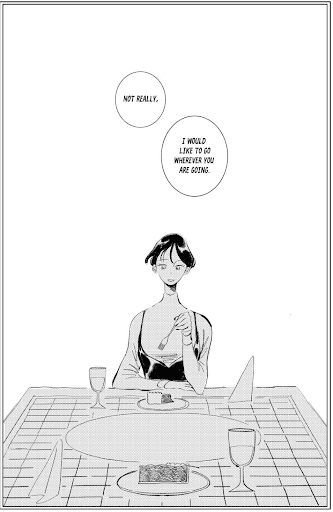
We then turn the page to reveal both Kait and Alea alive and well. And yet, the unease never leaves the reader’s sensibility. The shot used by Nguyen is a distanced one, the furthest within this sequence. We see neither character’s face, both too far away to get any details. And Kait, as her original Lynn does, has her face turned away from the reader. The is something unsettling afoot.
This is exacerbated by the next page, wherein we cut to underneath the table. This is the second page with multiple panels, this time just four separated into four evenly sized rows. What’s more, this is the first page in this sequence with dialogue. The first panel’s word balloon, spoken by Kait, connects with Alea’s body, matching with her desire to connect with her creator. “What should we do after this?” Alea’s words, meanwhile, separate the pair, emphasizing their separate nature. The placement of the balloons likewise acts to separate the two instead of connect them.
Furthermore, there’s how the panels are shaded. Nguyen has the table, the floor, and the majority of Alea shaded with small dots. This creates a shared reality between these aspects. By contrast, Kait is shaded much in the same way as her introduction page with crosshatches. It pushes her outside of the shared reality of the table, floor, and Alea. And yet, both characters provide hints of the other’s materiality, with some dots peeking out between gaps in Kait’s crosshatching and Alea’s shoes being shaded in a similar fashion as Kait. They are together even when they are separated.
This leads to the full page reveal of Kait’s face. This is depicted over the course of two pages and revealed to us via a page turn. Interestingly, the first page of the reveal, the one readers will be drawn two, minimizes the closeness of Kait, opting instead to place us within the point of view of Alea. As a result, there is a degree of smallness when gazing upon Kait’s form. She is clearly quite beautiful, but she is also small. A reveal would typically have itself be larger than this image implies. This is emphasized by the very next page, wherein we get that expected massive image of Kait. For all that it shows the reader, it always keeps them on the backfoot.
There are many other mysteries to be found within the book. Many moments of heartbreak, horror, and uncertainty. And yes, the book is very, very gay. It is, after all, a romance. Until it isn’t anymore and we’re faced with the uncertainty as to what we’re reading. The only thing that can be certain is that this is an extremely fascinating, heart stopping comic, well worth returning to again and again.
The Fool, The Absolute Mad Woman. is available now
Read more great reviews from The Beat!