
 Love, Misha

Cartoonist: Askel Aden
Publisher: FirstSecond
Published: June 2025
A road trip, a distant mother, her kid yearning for connection, and a journey to find their way home. If you read enough, comics or otherwise, this story construction isn’t new. But Askel Aden’s Love, Misha is a fascinating middle-grade addition to this genre of storytelling that is well worth your time and attention.
The story follows the titular Misha as they go on a trip with their distant mother who, way before the start of the comic, left Misha with her sister to raise them. From the start Misha’s mother, Audrey, has tensions with Misha and the family they live with. Then, very quickly into the book, Audrey and Misha get lost in a spirit realm relying on the help of the “wolf menace” Odun to help lead them out.

The plot isn’t too complicated, nor does it play or challenge any classic storytelling techniques. The narrative follows a pretty solid structure of conflict, overcome the conflict, move forward slightly with the penultimate conflict leading to a larger division between our two main characters Misha and Audrey. As expected, the end is a happier one. Much of this structure has to do with the audience that this book is engaged with, which leans heavily towards middle-grade into early YA readers.
What sets this book apart is that it offers the story of a nonbinary character struggling to connect to a mother who isn’t present, or immediately understanding of her child’s gender identity. It isn’t a “coming out” story as Aden adds in the Author’s Note at the end but a “focus on the time after Misha’s coming out”. While this focus on post coming out is a wonderful trend in many books lately, Aden is correct that there are still a lot of coming-out stories. Those stories are important but are only a part of the whole. Love, Misha seeks to fill in this gap.

While I want to stay objective in this review it’s difficult because the reason I wanted to read this book was that I’m the parent to a nonbinary child. To see a story that reflects our situation more precisely was attractive and something I didn’t know I was yearning for until reading Aden’s book. The added bonus of being able to read a book that both my eleven-year-old and I could talk then reflect on was needed as well. I struggled, though, with the aspects of the book that viewed Audrey, Misha’s mother, with grace and understanding. Aden works hard trying to tread the line between Audrey slipping up and not being present, literally and figuratively, with also providing moments of empathy for her character. I found myself so connected to Misha’s character, though, that it was hard for me to forgive the misgendering or Audrey’s absence. It’s a bold move to think beyond the binary of good vs evil or bad parent vs traumatized child, and one worthy of exploring. Love, Misha moves against this binary thinking. Though, for me, Misha was justified in every one of their complaints and Audrey, while making some significant changes at the end, didn’t reach out enough for me.
The fact that I was thinking this at the end of the book made me realize that Aden’s entry into this conversation is one that had me thinking deeply about where I stand as a parent and human. I ended up with more questions than answers: Where does forgiveness start? Whose responsibility is it to forgive and understand? In the case of prejudice, the hateful or the ignorant version, how much responsibility is on the one affected by the prejudice and how much is on the perpetrator? For me, in this time and place, in my own world and life, the answers to these questions lean further away from the answers that Love, Misha gives. Even though this is true, Askel Aden’s book does what truly wonderful books do; make you ask questions. This book made me think about where my line in the sand is, which makes it the kind of book I want to be reading.

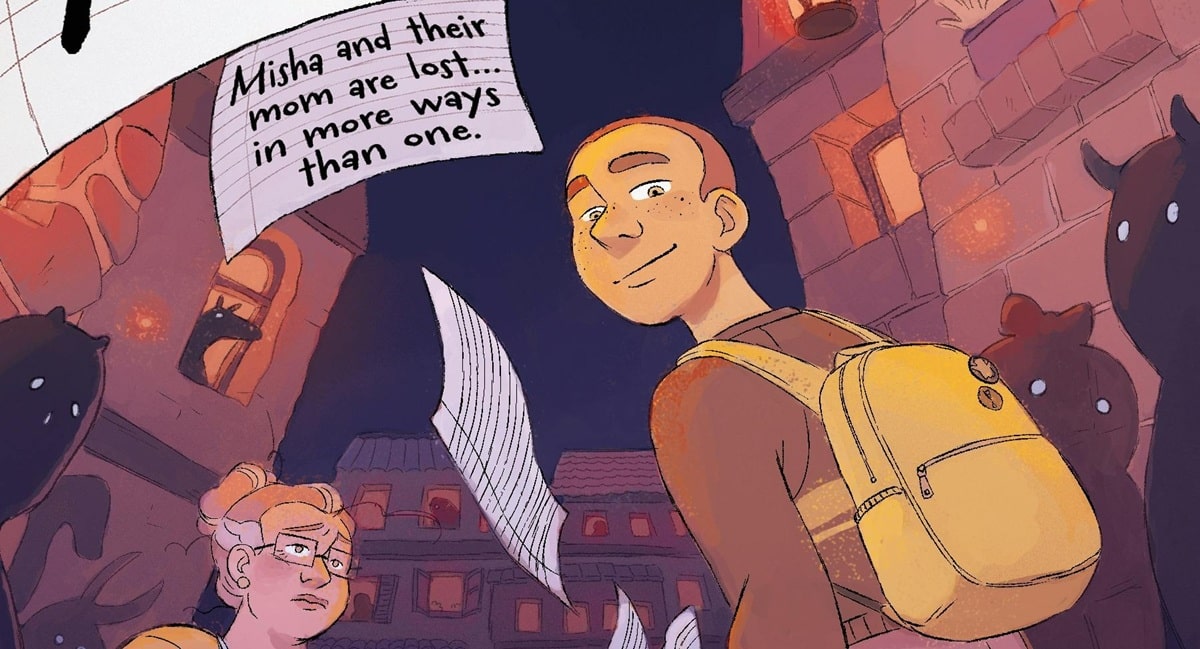
I also want to be reading comics that are visually interesting and stunning, which Aden does in heaps. The art of Love, Misha is gorgeous and seems deeply inspired by Studio Ghibli yet resists being derivative. The characters in the spirit realm are creative, unique, and add a wonderful layer to the journey that Misha and their mother are on. Odun, the pair’s main guide through the spirit realm, is complicated and beautifully rendered. From the small black bugs that litter the pages throughout (the most direct connection to Ghibli that I saw) to the giant owl dragon guarding a train track bridge, the spirits really stand out as individual creations from Aden while providing a wonderful magic to the world of the comic.
The pages also use space and panels in complimentary ways to Aden’s artistic style. Though most of the book plays in ways that won’t immediately catch the reader’s attention, it becomes more evident in moments of extreme stress on the characters. The attempted escape from the pond monster towards the end is an excellent example, as is when Misha almost drowns towards the middle of the book. The latter example is the highlight of the range of Aden’s artistic talent and control of the page. Popping back between memories of Misha’s and the trauma of the drowning compliments each other so effectively that it acts as an anchor in the book. It also gives a lot of context to Misha’s side of the story which portrays them with deep love and understanding.

Overall, Love, Misha is a perfect addition to an ever-growing list of comics tackling issues around queer existence and identity. It adds more options for younger readers to interact with stories that represent a variety of experiences and existence. Yes, it is a perfect book for a specific experience (nonbinary kid and cis adult) but the book presents it within a narrative that is immediately recognizable to many readers, adult or not.
And yes, I wish the character of Audrey found more room to grow, more room to do differently rather than promise to do differently. But, growth isn’t a straightforward process and not all books are written for me (or the “me” of the current political moment). Askel Aden seems to know this deeply. Aden considers the fact that each of us are human and not always in the places that could allow us to be our best selves. So, yea, I’m not a fan of Misha’s mom, but its because I see the worst parts of myself and other parents of nonbinary kids that I don’t want to admit were ever there.

I want us to be at the end of the story, where we walk through the portal back into the real world changed. But there are spirits to escape, challenges to overcome. We must escape the forest by going through. Love, Misha gives us one way we can make it to the end. I hope to see you there.
Verdict: You should buy queer books every month then double up every Pride month and get this book for the middle grade reader in your life!
Love, Misha is available now
Read more great reviews from The Beat!