



 Chicken Heart
 Chicken Heart
Cartoonist: Morgan Boecher
Publisher: Street Noise Books
Publication Date: February 2026
The premise of Chicken Heart by Morgan Boecher really capitalizes on the book’s subheading, Love Commune; it’s a place for misfits, specifically trans people who need a place to belong. In a world where trans bodies are othered by family, government and a broader society that desires trans lives to be on the fringes or simply not to exist (through genocidal policy), the term “misfit” is a broad though not all-encompassing brush.
Our protagonist in Chicken Heart, Jackie, is a stand-up comic, and we meet him with a letter informing him of his Aunt Sheila’s suicide right before his set. He’s awkward and self-deprecating — a shield for his own undeclared transness sitting in the shadow of the aunt whose identity was the target for the insecurity of a society too small minded for her to fit. A transphobic heckler brings into focus the broader views and vitriol of a conservative and regressive culture, so intent on cruelty that our collective humanity suffers. From this point we are invited by Chicken Heart on this journey with Jackie as he goes to the Commune that his aunt started; to grieve her and to discover where he fits in amongst a commune/community of misfits.
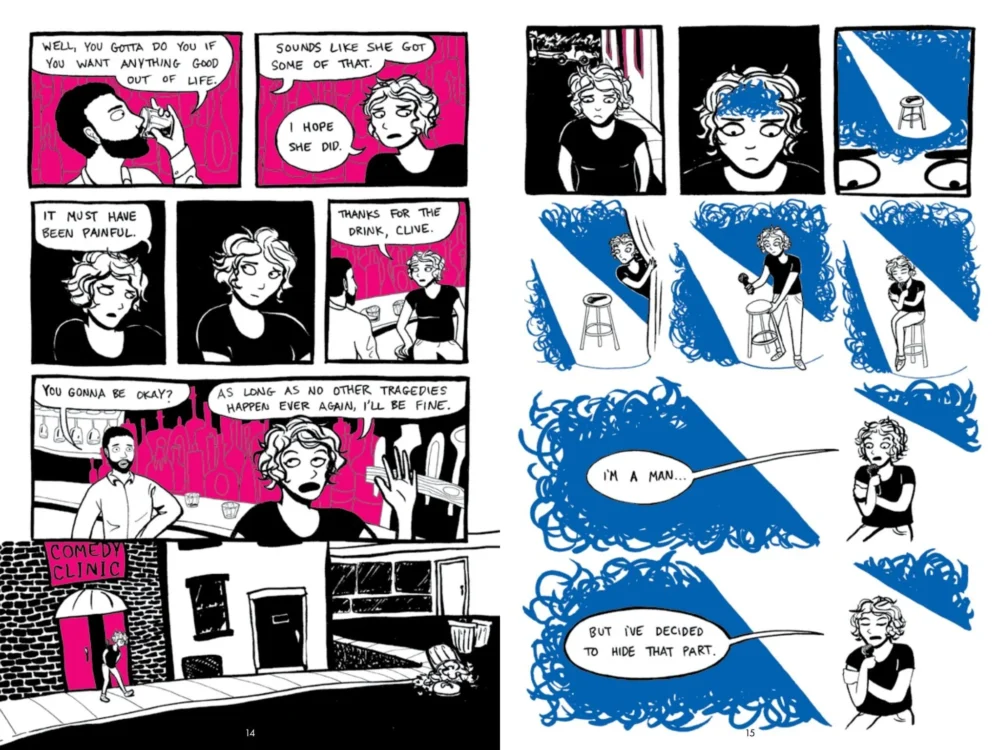
Boecher does it all here, from writing, to art, to colors and lettering, and it all meshes together seamlessly, making for a focused and deeply personal narrative. The art makes strong use of thick line work and distinct and expressive character designs, especially when we meet the members of the commune. The body and gender diversity here is worth noting and drawing attention to, asking us as readers what traits and expressions we put on the margins? What disturbs the confines of the boxes society imposes on us?
Boecher simply invites you in, with pronouns and warmth in this little place tucked away in the woods, no further explanation necessary; if you get it, you get it. In the commune, there is a potential to live authentically, though still isolated, and that isolation is two-fold for Jackie, who is from the city, a “city queer” whose gender expression is limited by familial trauma and expectation. Boecher lets us into Jackie’s thoughts visually, which plays up the comedy and at times the heartbreak, anxiety and the aforementioned isolation. Jackie’s self discovery and affirmation come through potential romance, seeing himself in another person and what he could be when self-actualized. That mirror is beautiful and complemented by the colors that frame some pretty big moments.
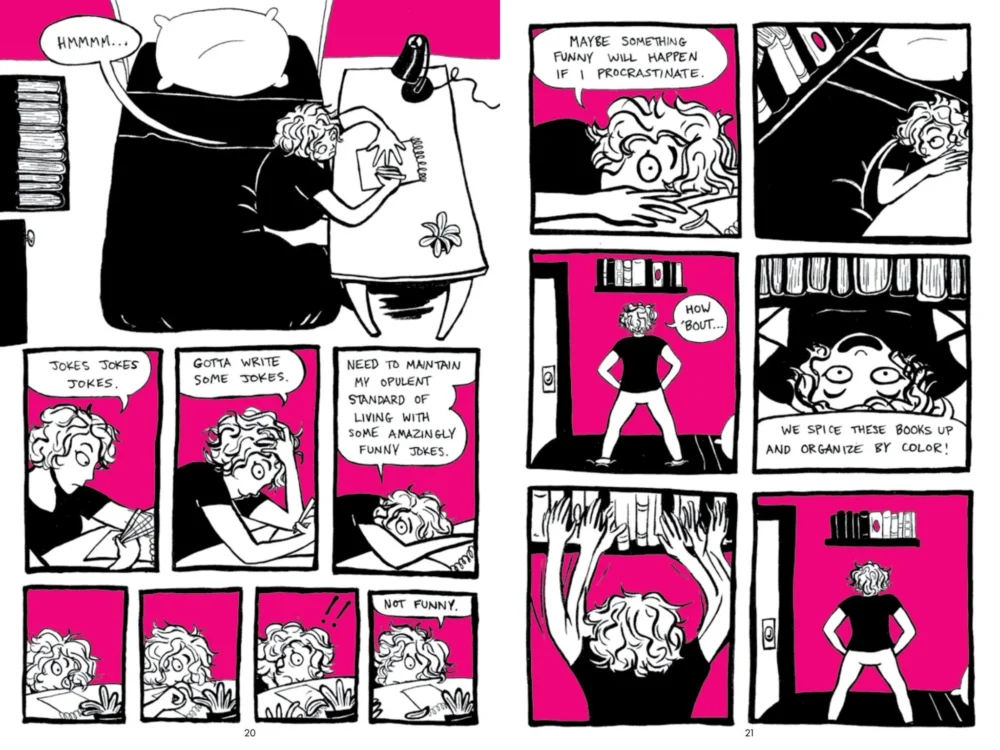
I loved the use of color here, the reliance on spot colors while letting the black and white do some heavy lifting. It’s inspired. The back end of chapter eight is one of the strongest examples of this work. This book is thoughtful, messy (complimentary), and full of heart. Jackie’s struggle is one that feels universal to an extent because we all desire to find a home, a place we belong, and one of the beautiful things here is in his discovery of that home.
Throughout, we see Jackie as a bit of a mess, and Boecher does not shy away from showing us Jackie at his worst and most self-destructive when coping with repeated rejection. What I appreciate is the overall understanding and resolution that Jackie being himself is okay, that there are things that he can contribute and maybe he messes up, but his heart is in the right place.
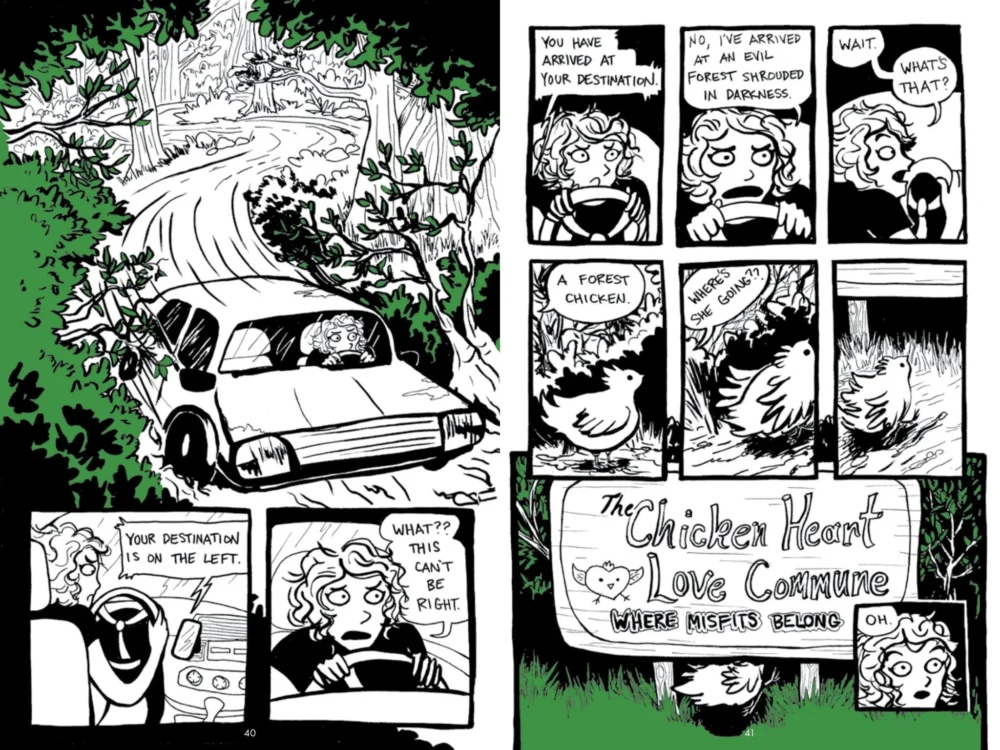
I enjoyed my time with Chicken Heart and its quirks and presentation. Boecher’s voice is as strong as his vision and in times like these, we need strong voices affirming trans people and trans existence, bolstering the courage to show up authentically and to make homes and communities that will protect them and cherish them.
Chicken Heart is out this month from Street Noise Books
Read past entries in the weekly Wednesday Comics reviews series or check-out our other reviews here!