
 A Confederacy of Dunces
Original Novel by: John Kennedy Toole
Graphic Novel Adaptation by: Albert Monteys
It is often rather difficult to tell a story about writers in a visual medium. For the most part, writers tend to be a rather solitary bunch who sit down and type out or write down various letters, numbers, spaces, punctuation, and so forth onto a piece of paper (or a computer screen) to make a narrative, an investigation, a review, or what have you. Their placement may be quite different. Some do it at a writing desk full of quills and inks. Others do it on a kitchen table, pushing dishes and placemats to the side.
I am writing this review on a reclining chair. It has been in my family since the early 2000s, if not the late 90s. It used to belong to my grandparents on my mother’s side. I’d sit on it frequently as a kid when visiting my grandparent’s home. It was in the family room, right at the edge of the archway leading to the kitchen where my Nonna would so often cook meals. My Poppi would be in the basement working on something new—a stool, a rabbit trap, a hammock chair.
When he got sick from decades of working as a stone mason and inhaling dust, my grandfather would sit in this chair. He couldn’t breathe without an air tank for that last year of his life. Even in the years beforehand, there was a sense of frailty to him. When we were alone, and he thought I couldn’t see, I noticed a sense of exhaustion in his eyes. The desire to just be done with it.
It was around this time, ten years ago, that he and my Nonna stayed with us for a period of time. There was a blackout in the area, especially where they lived — a rather long house in the middle of the woods. We didn’t want them to be in the dark, in the middle of the woods. Especially with his air tank. They slept in my family’s living room. He couldn’t go up the stairs anymore. He would be back to his own home a week later. He would leave it for the last time in November or December. He would barely make it to the New Year.
I’ve always had a discomfort when it comes to my elders dying slow, painful deaths. My Nonna, who is still alive, moved in with us shortly after my Poppi died—a good year after. She would stay with us until late last year, when her medical needs due to dementia required her be moved to a home that could actively care for her in a way we weren’t capable of. I struggle to visit her, the life simply gone from her eyes. I struggled to be with her when she was living with us, a sense of the madness of dementia overwriting the woman I knew and loved.
All my writing—all my personal writing—ends up being, in some way or another, about my grandparents. They were always there for me and my brother, even when we couldn’t be there for them. Especially when I couldn’t be there for them. They never particularly encouraged our artistic tendencies, though they helped with film projects my brother and I did back in high school. But still, I draw from them. The timbre of my Poppi’s laugh, the swiftness of my Nonna’s hands. The love in their hearts, even for their failures. I especially can’t help thinking about them as I write these words atop the reclining chair from my youth in the apartment my Nonna lived in for nearly ten years after my Poppi died.
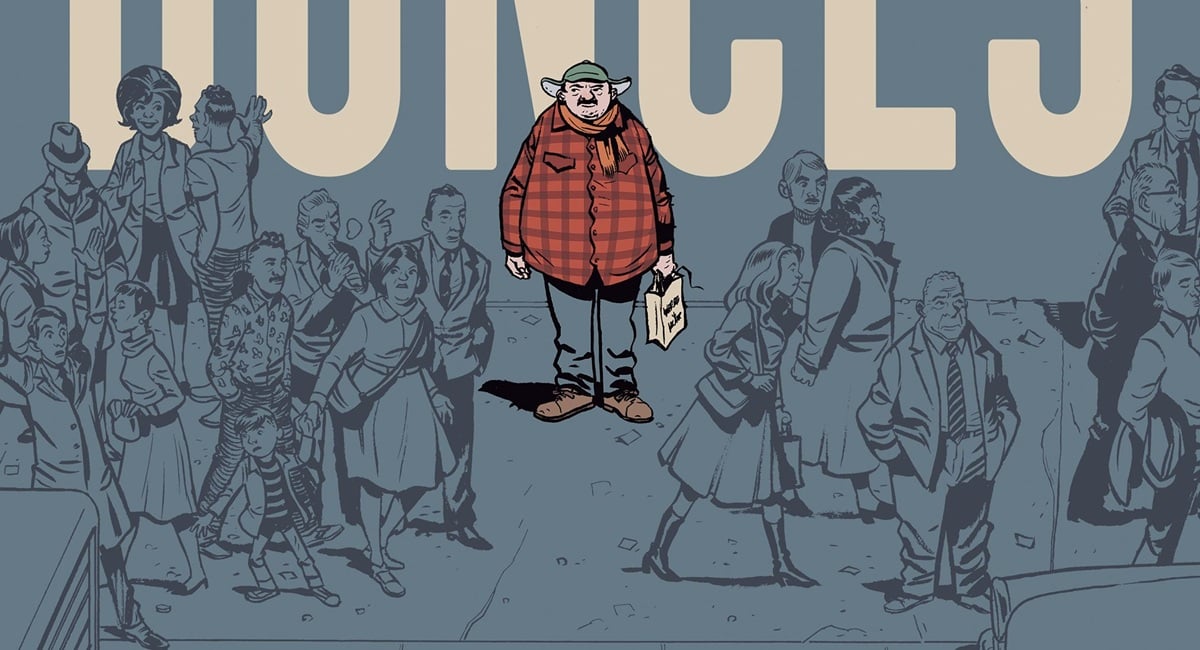
There are quite a bit of writers in Albert Monteys’ adaptation of John Kennedy Toole’s A Confederacy of Dunces. Be they the aggravated lead creating a manifesto in literature form, letter writers who correspond with him, or simply newspaper men telling tales of vice and homophobia. Character wise, Monteys is rather delightful, drawing his figures of pity and ridicule with a comedic timing. From the plumpness of our lead that highlights his buffoonish nature to the milksop supporting character whose own foolishness is time and time again beaten into his skull. Even minor characters who only appear in crowd shots have a sense of charm to them.
In many regards, the central failing of the adaptation of A Confederacy of Dunces can be found in how it depicts the act of writing. Every panel of the act of writing has the writer looking to the right of the panel, the text of what they are writing (alongside the occasional doodles) is presented above the writer. The writer is presented at a distance with a lot of negative space above them, highlighting their smallness in the grand scheme of things.
The problem is that there simply lacks the visual panache that made Monteys’ previous adaptation of Slaughterhouse-Five sing wonderfully. There are certainly moments that threaten to have visual intrigue. The recounting of our lead’s time in Baton Rouge use of a more storybook approach and the specific details highlighted by Monteys in unique ways are highlights within the book. But there’s never a sense for why this had to be a comic. Which is a problem since the book explicitly declares the necessity of depicting this within the comics form.
That isn’t to say that it’s just a slab of text presented next to images (though that could work within the context of the comics form). Rather, there’s a lack of urgency and energy within the images themselves that make them sparkle within the visual medium. One never gets the sense that there is a contrast within the world visually between our lead’s perception of it and the reality therein. What times there is visual surrealism feels like the expected images for those moments. Reds for anger and so-forth. One is never left surprised.
It is a fine adaptation, in terms of depicting the story as written by John Kennedy Toole. But it’s not an exploratory one that makes a reader yearn for this to be depicted in the graphic novel form. And in that respect, it is a failure.
“This is my studio. I work lying down, for obvious reasons: it allows you to take a nap whenever you want to. And I also use very soft lead pencils, they’re called Blackwings, and it means that they wear out very quickly, so you can spend a lot of time
sharpening. These pencils are very hard to find.
I write on yellow pads. I prefer the kind that have exactly thirty-two lines on them, because it means that you can make alternate choices of words in between the two lines. If there are too many lines, there isn’t enough space.
If there are too few lines, there’s too much space.
I do use a computer to write on occasionally, but mostly to transcribe lyrics. And to make things look professional.
The hardest thing about writing, for me, is getting started. It’s the first words on the yellow pad. You have to lose your inhibition so that you can afford to say something, perhaps corny or cliched. I use—I’ve often used, anyway—alcohol to help me lose the inhibitions. I sip out of a, out of a shot glass, because once you’re through an ounce and a half of liquor, if you want more, you have to get up and get more.”
-Stephen Sondheim, God
A Confederacy of Dunces is available now via BOOM!
Read more great reviews from The Beat!