
Space: the ol’ near infinite panel gutter. These are the carefully recorded Star Trek voyages of Ensign Avery Kaplan. Her mission? To dutifully observe and analyze the various arms and evolutions of the best sci-fi Franchise to ever grace the screen. This week, she and Ollie Kaplan are interviewing Collin Kelly and Jackson Lanzing about Star Trek: The Last Starship #5, available at your Local Comic Shop (LCS) today.
RED ALERT! This interview contains spoilers for The Last Starship #5, as well as preview pages from the upcoming The Last Starship #6.
THE ENSIGNS KAPLAN: Are you particularly proud of one of the original characters created for this series?
LANZING: Personally, I think Captain Sato might be the single most nuanced character we’ve had the privilege of writing across all of our comics work. In nearly every Star Trek story before us, the ship’s captain is a pinnacle of what is needed from her crew – Picard is the ultimate diplomat, Kirk the adventurer, Sisko the war leader, Janeway the survivor, Pike the explorer. But Sato is a man whose time has passed him by – a late-stage utopian living through the total collapse of the thing he understood so well. The game has changed on Sato and so his every decision comes with a really interesting counterweight of his own instincts, which are often wrong. Certainly, we see this most clearly in issue #5, when he lets his hope get the better of him and finds himself stabbed between the ribs by the person he trusted the most. And as the story progresses, Sato’s life isn’t getting any easier. I think when all is said and done, they’ll have never been a Trek captain like Delacourt Sato.
KELLY: For every rigid principle that holds Sato up, Doctor Zed has a curved perspective that helps him wiggle out of anything. For a lot of reasons he’s a personal favorite–I have a well known affection for the “silly little guy” character archetype–but I think the thing that really stands out for me about Zed is the journey of responsibility that he’s going on. Confronting the fact that the coping mechanisms that served you well in the past may not longer be helpful for your future is a critical phase of maturing into the best version of yourself…and becoming the best version of yourself is a critical element of being a Starfleet officer. Starting right here in Issue Five, we see Zed facing the absolute nadir of his choices…from which he’ll start to grow into the man the moment needs.
KAPLANS: At what point did Kirk come into the story? Did you always know he would be part of an ensemble, or was there an earlier version where he was the “main protagonist”? Will he play a bigger role in future issues?
KELLY: Kirk came into the picture early…but not as early as some folks might think. Our original characters all came first; Zed and Sato we’ve spoken on, but Vi gives us the vital look directly into Ni’Var’s role in the time period, while Valqis lets us explore the Klingon collapse (as well as continue the legacy of the Red Path). Whether or not the book even needed a real touch point back to the previous cannon was up for debate…until we realized that losing the future would hurt so much more if you were there to see how it was born. From that thematic necessity, you’ve got a fairly limited set of options (is this a robot-Picard situation? Or another Data story?) but in our hearts we knew that we needed to end with the man we started with. And even back when we did Star Trek: Year Five we knew a fundamental truth: “When in doubt? Kirk.”.
LANZING: As for a “bigger role”, by the end of Issue Six you’ll get a firm answer to your question, but needless to say you don’t resurrect a legend and then keep him on the sidelines. The goal was always to add him to an ensemble rather than have him drive the book… but at the same time, the character is a captain at heart.
KAPLANS: What is it like to pen a Surak quote for The Last Starship #5?
LANZING: Pretty wild – like joining a long continuum of Star Trek writers stretching back to Roddenberry and Heinemann. Mythohistorical figures like Kahless and Surak are so ingrained in the idea of Star Trek, ever since The Savage Curtain first aired back in 1969 – and they’re one of the things that makes Star Trek special. So, especially because The Last Starship is designed as a jumping-on point for Trek skeptics, it felt only right to bring in that unique flavor.
KELLY: And then twist it into a noose with which to hang Sato’s dream.
LANZING: Mua ha ha, as they say.
KAPLANS Can you tell us about the origins of the Ni’Varran Panoptical Diplomascope?
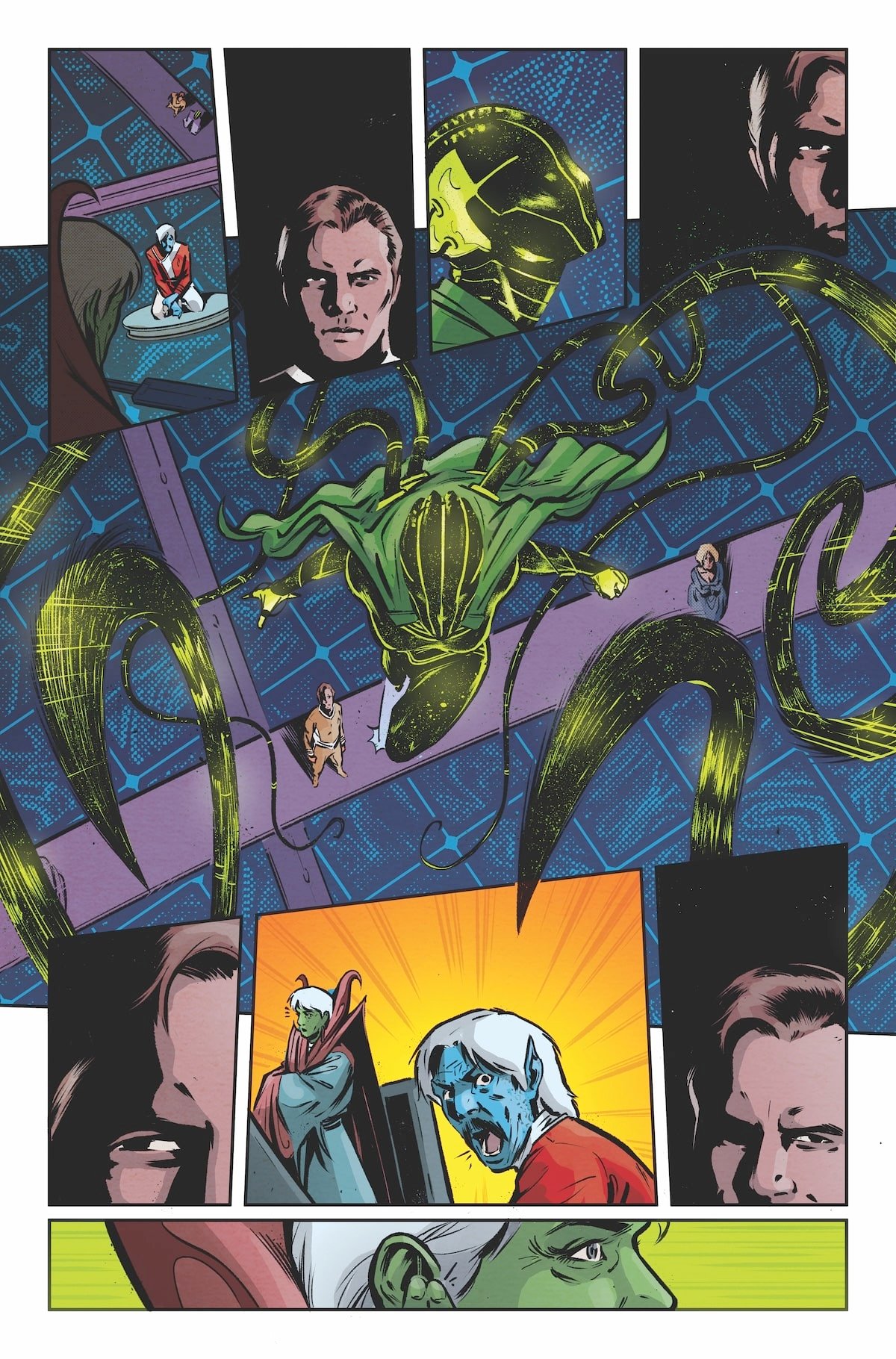
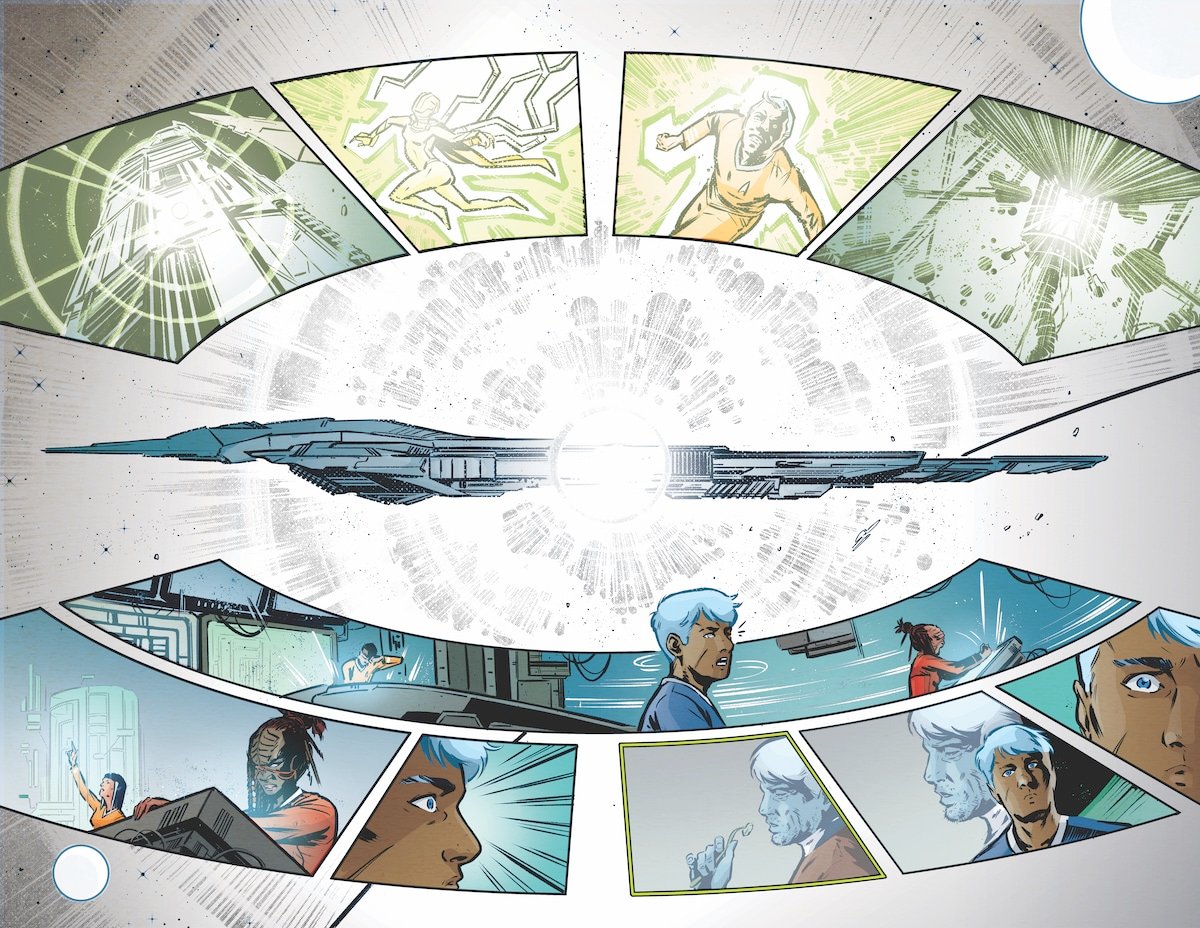
LANZING: Well, we always knew the big challenge of this chapter was going to be the diplomatic nature of the story – especially after the truly incredible and savage action in chapter one. We opened the Last Starship with a bang, but Star Trek is a story in large part about debate and ideals and, as Collin likes to say, “ powerful speeches in carpeted rooms.” It’s one of the problems Trek has had in comics, traditionally; how do you visualize incredible debates or negotiations between characters in a way that isn’t just aping the shows, with a bunch of camera angles and intense acting?
With the Babel Conference, we wanted to blow up the reader’s expectations of how a big diplomatic conference might look and feel. Lean into the futurism and utopian vision of the 29th century and re-imagine the Star Trek debate scene. And more than anything, we wanted to unleash Adrian onto something visual and complex that could really act as a conduit for great comics storytelling.
KELLY: At the end of the day, that’s the real point of any comic of ours: give the artist something truly new to draw. Never leave a story less weird or innovative than you found it, and always remember that it’s a visual medium first. We’re happiest when we get pages back and the artist has done such a great job that our words are no longer needed. Adrian in particular is getting to be a master at this; he can convey as much in a single panel as we can with a whole run of dialogue, so giving him space to shine has become a privilege and a pleasure.
KAPLANS: With the establishment of the Emerald Chain in this issue, you’ve introduced another major element of The Burn storyline from Star Trek: Discovery Season 3. What part of the post-Burn world has been the most enjoyable for you to expand, and which part of your expanded world do you think is most likely to become alpha canon? Back in issue #1, it’s suggested that pre-Burn the galaxy effectively had 35 years of peace—what do you envision this time period to be like and are there plans to explore it in the future?
KELLY: “Expand” is a fun word here, considering that so much of our worldbuilding revolves around the fraying relationships between worlds that have had alliances for–in some cases–almost 900 years. And I don’t think that is highlighted anywhere better than this second chapter of our story. In this issue specifically, we got to explore the fate of worlds from across the Federation, uniquely tuning each to their own brand of cultural tragedy. As for Alpha Canon, that’s a bit of throwing a dart into the fog, but if I had to guess…I think our finale is going to be so load-bearing to the history of Trek the weight of it alone will lock it into place.
LANZING: We think those 35 years were effectively as close to “the dream” as the Federation ever achieved. An era of peace and collaboration, of mutual respect and productive discourse, and advances in technology that would seem like magic to Captain Archer and good ‘ol Trip. A time when Trek’s core ideals of Infinite Diversity in Infinite Combinations allowed it to become the final stage of galactic utopia. That’s the peak that Sato stands atop in those first few pages of Issue #1 and that’s the heights from which the universe falls. As for future plans to explore the time period further, neger say never – but by the end of The Last Starship, we’re confident we’ll have said what we need to say.
KAPLANS: What can we expect from the next few issues?
LANZING: The death of the dream… and then the nightmare that waits on the other side.
KELLY: Emphasis on nightmare.
LANZING: Yeah, we’re going full cosmic horror in chapter three. The Last Starship is a tragedy, after all. Gou Tanabe fans are gonna be eating well between issues 7 through 9.
KAPLANS: Is there anything else that you’d like us to include?
LANZING: I’d just really like to use this opportunity to publicly thank the comics readership and the retailers who’ve given this book such a warm reception. It’s rare that a book like this gets made, let alone that it sells well enough to continue in confidence. We’re deeply grateful and working hard every day to make a book worthy of that trust.
PREVIEW of The Last Starship #6