
Hello. My name is Adam Barnhardt, and I’m trying to break into comics. And for some godly unknown reason, I’ve seemingly picked the hardest way possible.
“Breaking in” is the end goal for the vast majority of independent and small press folks. Creatives that are kicking, scratching, and clawing their way to the top, just for the faintest chance at writing or drawing a character like Superman, Spider-Man or, in my case, the Immortal Iron Fist. The phrase, and the action it represents, is one of the most prevalent topics at the level I find myself at as a creative. So prevalent, in fact, that most comic conventions will have at least one panel about it as creatives share their own personal experiences on landing jobs with the Big Two.
Still, the advice remains the same from one panel to the next. And more often than not, two pointers stand above all else: start small, and avoid superheroes. In fact, most indie publishers won’t even look at your submission packet if a cape or spandex is remotely close to being included in your pitch.
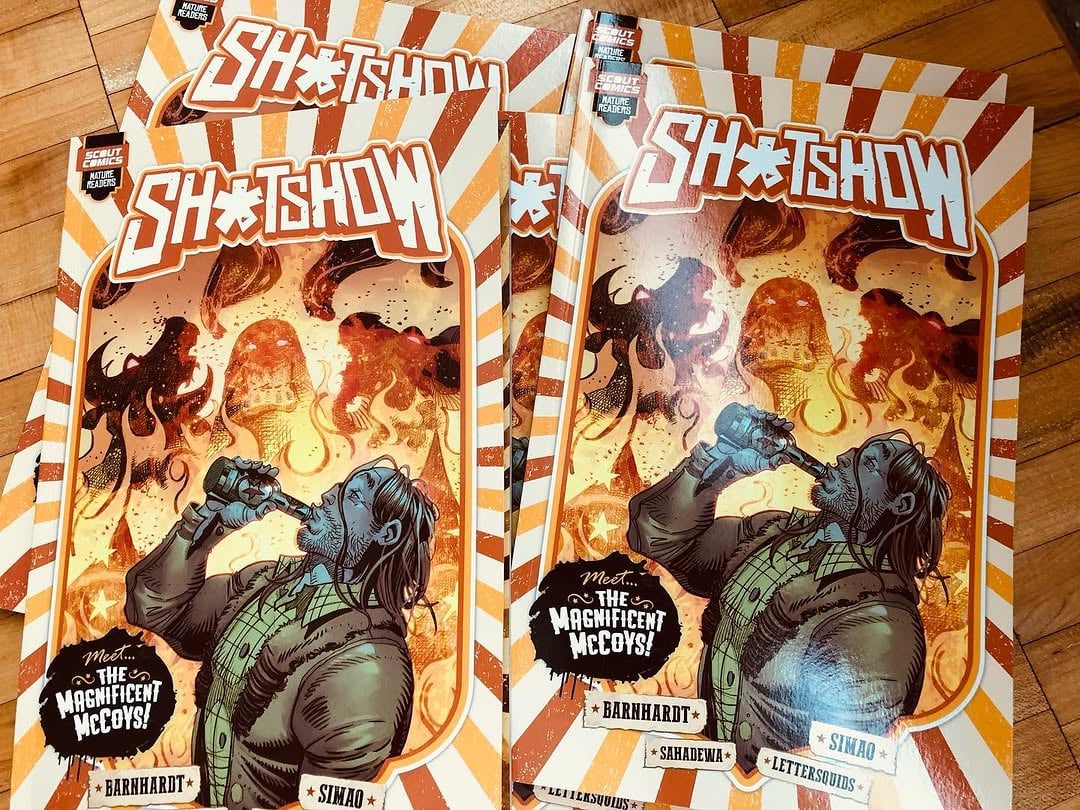
At least, that’s how it was when I submitted my first comic SH*TSHOW. At the time, the publisher that eventually signed it explicitly called out superhero titles as a submissions’ no-no. Even nearly a decade later, small presses — see the submissions page on the Source Point Press website — continue to rail against the cape, with the publisher (very politely) saying, “If your first graphic novel you’re considering pitching to us revolves around characters who wear costumes, we encourage you to get familiar with the books we publish and objectively evaluate whether or not it would fit with the types of titles that are our primary focus.”
On the “small” end, you’re not supposed to expect your magnum opus with your first release. Let’s be real, the chances are your first project won’t end up being your Watchmen or your Saga. Because you’re supposed start small and make comics that are just a page or two. Then you’re supposed to move onto anthologies with longer (but still plenty short) six- to eight-page stories. Then maybe a one-shot. Then maybe a mini-series. Then maybe, just maybe, you’ll know enough to write a bigger, more “ongoing” book.
At least, that’s what the conventional advice tells you what to do. With that knowledge in tow, I feel I should let you know…
I’m working with some friends on making a full-fledged superhero universe. Over two dozen creatives across a dozen or so titles. Given what we’ve all learned about breaking in….that doesn’t really make a whole lot of sense, right?
Before we get any further, I want to make something exceptionally clear. I’m not claiming to be a God of Crowdfunding, as that title has already been claimed by several before me. I’m not claiming to have the exact answer on what makes one’s campaign really click. And no, I’m not claiming to know how to break into comics, considering that’s something I’ve yet to achieve.
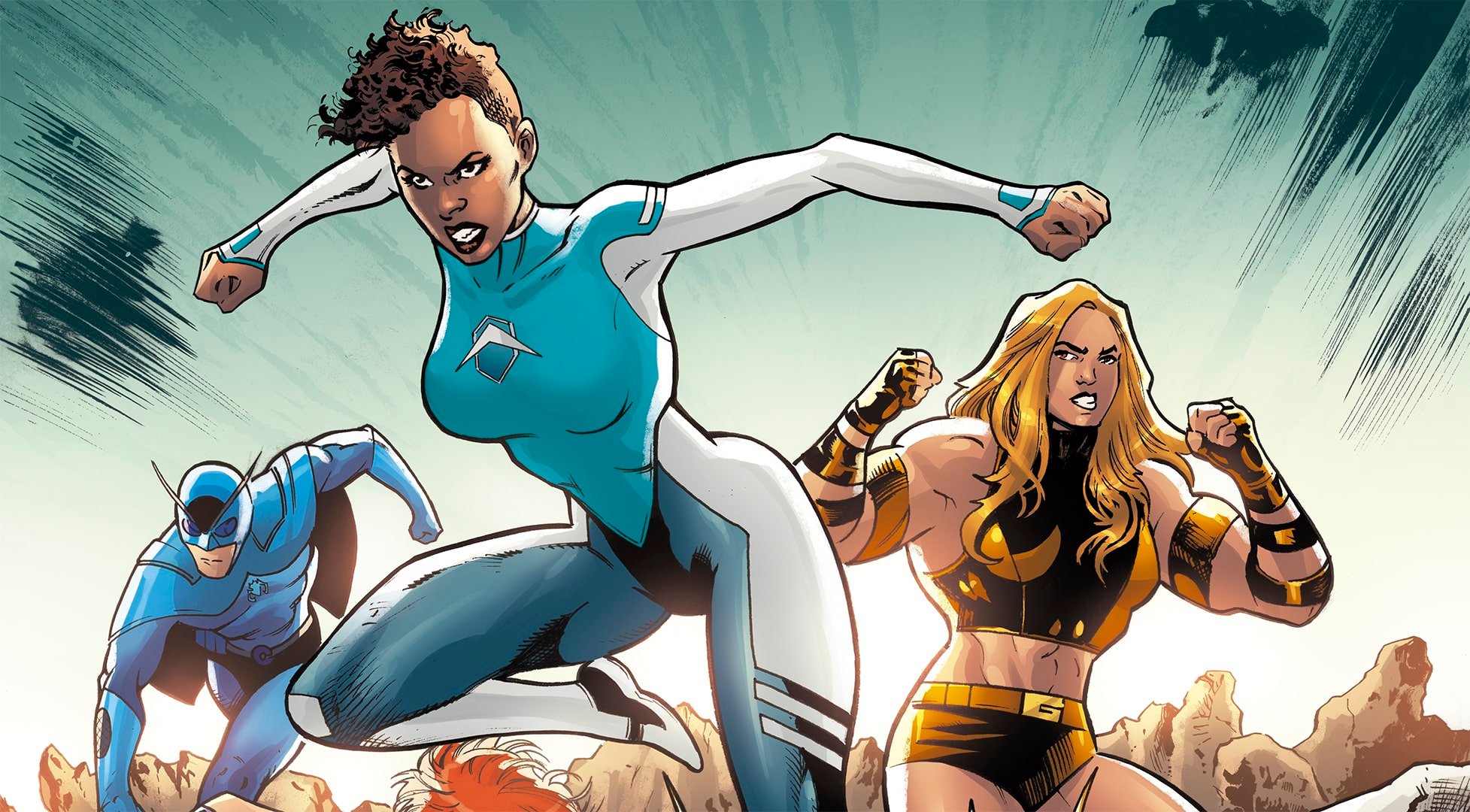
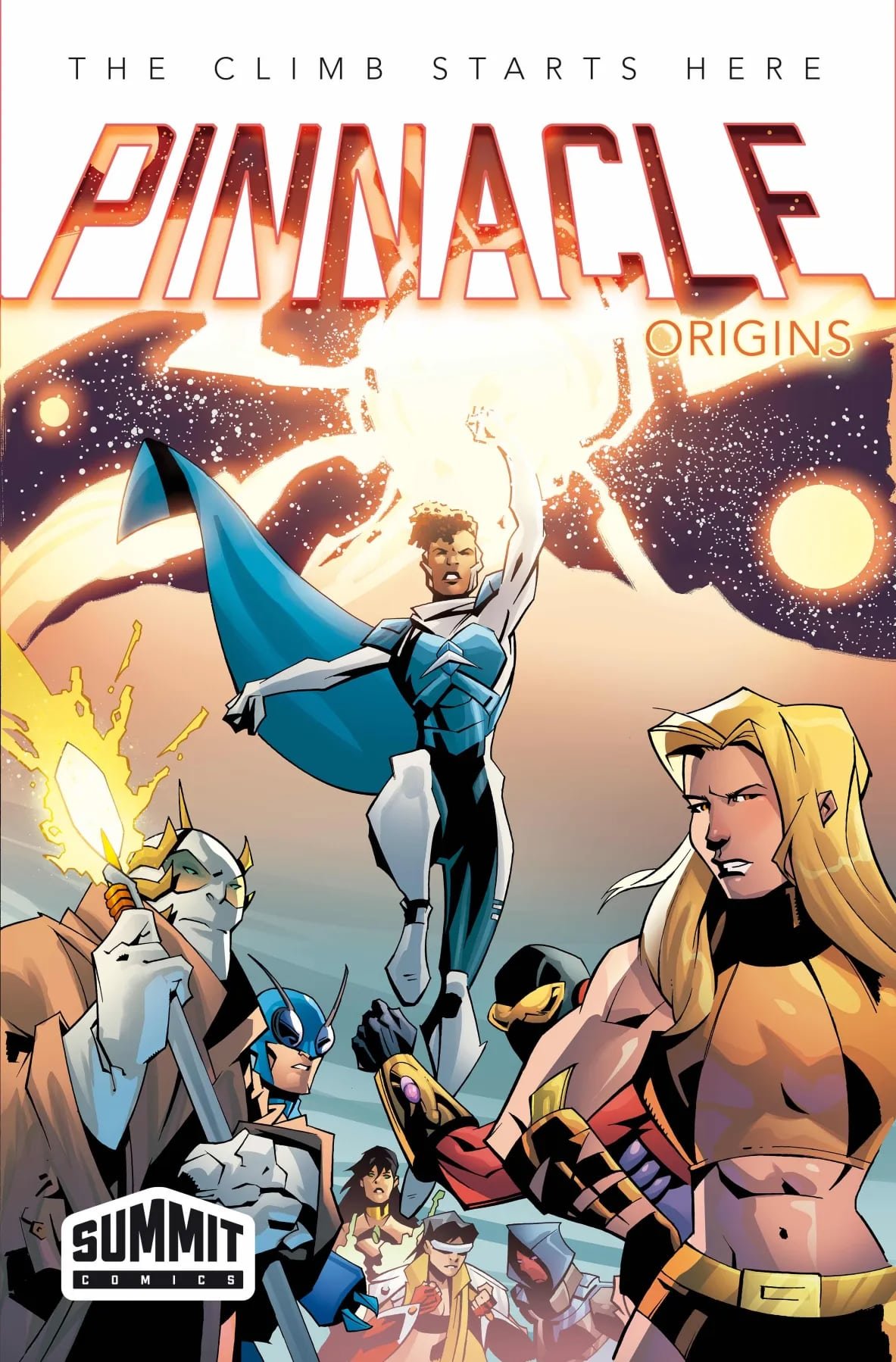
But what I do know, however, is what I did (both in collaboration and by my lonesome) to get to where I am today with Summit Comics and an unexpected success on our first-ever crowdfunding campaign for Summit: Pinnacle #1. Which, as of publication, still has 20 hours left on its funding!
Really quick, let’s start back at the beginning. I am a once-journalist. I started over a decade ago as a volunteer position at a little site called MCUExchange, which led to a paying job at CBR, which led to an eight-year full-time career at ComicBook, which led to a non-comics day job with regular, non-night hours so that I could have more time with my family and hopefully, just hopefully, regain a sliver of sanity.
Along the way, I’ve had two titles published in the direct market (and have self-published an additional 15 issues of various titles through crowdfunding), so I very much consider myself a newcomer to the landscape. Like I said, I still haven’t “broken in” yet.
That brings me to now, and the creation of the Summit Universe. If you’re reading this and are into small press or crowdfunding types, perhaps you’ve already heard of us. Our first project—Summit: Pinnacle #1—is now funding on Kickstarter and, as of this writing, is over 225% funded at $24,000 and some change. That’s no small feat for a Kickstarter campaign, if you know even the slightest about the platform.
At its root, Summit is essentially a collective of creators pooling their resources together to make the idea of making comics easier on all those involved. The great thing about the industry is that folks from all walks of life come together to tell their stories. It also happens to be a medium with one of the highest barriers to entry. After all, you can technically make a short film on your cell phone whereas if you only write comics, you’ll have to, at minimum, hire an artist to help you bring your ideas to life. By the time a writer pays the art team and gets a crowdfunding campaign ready to launch, they’ve exhausted all time, money, and resources at their disposal.
So we wanted to help our peers. The idea for the group quite literally was born in a Discord server out of a conversation where we had been having the chat above. One person raised the fact they were good with designing graphics for a Kickstarter page, offering to do that in exchange for editing services. Another person who didn’t have graphic design capabilities but knew how to get post seen on social, could help in their own way. A person who knew neither design nor digital media, offered to donate character turnarounds that interior artists could base their work on—so on, and so forth.
The beauty of this collective—this “Summit Universe,” as we are calling it—isn’t just that we’re sharing the workload. It’s that we’re actively spitballing in the face of the “no superheroes” mandate that’s been the gatekeeper’s gospel for a generation.
As a quick side…I mean, just think about the absurdity of that rule for a second. A lot of us grew up on the capes and superhero comics. We learned to read by following the primary-colored exploits of gods and monsters. Superhero comics are the very thing that made, and continue to make, the medium what it is today.
Yet, the moment you want to make your own, the industry pats you on the head and tells you to go write a quiet, slice-of-life short about a spurned lover or a semi-autobiographical coming-of-age story set in a rainy Midwestern town. Or maybe it’s a crime heist that’s kind of like Ocean’s 11 but kind of not. Don’t get me wrong: those stories are vital. I’ve read them, I’ve loved them, and I’ve probably tried to write a few of them while trying to play the game of comics.
But at the end of the day, my heart beats in 20-some-page installments of high-octane, spandex-clad chaos. And to some extent, I’m betting yours does too.
From the second we started talking about doing a shared superhero universe, the ultimate collaborative, “Yes, and” type of environment formed. Someone would bring an idea to the table and instead of critiquing it or shutting it down, our partners would figure out a way to make it work.
“I want to do a book about a legacy hero with a cosmic burden,” someone would’ve said to be met with something like “Yes, and I’ll handle the lettering so you can afford a better colorist.”
Someone else might have said, “I have a character who’s basically a living nuclear reactor,” to get a response of “Yes, and we’ll make sure he exists in the same city as my street-level vigilante so we can do a crossover in a year or two.”
By pooling our audiences into a single shared universe, we stopped being twenty solo acts screaming into the void of the algorithm. We became a superhero festival. When someone backs Summit: Pinnacle, they aren’t just buying one guy’s dream. They’re buying into an infrastructure. They’re supporting an ecosystem of good, ol’ superhero storytelling.
I’ll be the first to admit that seeing a figure over $10,000 on the Kickstarter dashboard gave me a mix of exhilaration and a very specific kind of “oh-god-now-I-have-to-deliver” vertigo. For a long time, the small press ceiling felt like it was made of reinforced concrete. You’d run a campaign, struggle to hit a couple thousand, ship your books, and end up with $47 in profit after postage ate your soul and the postman shunned you for using Media Mail to ship your comic books.
Breaking not only that $10k mark as a group of “indie nobodies” (I say that with the utmost affection), but continues on past $20k and beyond proved something to me: The audience does want superheroes.
And more importantly, they want to see creators actually helping one another. In an industry often defined by its crabs-in-a-bucket mentality, where everyone is fighting for the same three freelance slots at the Big Two, Summit is trying to build a bigger bucket.
Remember that conventional advice I mentioned? The part about not expecting your first project to be your Watchmen?
They’re right, of course. My first few scripts were hot garbage. They were overwritten, the pacing was a nightmare, and I’m pretty sure I broke the 180-degree rule in every single panel description. But there’s a flip side to the “start small” coin that people rarely talk about: starting small can sometimes mean thinking small.
If you spend your whole life writing six-page anthologies because you’re afraid of the same superhero curse, you might never learn how to build a world. You might never learn how to weave a thread across twelve issues. You may never experience the sheer, unadulterated joy of seeing a character you created on a Tuesday night in a caffeine-induced haze become someone else’s favorite hero.
At Summit, we decided to skip straight to the “Universe” stage. Is it arrogant? Maybe. Is it the “hardest way possible?” Absolutely. But it’s also the only way that feels honest to why we started reading comics in the first place.
So…where does that leave us?
We’re currently knee-deep in preparing for fulfillment on Summit: Pinnacle #1 as we ready the print file to be sent to the printer the second funding is received. We’re knee-deep in script edits, production on a dozen separate titles, and the kind of logistical gymnastics that would make a Cirque du Soleil performer weep. We’re learning that a collective is only as strong as its weakest spreadsheet. We’re learning that being your own publisher means being your own intern, your own PR firm, and occasionally, your own therapist.
But we’re also seeing a path forward that doesn’t involve waiting for an editor in Midtown Manhattan to find our email in their spam folder.
If you’re a creator sitting on a cape pitch that you’ve been told is unmarketable or tiresome for the indie scene, I’m here to tell you that the rules are more like… well, they’re more like suggestions. The barrier to entry is still high. Art is expensive, time is a thief, and the postal service is a fickle god, but the walls are thinner than they look. And, at the very least, we’re hoping to inspire you to break down that wall.
I’m still the guy who skipped college to work for arena football teams and be paid criminally low wages for doing so. I’m still the guy who spent eight years writing about what other people were creating. I haven’t “broken in” by the traditional definition. Hell, I can’t even be approved for an artist alley table at a convention like NYCC or Emerald City Comic Con.
But I have a community. I—we—have a universe. And thanks to nearly 500 people who decided to take a chance on a bunch of “rulebreakers,” I have a reason to keep scratching and clawing.
We aren’t the gods of crowdfunding. We’re just a bunch of people in a Discord server who got tired of being told “no.” Because as it turns out, that “yes” is a much better story to tell.
Adam Barnhardt is in marketing for a manufacturer during the day and at night, loves nothing more than hanging out at home with his wife, son, and three cats. And comic books. He’s written for The Beat, ComicBook, CBR, and once even had bylines at the legendary Pocahontas Record-Democrat (circulation 3,000). He can be reached at adam.barnhardt@gmail.com or on most social media platforms at @adambarnhardt. He also has his first solo Summit campaign, The Curious Case of Dr. Vane, live on Kickstarter now.
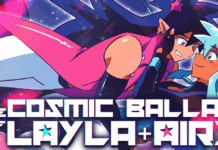
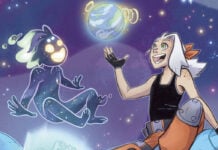
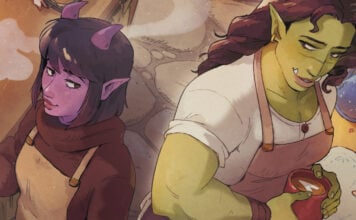


 Adam Barnhardt details his tumultuous process of "breaking in" to comics with Summit Comics)