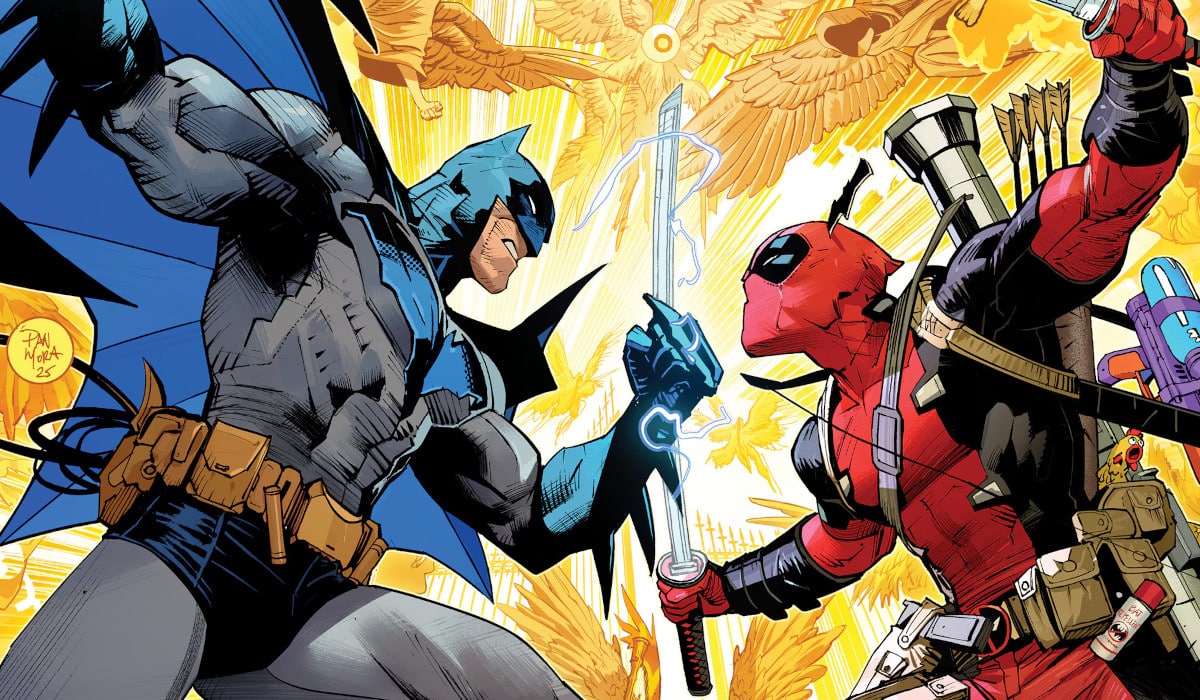

In spite of making a “far, far superior comic book,” comics retailer and pundit Brian Hibbs reports that his sales on the DC-published DC/Marvel Batman/Deadpool #1 have disappointed relative to Marvel’s earlier Deadpool/Batman one-shot. In a social media post, Hibbs shared raw numbers and anecdotal experience that seems to suggest some of the hype around the crossover may have cooled in the weeks between the comics.
Hibbs, a longtime columnist at Comic Book Resources, The Beat, and elsewhere, owns Comix Experience in San Francisco, CA. He said that he had ordered 120 copies of Marvel/DC Deadpool/Batman, and sold through them all in two weeks back in September. As a result, he increased orders on Batman/Deadpool, but has sold through only about half of the comics, which carry a higher cover price.
While DC did have some higher-priced “enhanced” variant covers, the publisher did not offer “incentive variants” — rare covers that a retailer can only get by ordering high quantities. Marvel did offer 1:50 and 1:100 incentive variants, which Hibbs flipped on eBay for significantly more than cover price.
Hibbs said that there was more hand-selling of the DC version, since he considered it a better book, and doesn’t offer much commentary on why he thinks the books might have performed the way they did. There are, however, a number of relatively obvious possibilities.
Deadpool/Batman, which came out first, was the first DC/Marvel crossover book in years, which likely helped. DC’s book coming second, with a virtually identical title, and a higher cover price, likely hurt it. While the two one-shots were both billed as #1 issues, similar past “one and one” crossover events like Spawn/Batman and Superman/Savage Dragon, the fact that they released several weeks apart may have caused fans to react to DC’s book like it was a “second issue” rather than a one-shot. As anyone who follows comics knows, attrition between the first and second issue of a new series is virtually always high.
A number of commenters also indicated that some consumers were confused by the back-to-back #1 issues and numerous variant covers, thinking that the DC version was just a reprint of the same Marvel book they already owned.
The Deadpool/Batman crossovers aren’t exactly like those other crossover books, either; in the past, those crossovers featured one or two creative teams telling one-shot stories. This time around, the crossover is more of an anthology title, with various creative teams telling short stories featuring different DC and Marvel characters crossing over. The lead feature in each puts Batman and Deadpool together, with each publisher handing the gig to a high-profile creative team.
In spite of being a major retailer in a big American city, Hibbs is still only one guy with anecdotal experience…but comments on his post from other retailers seem to echo that experience.
Fines Massey of Massey’s Comics in Missouri said that “The extra price for variants is definitely a sticking point for customers,” while Ron Hill, Co-owner of JHU Comic Books, said he only sold through about half of his stock of the DC book.
Still, Hill isn’t as concerned over it as Hibbs, saying that he thinks the book will be “evergreen” and he can essentially sell through them over time.
“It’s something I like to refer to as a ‘tchotchke,’ I think this book will continue to have appeal to various dabblers for the months to come,” Hill wrote.
That’s likely true, at least for stores who have enough shelf space to leave it out in the open rather than filing them away in back issue bins. Hibbs, though, wasn’t impressed with that solution. In the original post, he wrote, “Maybe these will still be trickling out a few copies a month until next June! I would have liked to have that money RIGHT NOW, however, as it does me zero good to have these looking forlorn on the racks like that.”
The Beat spoke with Jeff Watkins, the co-owner of Funky Town Comics & Vinyl in Syracuse, NY, who said that his stores “moved both in equal measure, but a little more effort went into the second release.” He wasn’t sure what had contributed to sagging enthusiasm, offering options like consumers’ shorter attention spans or confusion, suggesting some thought, “Didn’t I already have this?”
In a statement to The Beat, Watkins wrote, “There are skews of people finding comics and comic shops for the first time, so we are routinely explaining how comics work. (Always as ambassadors to the medium, and always with welcome. Everyone remembers their first visit to the comic shops.)” He added that the X-23/Nightwing story was the one that seemed to elicit the most excitement of any so far.
“My takeaway from this is that there is longevity in the big two crossing over. It is an experience unique to comic stores and can’t be found on streaming. More of that, the better,” Watkins wrote. “And pleeeeease Marvel, create that Star Wars/Marvel crossover. Yoda and Rocket? Vision coming through Darth Vader’s chest plate? Wolverine slashing through hordes of Battle Droids. Jessica Jones and Princess Leia. Boba Fett and Iron Man beating the brakes off each other. The online engagement, the in-store discussions. All of this empowers comic shops. Empowers retailers and gets the butts in seats.”





I can understand why they wouldn’t want the issues to come out the same week, but DC should have insisted they come out the same month. It could have been a first week/last week release.
I would love to visit the parallel world where the DC one came out first. It was FAR and away the better one.
I wasn’t terribly impressed with the first book. The main story fell flat. And only liked the Captain America and Wonder Woman backup story.
Comments are closed.