
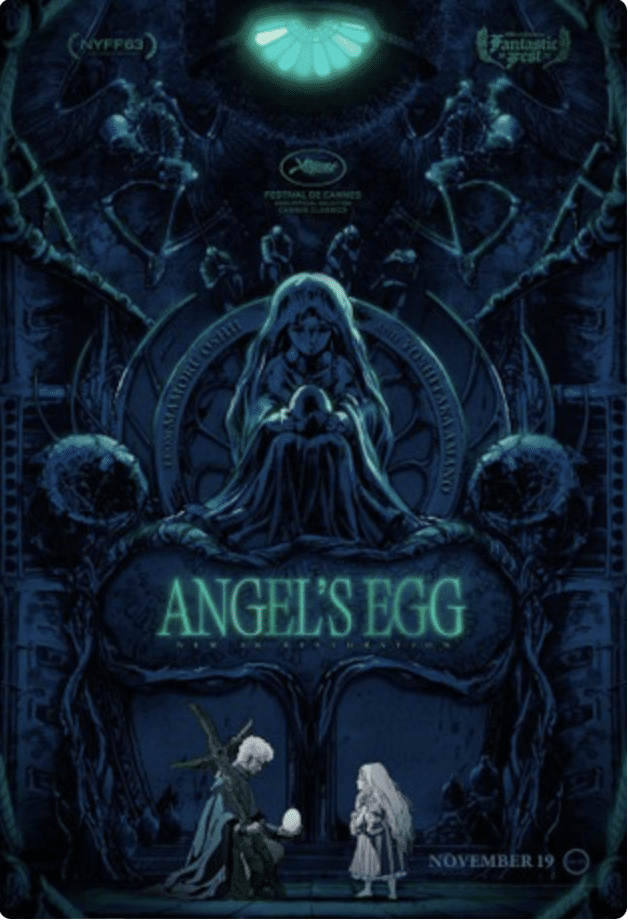
1985’s Angel’s Egg represents a very specific moment in anime history. A point when the emerging home video market in Japan meant video store shelves needed content to rent and sell. Animation studios took chances on putting out almost anything, even the most surreal ideas, for Original Video Animation or OVAs. This is the only environment that might allow two emerging talents like Mamoru Oshii and Yoshitaka Amano to create something as dense, dreamlike, and utterly mesmerizing as Angel’s Egg. The occasion of its fortieth anniversary is a good reason to examine why this film remains a masterpiece.
Remarkably, Angel’s Egg was Oshii’s first original film after directing Urusei Yatsura 2: Beautiful Dreamer as well as a career of directing and storyboarding for TV. Beautiful Dreamer saw Oshii more fully embrace surrealism for the first time in a film. He favored a more elliptical plot and moments of stillness as the cast of Urusei Yatsura were trapped in a time loop. While far more straightforward, it lay the groundwork for Oshii to become a more fully realized director with Angel’s Egg.
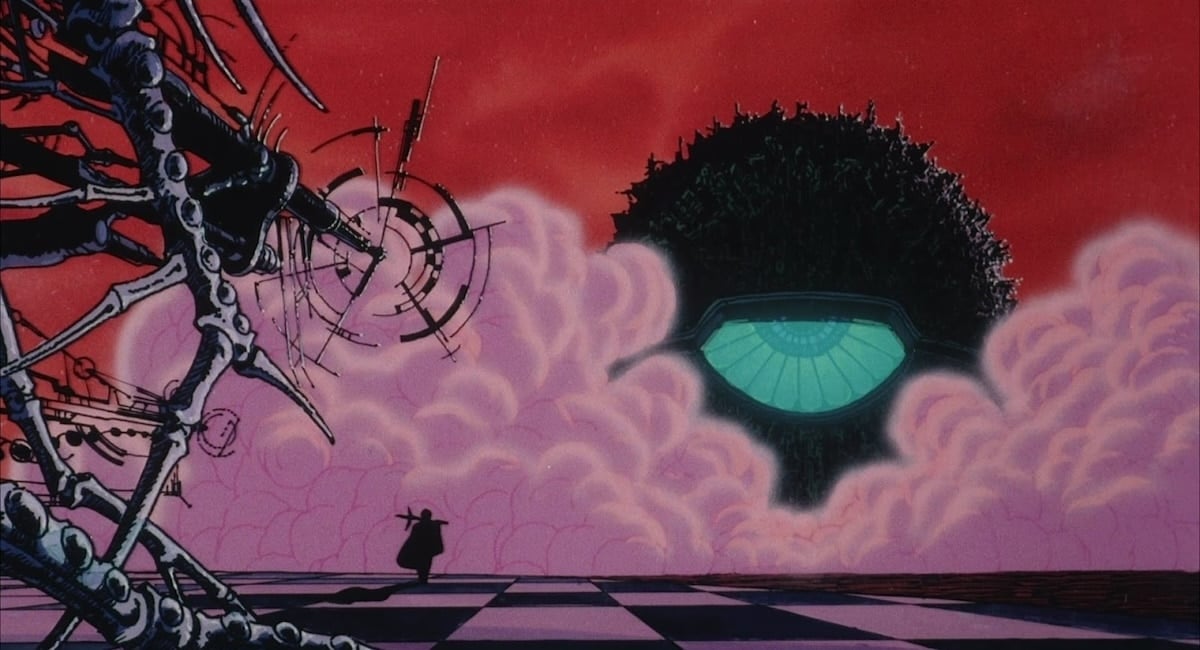
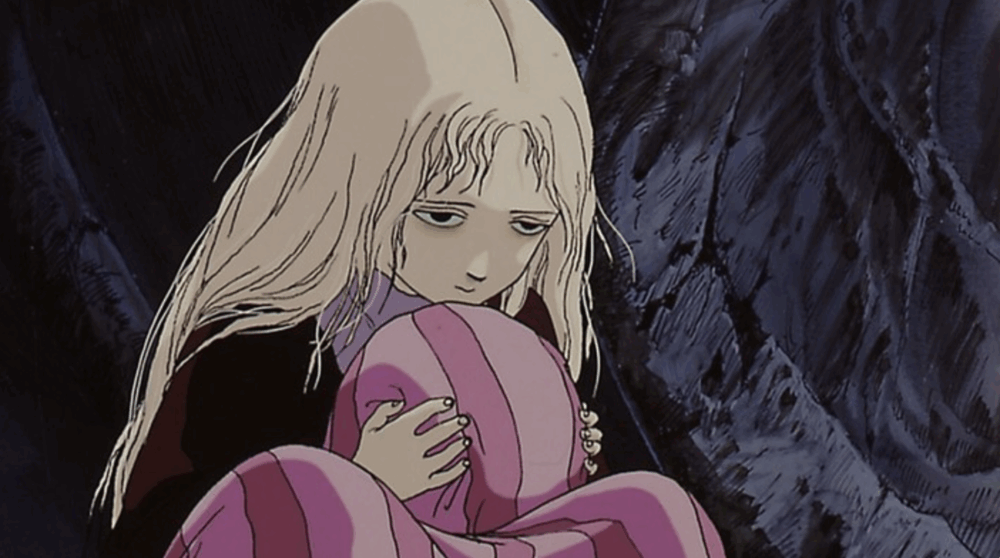
Describing the narrative of the film feels like grasping smoke. A very young girl carries an egg around while she’s followed by a soldier. They wander around a mostly empty city. There’s tanks, a massive floating city-like object, the shadows of massive fish, and other haunting images. Allusions abound to the biblical book of Genesis. Writer/director Oshii is never one for easy answers.
Yet the plot, if one even exists, doesn’t matter. This is a film of the symbolic where images matter more than plot. Any attempt to connect any narrative dots is best represented by the sequence in the film where men throw harpoons at shadows. Angel’s Egg is closer to the films of David Lynch or Andrei Tarkovsky where visual expression matters more than a stated one. Angel’s Egg at its core is a film meant for viewers to bring their own experiences for interpretation.
Which is why it makes sense that Oshii teamed up with illustrator Yoshitaka Amano as his main collaborator. The illustrations of Amano, credited as art director on this film, have always had an ethereal quality to them. There’s something otherworldly in his wispy lines and watercolors that Oshii replicates to great effect in the film. Like any good dream, his drawings exist as a world of fantasy that functions with their own logic.
And this is one of the most gorgeous animated films ever made. The kind of film where you can get lost just looking at how a character’s hair is animated. One of the most astonishing sequences is one where a fisherman is hunting the shadows of fish floating through a nameless. Harpoons fly through the air at black masses but only damage concrete, brick, and glass. There is a desperation in the throws of these faceless, shadowy men. Yet the most striking scene is one where the characters simply sit around a campfire. Like any good dream, the images stick with viewers long after they wake up.
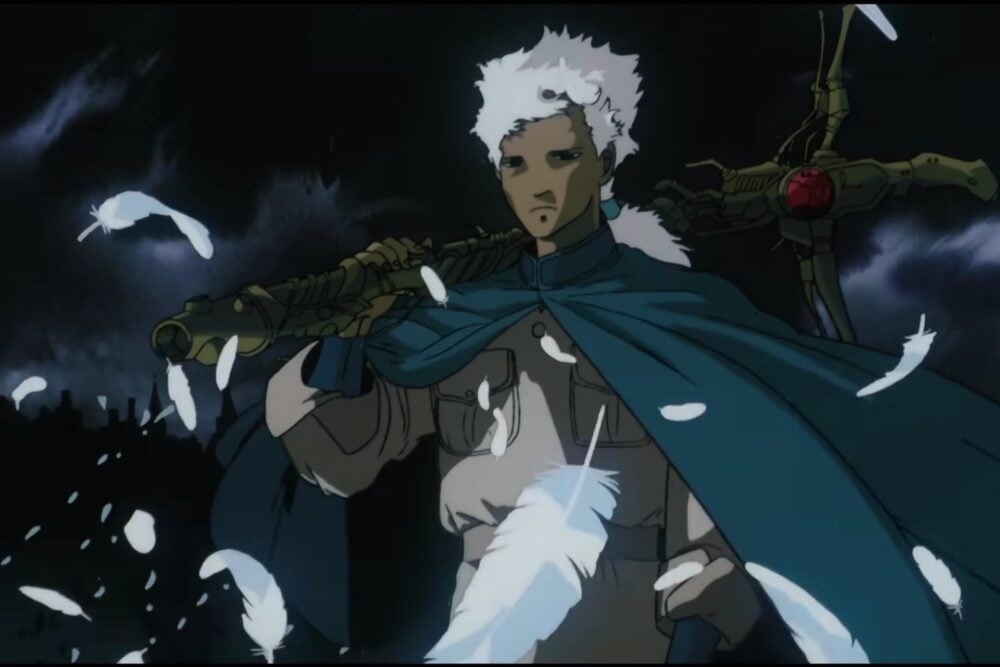
Angel’s Egg shows a true collaboration between two artists playing to each other’s strengths. Oshii brought his ability to create films with dream-like logic to Amano’s ethereal drawings and Amano gave the director a rich world with which to play. Oshii continued to merge the dreamlike and the everyday, especially in his two Ghost in the Shell films. Amano originated the look of the long running Final Fantasy video game series two years later. Yet Angel’s Egg represents a collaboration that could only have happened in a world maybe a littler more willing to see something this singular happen.