
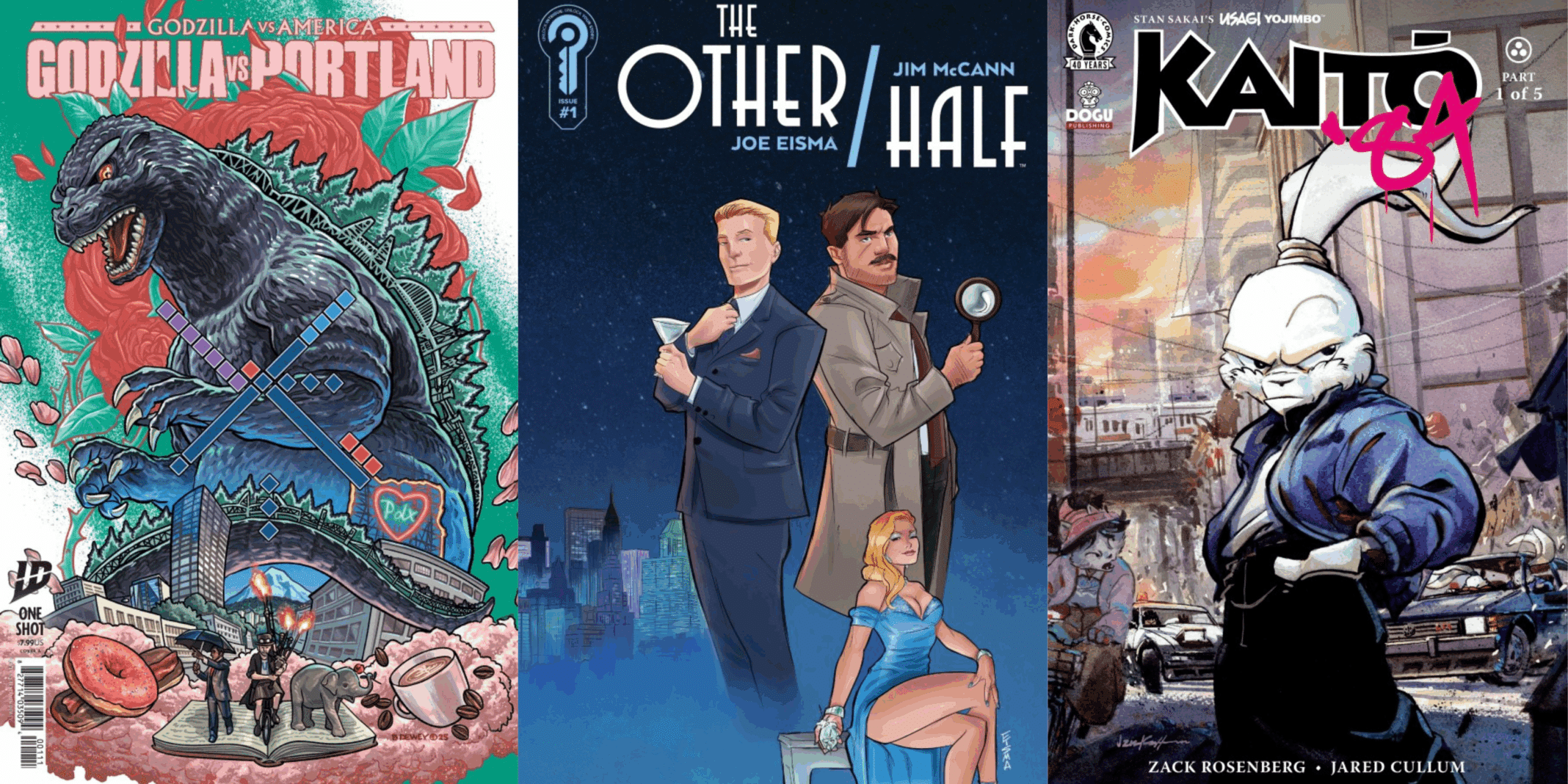

This week we’re looking at the first non-Stan Sakai Usagi Yojimbo comic with Usagi Yojimbo – Kaito ’84, a holiday celebration with the Dick Tracy – St. Patrick’s Day Special, Godzilla vs. Portland, and more! Plus, FOC Watch and The Prog Report!
 Usagi Yojimbo – Kaito ’84 #1
 Usagi Yojimbo – Kaito ’84 #1
Writer: Zack RosenbergArt and Lettering: Jared Callum
Publisher: Dark Horse Comics – DOGU Publishing
Review by Dan Morris
One of the joys of Stan Sakai’s Usagi Yojimbo is how pliable the series is. The long running series has ventured into practically every genre at this point; comedy, horror, samurai epics. It’s even different shades of science fiction in stories like Senso, a recent cross over with the Ninja Turtles and in the spinoff Space Usagi. But other than the future set Space Usagi, all of these stories exist in the Edo time period.
Enter Usagi Yojimbo – Kaito ’84, a story that breaks two major rules of the series. One is that this story takes place closer to modern day in 1984 Osaka with Usagi’s Robin Hood-esque descendent Kaito. The other that this is the first story not to be made by Sakai. Instead, writer Zack Rosenberg and artist Jared Cullum handle storytelling duties here.There’s a certain fidelity to the storytelling and traditions laid down by Sakai in his series. The script by Rosenberg never veers too far in style from what Sakai might craft. Like his ancestor, this Usagi finds himself caught up in some kind of power struggle and needs to navigate his way out. There are nods to both the creator and his creation abound throughout this issue,. It’s clearly made by people who love this staple of independent comics.
And like Sakai, Rosenberg and Cullum clearly also enjoy Asian cinema. Where Sakai favored the samurai dramas of Kurosawa, these two look to the fast moving martial arts films of 1980s. Kaito ’84 owes a heavy debt to the films of Jackie Chan and Sammo Hung made in that time period. Kaito, so far, relies on his fists and quick thinking instead of sword battles. Familiar characters get updated for this time period and this mode of storytelling.
Cullum meanwhile adapts that energy into the comics medium with his beautiful watercolor work. Take the second page of this issue. He has two characters have a conversation in the foreground while Kaito pulls off a heist in the background. Kaito poses like he’s in a martial arts film and there’s such a fluidity to those poses it’s like he’s actually moving.
More importantly while Cullum at least tries to have a visual continuity with Sakai’s work. He may not draw the skull in the word balloon (yet), but his anthropomorphic character designs don’t look too far removed from Sakai. They both have such clear storytelling though Cullum adds his own flair for engaging page layouts throughout. It’s all unique but never out of step with it’s predecessor.
Which describes Usagi Yojimbo – Kaito ’84 perfectly. This all works because both creators know a Usagi Yojimbo story can become anything. This version of the character isn’t even the strangest Usagi Yojimbo story ever told. But a story in the vein of Hong Kong’s free wheeling martial arts comedies feels perfectly in line with the best that Usagi Yojimbo can be.
 Dick Tracy – St. Patrick’s Day Special #1
 Dick Tracy – St. Patrick’s Day Special #1
Writers: Alex Segura, Michael Moreci, & Tim Seeley
Art: Craig Cermak & Rebekah Isaacs
Colors: Mark Englert & Marissa Louise
Letters: Patrick Brosseau
Publisher: Mad Cave Studios
Review by Clyde Hall
Holiday themed comic book Specials usually arrive in varieties bearing Christmas wrapping, Halloween masks, Valentine’s bouquets, or Summer beachwear. St. Patrick’s Day clovers, though, aren’t normally part of these parcels, even though green-themed comics characters would lend themselves to such projects. Now along comes Dick Tracy: St. Patrick’s Day Special and, since Mad Cave put out one of the best 2025 Halloween Specials during the last spooky season, it warranted a look. Keeping with the celebratory theme of the occasion, it’s a holiday Special you’ll feel fortunate for picking up.
Is it a result of much-vaunted Irish luck? No, it’s mostly because the writers of the two stories herein , Alex Segura & Michael Moreci on “Irish Goodbye”, and Tim Seeley on “The Short of It” understand the modern appeal of the classic, yellow-coated detective and the character ensemble around him. They also have the chops for transferring modern themes into their stories in ways that are organic and satisfying, i.e. making their stories entertaining and relatable across many generations and without changing the essence at their core. It’s not a simple task, but every issue of the ongoing series as well as these Specials, the creative team is doing the job well.
In this one-shot’s first story, we get a fairly well-known Tracy villain cast in an emerald light similar to the franchise history, but with outlooks and motivations slightly altered. The trick isn’t in Segura and Moreci making the narrative align with the era setting of the original strip. The laudable accomplishment is their recognition of ways those yesteryear situations apply once more, then aligning them for modern readers. A criminal not known for murder begins killing extremely wealthy men. Captains of industry, investors, politicians. People he feels, given the economic downturn of last century, have rigged the system so that they can rob innocent parties and legal institutions for their own gain.
Tracy and Sam face the challenge of tracking down a killer not acting out of murderous passions, but with the criminal precision of a master thief eliminating competitors who do much more harm for much more profit than he’s ever managed, and who unlike himself face no legal consequences for it.
It’s an engaging and timely tale, only hindered by two elements. The handling does get heavy in a few instances, perhaps for fear that modern readers won’t get the correlations between societal then-and-nows that the creators are shooting for. In those moments, more subtlety would suffice. The second shortcoming is editing. Missing words or words which don’t seem like the ones intended derail otherwise great dialogue. And here were multiple derailments. As a writer who’s made the same mistakes and regretted it, I understand. As a reader enjoying the work but not the story flow interruptions from filling in the gaps, I grumble. A little. The tale is worth the effort, but that’s exactly why it deserves better editing.
Craig Cermak’s artwork for “Irish Goodbye” matches the story tone well. It’s straightforward, reserved stylistic touches coming in opening party scenes most noticeably. And those reveal more than any other panels why his work shines. These look like behind the shades galas of the day, where powerful men gathered and partied out of the view of the public and their wives. Cermak makes it look realistic but not vulgar, the fashion revealing but not scandalous as we think of that term today. It’s true to the era when bikinis were just beginning, their more revealing variations still decades away. And despite being a wild party scene, there’s no overdone Baz Luhrmann-esque splendor wooing modern sensibilities but diminishing the time period depicted.
The visual splendor comes from artist Rebekah Isaacs with the second story of the issue, “The Short of It”. She renders the difficulty former criminal’s accomplice Acres O’Riley has staying on the straight and narrow as the city celebrates St. Patrick’s Day with a weary street wisdom. But also with an added sparkle of enchantment hinted in every panel. It’s a feast of visuals, and it’s vital to the charm this story bestows.
It also gives the title a hook its one-shot predecessors had, introducing lesser known characters or stories from the Dick Tracy tapestry which don’t always fit into the ongoing series. Acres O’Riley, a 9-foot tall cabbie in Tracy’s city, wasn’t a supporting character I was familiar with. But seeing Acres recall her time as muscle for a diminutive male paramour, the criminal called Heels Beals, sent me in search of her exploits within the Tracy comic strips.
Tim Seeley’s script is succinct, tightly written but with plenty of opportunities for a good stretch o’ the legs in Acres’ ghillies. We feel her loneliness, we empathize with her regret over past mistakes and the judgment it still brings to bear. And we admire her, both her determination not to fall back into old, hurtful habits and also her defiance by giving love another go. Through it all, there’s a golden sheen of enchantment layered somewhere between the sooty smoke stacks and grimy backstreets of the city. It’s an unshakable charm that maybe, in honor of the holiday, Tír na nÓg isn’t so far away.
The Dick Tracy: St. Patrick’s Day Special is a solid buy for anyone wishing to see the iconic detective handled well and with added relevance for a world far removed from his original timeframe. In chronology if not in nature. Mad Cave’s ongoing Dick Tracy titles are always affirmations that there will be good story material out there when the film and television rights for the character are once more available. In the meantime, creative teams like this one show us why the character has lasted so long and right ways of tapping into that vast mythology for new generations.
 Tigress Island #1
 Tigress Island #1
Writer: Patrick Kindlon
Artist/Letterer: EPHK
Publisher: Image Comics
Review by Zack Quaintance
I’ve been interested in Tigress Island since last fall, when I read artist EPHK’s graphic novel, Harpy (read my review here!). It was excellent, the type of book that made me immediately want to know what the creator was doing next — and the answer was Tigress Island, a five-issue miniseries scripted by Patrick Kindlon, published by Image Comics.
And now I’ve had a chance to read Tigress Island #1, and it’s a strong debut. The book is definitely an excellent showcase for EPHK’s future-looking, kinetic art. It’s billed as exploitation film-esque action-adventure comic, and it’s certainly that. The plot is that a group of women who work as high-end escorts are trafficked from a fancy nightclub in Hong Kong to a mysterious island prison.
We as readers are essentially given a close third-person POV to the kidnapped women, and we don’t really know anything more than they do, which is very little. When one character asks for answers about their situation, the warden of the island tells her that in this place, answers are earned. It’s intriguing, and EPHK’s art is unsurprisingly great. It’s cheesecake-y to be sure, but that fits the nature of the story.
The book is also well-written. The characters are all distinct, and there’s a great visual sequence that gives us just enough of each of their backstories. Kudos are owed all around for that. The book also makes great use of the two-page spread in a way that makes it read fast and feel perfectly-paced.
Tigress Island also is self-aware. It knows it’s playing with exploitation, and while it’s not offensive or insensitive, it’s also not the type of book that really wants to say something Important about international human trafficking. Instead, it uses it as the backdrop to get its characters into a severe predicament.
Overall, I enjoyed this book quite a bit, and I’m excited to see where the story goes, powered as it will be, of course, by EPHK’s fantastic artwork.
Godzilla vs. America – Godzilla vs. Portland #1
 Godzilla vs. America – Godzilla vs. Portland #1
Creators: Colleen Coover, Cat Farris, Caitlyn Yarsky, Heather Breckel, Mark Russell, Eryk Donovan
Letterer: Sandy Tanaka
Publisher: IDW Publishing
Review by Gianni Palumbo
Godzilla vs. Portland is the most recent entry in the incredibly fun Godzilla vs. America anthology series of one-shots from IDW. These are always such a treat. Not only is it a fun time for die-hard Godzilla fans but it’s a great showcase for both seasoned veterans and new talent to stretch their comic book making muscles. Put simply, it’s gooooood comic booking.
This 50 page one-shot features 4 short stories all set in Portland, Oregon (obviously) starting with Godzilla vs. Sasquatch with Colleen Coover on writing, art, and lettering, just absolutely dunking on all of us. There isn’t a ton of dialogue or narration here which allows the spectacular art to really shine. I especially love how the lettering is incorporated into the art. Nearly every page is covered with onomatopias emphasizing the destructive chaos (and hilarity) of these two massive beasts facing off with a great cherry-on-top punchline.
Next up is Dog Day Afternoon written and drawn by Cat Farris with letters by the great Sandy Tanaka, who is on lettering duty for all the stories from here on out. Now, just by the title this one caught my eye. I’m a massive cinephile. Sidney Lumet’s Dog Day Afternoon (1975) is one of my all time favorite films. It’s on my hypothetical Sight and Sound ballot for their “250 Greatest Films of all time” list (it’s a personal dream of mine to vote!). Well, this story has nothing to do with the film, but it’s still great! In fact, it’s probably my favorite from the bunch! The story follows a journalist working on a write up for “Weiner Week” and his friend who dare find the answer to an age of question. What is the quintessential Portland hot dog? As they make their way to the famous hot dog stand, trying to guess what makes this hot dog special, Godzilla makes their way through the city, causing all sorts of chaos. The duo couldn’t be bothered. They are on a mission. After a slew of slapstick comedy and background gaps, the duo finally reaches their destination and…well, you’ll just have to read to see what happens.
Next up is a really interesting one. High Score, with writing and art by Caitlin Yarsky and colors by Heather Breckel, has such an insane internet deep cut that literally made me do the Leo pointing at the screen from Once Upon a Time…In Hollywood meme. It uses Polybius, an internet urban legend about a lost arcade game, as the MacGuffin. For those unaware of the legend, Polybius centers around an arcade game of the same name that appeared in arcades in Portland circa 1981. Its gameplay was highly hypnotic and addicting to the point where people would go insane. Supposedly, “men in black” would record data of the effects before removing the cabinets, never to be seen again. Crazy, right? Yarsky and co. then take this iconic Portland urban legend and weave into the appearance of Godzilla. When Polybius shows up, so does Godzilla and chaos ensues. It’s mass hysteria x2.
Finally, we have Under Siege in the 503 with Mark Russell on writing and Erik Donovan on art. First off, I have to shout out Erik Donovan’s art. It simply rocks. It’s got this rough and sketchy style that really benefits the chaos and destruction that Godzilla causes. The story here is simple but incredibly effective. It’s all hands on deck. People from all walks of life in Portland work together using whatever resources and strategies they can think up to defeat the Kaiju. Honestly, in the crazy times we are living in where everyone is constantly on edge and distrustful of each other, it’s nice to see a community work together to achieve a common goal. The goal in this case being defeating Godzilla, but still, it’s nice.
The Other/Half #1
 The Other/Half #1
Writer: Jim McCann
Artist: Joe Eisma
Colorist: Peter Pantazis
Letterer: AndWorld Design
Publisher: Ignition Press
Review by Tim Rooney
Ignition Press’s The Other/Half is a fun concept, think a mashup of Frasier and Columbo, but the leads are married to one another.
There’s a breeziness to Jim McCann’s script with its rapid fire patter and high society glamor. Joe Eisma does solid work on the visuals, particularly in the way he visualizes the odd-couple distinctions between our married lead couple. Henry is, while not quite schlubby, a bit unkempt, with tousled hair and frumpy outfits. Ethan is highly polished, with sharp angled clothing and slicked back hair.
This first issue is mostly about tone-setting, inviting us into the couple’s world and their distinct personalities before forcing them to swap worlds to solve the mystery set up at the end of this issue. Peter Pantazis‘s colors are as core to that tone as McCann’s script. His bright colors leave no doubt what this book is setting out to do. This is no noir, it’s a crime-themed romcom, where the stakes are low and we don’t even need to fear too much about any emotional fallout.
I wish there was a bit more meat on the bone here, because while Eisma’s visuals are pleasing to the eye, they are a bit thin on detail, which keeps this high society New York setting feeling a little thin. The slice of life focus certainly helps us care about our heroes and understand their dynamic but it could have handled that with a bit more intrigue. It’s encouraging to see a story spotlight a happy and supportive gay couple in this climate, particularly in a way that plays on familiar trappings.
But this book is going for a comfort food, low-stakes feel and nails that tone. A feel-good caper.
FOC Watch
The following title is currently available for pre-order at your local comic shop!
Hidden Springs #1
 Hidden Springs #1
Writer: Rob Thompson
Artist: Nil Vendrell Pallach
Colorist: Berta Sas Forrelland
Letterer: Simon Bowland
Publisher: Dark Horse Comics
Due Out: May 13, 2026
Review by Zack Quaintance
Talking about generations is just so tiresome. Arguing about which was better, and whose era is responsible for what. And don’t even get me started on those terrible reels that show the different generations at the office. It’s all bad. But you know what’s not tiresome? Kaiju comics built around generational differences, it turns out.
Or at least, that was a thought I had while reading Hidden Springs #1 from writer Rob Thompson, artist Nil Vendrell Pallach, colorist Berta Sas Forrelland, and letterer Simon Bowland. The book’s principal cast is a group of retirees who live in a home for high-profile and artsy guests. They are, essentially, retired celebrities (the Ozzie Osbourne analog is a highlight). It starts with them on a hike, separated from their stereotypically Gen Z minders, and off we go.
Pallach and Forrelland’s art and designs are great, giving each of the characters a distinctive look drawn from their characterization. And Thompson does a fantastic job making these inflated people individual, charming, and also fun. It’s really a great example of a fun high concept, wherein the creative team puts in the hard work of realizing said concept’s potential.
This is really my favorite sort of comic. It’s one with just a silly-as-hell idea: what if old celebrities took on kaijus? But an execution that takes its comics nonsense seriously. Add to that such clever writing and art, and you’ve got a fantastic first issue that gets me on board for the full story.
The Prog Report
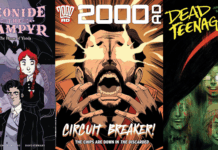
 2000AD 2473 (Rebellion): This week’s magazine brings us the finale of Herne & Shuck: Power Trip by writer David Barnett, artist Lee Milmore, colorist Gary Caldwell, and letterer Annie Parkhouse. I’ve enjoyed this strip through its run, especially the installments that were organized around Herne going up against a series of challenges (King Arthur and OnlyWenches is just a top-tier joke), and this week we get to see the outcome of it all. While it’s an ending to this arc, the story is very much a setup for more Herne & Shuck to come, kind of like one of those movies (that are all the rage of late) that just give you part one. This week’s cover (above) is by Mark Sexton (and what a doozy! wow). As always, you can pick up a digital copy of The Prog here. —Zack Quaintance
 2000AD 2473 (Rebellion): This week’s magazine brings us the finale of Herne & Shuck: Power Trip by writer David Barnett, artist Lee Milmore, colorist Gary Caldwell, and letterer Annie Parkhouse. I’ve enjoyed this strip through its run, especially the installments that were organized around Herne going up against a series of challenges (King Arthur and OnlyWenches is just a top-tier joke), and this week we get to see the outcome of it all. While it’s an ending to this arc, the story is very much a setup for more Herne & Shuck to come, kind of like one of those movies (that are all the rage of late) that just give you part one. This week’s cover (above) is by Mark Sexton (and what a doozy! wow). As always, you can pick up a digital copy of
 Column edited by Zack Quaintance.
Read past entries in the weekly Wednesday Comics reviews series or check-out our other reviews here!





Not picking up many comics recently but really enjoy the reviews as it gives me some ideas of books, I might be on the lookout for when I do visit a shop (usually Comics Kingdom here in Reno).
Comments are closed.