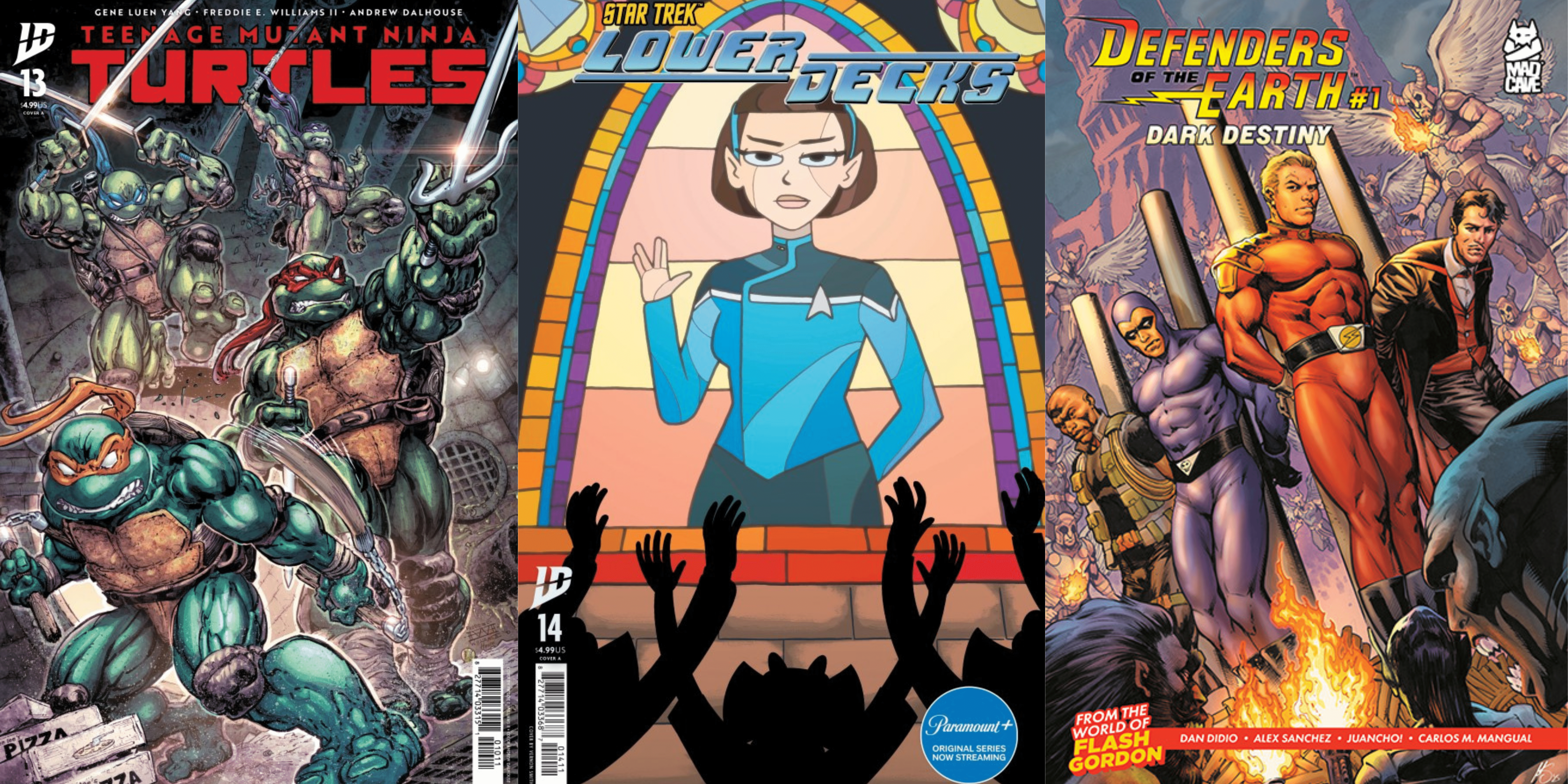

In this week’s Wednesday Comics Reviews, the team takes a look at the new creative team coming aboard in Teenage Mutant Ninja Turtles #13, a new start for an old team with Defenders of the Earth – Dark Destiny #1, and more. Plus, Ensign’s Log and The Prog Report!
 Teenage Mutant Ninja Turtles #13
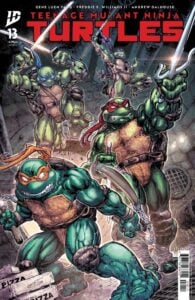 Teenage Mutant Ninja Turtles #13
Writer: Gene Luen Yang
Artist: Freddie E. Williams II
Color Artist: Andrew Dalhouse
Letterer: Shawn Lee
Publisher: IDW Publishing
Review by Jordan Jennings
The next era of the Teenage Mutant Ninja Turtles kicks off this week with Teenage Mutant Ninja Turtles #13. Writer Gene Luen Yang starts the run with strong with a clean on-ramp for new readers by bringing them up to speed with the current status quo of the Turtles. To be fair, it’s not too far off from classic movies when compared to some TMNT comics where you could expect to find Donatello in a robot body. To be clear, while Yang’s turtles are familiar, they are no less engaging with readers. He opts not to reintroduce the entire cast or throw everything out of the window. The brilliance of the issue comes from Yang’s use of our cultural understanding of the Turtles to turn the focus of the issue onto a gang war in Chinatown and Mayor Baxter Stockman’s corrupt past coming back to haunt them. What’s even more impressive is that there are plot threads from Jason Aaron’s run still in play, but Yang keeps them going. In an era where comic writers often focus less on playing well with the past in favor of their singular vision, it is a welcome sight to see a creator pick up the ball from the past creator and keep running with it. Moreover, this issue is about as new reader friendly as you can ask for from a long running narrative such as IDW’s TMNT.
As for the issue’s art, Freddie Williams II delivers a phenomenal issue with his pencil work. His big and blocky character designs really suit the Turtles’ design sensibilities. Williams brings along his excellent eye for detailed work as well. There are so many fiddly bits such as the shell pattern on the Turtles’ shells or the shape of the mask for each Turtle that just brings a nice visceral feel to the book. Williams’ page and panel composition complement the stories’ swift plot quite well. Great example of this is on pages where the action is extra kinetic the borders go from clean, crisp lines to thick, sketchy borders that capture the frantic moments. This is an ancient technique from the 80’s and 90’s, I know, for I was there, but there is no denying its effect when executed.
I would be remised to discuss Freddie William II’s art and not mention his frequent collaborator, color artist Andrew Dalhouse. Dalhouse’s approach to coloring Williams is best described as a mixed media approach. On any single page alone you will find gauche, traditional watercolors, color pencils, and/or typical digital coloring techniques such as gradients. Willaims and Dalhouse’s books always look visually distinct from everyone else. I will be the first to say, it doesn’t always work as sometimes it comes off as too busy, but here in this issue the work is clean and easy to read but keeping with the kinetic frenzy you would want to see.
At the end of the day, I deeply enjoyed Teenage Mutant Ninja Turtles #13. I am the target demo for this book, admittedly, but that doesn’t always guarantee success. The book is successful at what it aims to do and sets up an interesting story going forward that I am looking forward to reading. This exhilarating comic is a must read for any TMNT fan. Definitely check it out.
 Defenders of the Earth: Dark Destiny #1
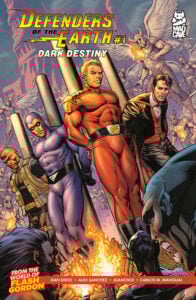 Defenders of the Earth: Dark Destiny
 Writer: Dan DiDio
Art: Alex Sanchez
Colors: Juancho!
Letters: Carlos M. Mangual
Publisher: Mad Cave Studios
Review by Clyde Hall
When the holidays roll around, a favorite vintage comics image is the King Features Syndicate Christmas cards bearing likenesses of their classic comic strip characters. The future founders of Defenders of the Earth included. Circa 1939 through the 1950s, these featured Flash Gordon, Dale Arden, Mandrake the Magician, and the Phantom sending readers Season’s Greetings on behalf of their creators and artists.
So, the December release of Mad Cave’s Defenders of the Earth: Dark Destiny feels appropriately nostalgic from a 2025 perspective. Those characters have been with us for a long time. Some would say they’re past due for a reimagining or continuation, maybe in a Phantom 2040 way. I’d be aboard with it. Because, unless the story is set in the past, shouldn’t the DotE characters come off as quaint and dated now?
The answer from some would be yes, but writer Dan DiDio has a different response. He makes them viable, likable, and remarkably true to their original concepts and characterizations, all in a fairly modern setting based on the Defenders of the Earth animated series. Mandrake still wears his classic stage magician tux and top hat, but comes off as effective an adventurer as ever he has. Lothar provides physical prowess and combat skills in support of Mandrake’s legerdemain. Flash shows why he’s earned a reputation for battle tactics and improvisational skill. The Phantom is still a sworn protector of humanity against evil in all its forms. And Mongo remains a world of long-standing racial feuds and factional rivalries that freedom from Ming’s regime hasn’t dispelled.
In the premiere issue, the DotE founders are finding out about the Mongo situation first hand, as prisoners. Because the one thing those warring factions of Mongo can agree on is that Flash Gordon and company are now their enemies. Part of the reason stems from the belief that Gordon granted Ming’s scheming son, Prince Kro-Tan, asylum on Earth (a plotline from the Mad Cave DotE title). And partly because having a common enemy once more brings at least a truce to the planetary infighting. Flash Gordon as an enemy also serves as path to Mongo’s throne that all involved can agree on. Basically the one who kills Gordon earns the right to ascend.
Back on Earth, young DotE members including Jedda Walker, Rick Gordon, LJ, and Kishin run into difficulties of their own tracking down Kro-Tan and gaining access to one of his hidden bases of operation. It makes for an elder heroes perilous wraparound and a next gen setup for Terran conflicts in subsequent issues.
It’s an approach which works, though I hope if the wraparound/center story formula repeats next issue, we get the junior heroes with wraparound lion’s share and their elders on the smaller center stage. Because the promotions for this series had me wanting to see the next phase of the younger heroes, the legacies, coming into their own. Not because the classic characters are tired or trite or portrayed badly here. They aren’t. But just as seeing Wally West take on the mantle of the Flash and having Dick Grayson at least temporarily take over as Batman came with new outlooks, voices, and character possibilities, witnessing similar developments for the Young DotE could be equally fulfilling.
Maybe in a future miniseries. Maybe with that Phantom 2040 vibe applied to a Next Gen team book. As it is, the creative team remains very true to both the main King Features Syndicate characters and the legacy characters from the 1986 cartoon series. Those familiar with the Mad Cave Defenders of the Earth continuation of the series will feel right at home here. New readers will want to catch up with that series first.
Artist Alex Sanchez brings the Defenders of every generation, as well as their friends and foes, to vibrant life. The detail in facial features alone is worth the cover price. And combining those elements with slamming panel shapes in the action sequences puts the punch in DiDio’s snappy dialogue. Color artist Juancho! texturizes the renderings, giving fabrics distinctive folds and settings their own variance. It’s why we have scenes set seaside on Earth and on Mongo with water that looks completely unique to both.
If the first issue of Defenders of the Earth: Dark Destiny was a car, it would be a primo vintage sports model. One with sharp lines, signature extras for character, and a purring Nailhead V8. The creative team handles these classic characters with precision and horsepower driving the narrative. Their fans, and fans of the DotE animated series, are in for a holiday treat. A Season’s Greetings from familiar action-adventure heroes who still know how to wriggle free of a deathtrap and slam the villains who set it.
Our Soot Stained Heart #1
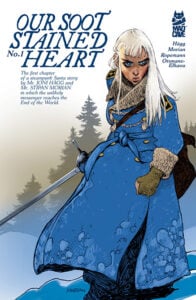 Our Soot Stained Heart #1
Writers: Joni Hägg, Stipan Morian
Artist: Stipan Morian
Colorist: Ropemann
Letterer: Hassan Otsmane-Elhaou
Publisher: Mad Cave Studio
Due Out: Dec. 10, 2025
Review by Zack Quaintance
I’m often reluctant to say that a specific comics creator’s work is unequivocally must read, especially when it comes to creators who make comics as part of collaborative teams. That said, Stipan Morian is doing absolutely incredible things right now with his art, and I think anything he puts out is a book that you should at least give a chance. I would certainly recommend picking up Our Soot Stained Heart #1 this week.
Morian’s new project is a sort of Fairy Tale with touches and themes taken from the Gilded Age, and it’s gorgeous. Co-written by Morian and Joni Hägg, the book will hook you with its lush, almost Dickensian aesthetic, before it next spends much of its extra-long first issue familiarizing you with its world, the stringent code that runs it (one must make quota), its lead character, and the impact even a single person with integrity and the will to rebel can have on a status quo.
A lot has been written about Morian’s work, typically in the context of praising his Deniz Camp collaboration, 20th Century Men, so apologies if any of this seems repetitive. But Morian is an artist who knows exactly when to exaggerate his people, places, and things, as well as when to stylize the point of view. It feels like all his pages have been carefully considered, labored over in a good, productive way to ensure that there’s not a single boring stretch in the comic.
And, of course, as a co-writer of this script, in Our Soot Stained Heart #1, he delivers visual set piece after visual set piece, ranging from battles on top of a train, to slogs through the snow, to the chilling speechifying of the book’s lead villain. It sounds cliched, but there’s not really a dull moment in this comic.
And while the moralistic quota for doing bad things in the world might feel like it’s laid out one too many times, I think establishing this comic as a bit of an allegory or fairy tale dispels the repetition as something that might take one out of the story. Everything is heavy, everything is over-the-top, everything is exaggerated so that the world and the comic feel larger than life.
In brief, I unabashedly loved this comic, and I’m not hesitant even a bit to call this one a must read.
Ensign’s Log
As IDW’s Star Trek comics continue to expand, Ensign Avery Kaplan has enlisted here to keep a careful log!
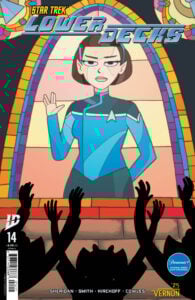
Star Trek: Lower Decks #14
Written by: Tim Sheridan
Art by: Vernon Smith
Colors by: Charlie Kirchoff
Letters by: Clayton Cowles
Design & Production by: Johanna Nattalie
Publisher: IDW
The ongoing storyline that started last month in Star Trek: Lower Decks #13 continues in issue 14, the second chapter out of six total. In this issue, Captain Carol Freeman and the crew of the U.S.S. Cerritos continue their investigation into the disappearance of the Laaperians, predominantly through a visit to Laaperia’s sister planet, Lapoonia. In fact, now is a great time to mention: if you were ever going to read a Star Trek comic out loud, this one would be a great choice, as it’s filled with silly-sounding made-up words.
This issue moves the story along, developing the narrative that began in the previous issue and leaving us on a cliffhanger at the end. So far, this more serialized format is working for the Lower Decks comic, and I’m looking forward to where the story goes from here.
While the previous issue did not include any appearances by D’Vana Tendi, she plays a significant role in this one, alongside T’Lyn. In fact, T’Lyn is even featured on the fabulous main cover, which features a stained-glass window depicting her image being worshipped by a trio of Lapoonians. While Bradward Boimler gets his own brown nosing-themed subplot, this issue does not include any appearances by Samanthan Rutherford or Beckett Mariner. I’m sure we’ll see them in the next issue, and I understand that it is a function of the limited number of pages in each monthly chapter, but I do always prefer it when all five of our heroes get to spend some time together.
That being said, there is still plenty to love in this issue, including decent-sized parts for Freeman and Jack Ransom, as well as a very funny gag for Doctor T’Ana. Smith does a great job with the visual gags, while Kirchoff’s coloring remains excellent (especially for the Cerritos). The lettering by Cowles is reliably well done. And Nattalie’s design & production on the series has been quite consistent.
Finally, a tangentially related note: the advertisements in the back include the trade paperback collection Star Trek: Shaxs’ Best (And Worst) Day, collecting the two one-shots Shaxs’ Best Day and Shaxs’ Worst Day. If you are a Lower Decks fan, you need to read both of these issues, and your chance could arrive when this collection gets here in January 2026. Don’t miss out!
The Prog Report
 2000AD 2462 (Rebellion Publishing): Maybe I’m reaching here, but I think you could make a case that all four stories in this week’s Prog are about zombies of some kind, even more so if you stretch that to encompass simply ghouls from the past. There’s the story that’s literally about zombies, Deadtown, which I wrote about last week, and there’s the lead strip, Judge Dredd: Messengers, which sees our lead character stomping around in the forgotten undercity, dealing with monsters from his past as well as supernatural beings that might be determining everything that happens above. Then there’s this week’s contained Future Shock, about a meme that turns people to zombies (more Infinite Jest sort of zombies than Walking Dead zombies), and finally, there’s an action-packed extra-long chapter of Rogue Trooper: Ghost Patrol, which also deals heavily in the past of the soldiers, the chips, and Rogue himself. What does this all mean? Well, perhaps it just means that I’ve read too many comics this week (our Best Of list is going live tomorrow), and I’m a bit loopy, or that the creatives involved here were all simultaneously in the mood to contemplate how the past informs present behavior, or how going through life can feel rote. I don’t know, and as I said at the start, maybe I’m just reaching here. Join us here next week for the last Prog Report of 2026, looking at the 100-page holiday issue! This week’s cover (above) is by Nick Percival. As always, you can pick up a digital copy of The Prog here. —Zack Quaintance
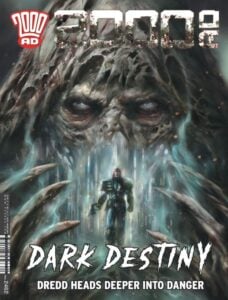 2000AD 2462 (Rebellion Publishing): Maybe I’m reaching here, but I think you could make a case that all four stories in this week’s Prog are about zombies of some kind, even more so if you stretch that to encompass simply ghouls from the past. There’s the story that’s literally about zombies, Deadtown, which I wrote about last week, and there’s the lead strip, Judge Dredd: Messengers, which sees our lead character stomping around in the forgotten undercity, dealing with monsters from his past as well as supernatural beings that might be determining everything that happens above. Then there’s this week’s contained Future Shock, about a meme that turns people to zombies (more Infinite Jest sort of zombies than Walking Dead zombies), and finally, there’s an action-packed extra-long chapter of Rogue Trooper: Ghost Patrol, which also deals heavily in the past of the soldiers, the chips, and Rogue himself. What does this all mean? Well, perhaps it just means that I’ve read too many comics this week (our Best Of list is going live tomorrow), and I’m a bit loopy, or that the creatives involved here were all simultaneously in the mood to contemplate how the past informs present behavior, or how going through life can feel rote. I don’t know, and as I said at the start, maybe I’m just reaching here. Join us here next week for the last Prog Report of 2026, looking at the 100-page holiday issue! This week’s cover (above) is by Nick Percival. As always, you can pick up a digital copy of