
In this week’s Wednesday Comics column, the team braces for a ending with Everything Dead and Dying #5, while covering a pair of new beginnings with Bloodland #1 and Touched by a Demon #1, and more! Plus, Ensign’s Log and The Prog Report!
 Everything Dead and Dying #5
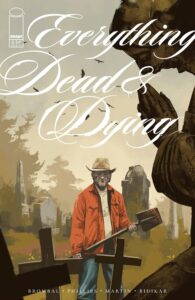 Everything Dead and Dying #5
Writer: Tate Brombal
Artist: Jacob Phillips
Colorist: Pip Martin
Letterer: Aditya Bidikar
Publisher: Image Comics
Review by Jared Bird
The whole world is against Jack Chandler. Fighting off the fellow survivors that aim to claim their farmland for themselves, everything comes to an end in this final issue of Everything Dead and Dying, concluding on a melancholic and bittersweet note with heart-racing action along the way.
Following the events of previous issues, Chandler’s husband has died and he’s on a desperate quest to find his daughter before she dies too. Cornered by all sides by ruthless survivors just trying to make a new life for themselves, Jack will have to fight back one final time to see if he can return to the peaceful life he’d carved out for himself, for better or worse. This final issue is both exciting and devastating, beautifully weaving a climatic final fight with a beautiful emotional resolution to the story, seamlessly balancing tones throughout.
The script and story by Tate Brombal is fascinating. I’m relatively well-versed in zombie fiction and can comfortably say Brombal has found an interesting and unique take on the genre here, taking an idea explored before in small doses (someone protecting their loved ones, even after they turn) but exploring it in more depth with a level of striking emotional intimacy that made the book easy to invest in as a reader. Chandler is a wonderfully well-rounded character, a survivor whose entire life has been a fight to be who he wants to be. In this ruthless, cut-throat apocalyptic setting, he has to fight just as hard to live his life how he’s supposed to, and there’s a tragic element to his final fate that rings real and true.
Jacob Phillips has been one of the best artists in comics for a couple years now, but continues to push himself further with every project. His framing and page layouts here are fantastic, maintaining a brutal and unforgiving pace as Chandler’s world collapses around him. His character expression work is remarkable, managing to capture moments of gutwrenching heartbreak and loss in beautiful and harrowing detail, and his first full foray into the horror genre displays a new range and ability to his work that’s wonderfully exciting to witness. Aided beautifully by Pip Martin’s fantastic color work, it’s a great showing from the art team, who really help make the book shine in every way possible.
Everything Dead and Dying is, ultimately, the story of one man trying to protect the family he fought so hard to gain in the first place. It resonates especially hard in the current climate, with its emotional narrative at the forefront, without ever sacrificing being a compelling and exciting horror comic. It’s great work from everyone involved, and absolutely worth checking out, though be warned; bring a box of tissues.
Bloodland #1
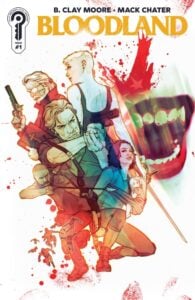 Bloodland #1
Writer: B. Clay Moore
Illustration: Mack Chater
Letters: Dave Sharpe
Publisher: Ignition Press
Review by Clyde Hall
Initial promotions for this title drew parallels between Bloodland and Kirkman’s Walking Dead with vampires in place of zombies. And as the ongoing series continues, this may become the case. However, the first issue had a definite True Blood flavor to it, society in upheaval over the integration of the undead into it and all the way vampires impacted humanity’s institutions. Financial. Religious. Political.
Take the latter, view it through a lens of modern American politics, and apply parasitic supernatural overtones. That’s at least part of the beginning recipe for the Bloodland launch. And a winning portion of that recipe is watching wannabe authoritarian overlords cozying up to immortal predators as a way of retaining power. Which casts their political party legions into Renfields while granting the rising freedom fighters a certain Van Helsing aspect.
Writer B. Clay Moore shows us this as the story opens with what amounts to a diplomatic entourage arriving in Washington D.C. for a negotiation session with American President Andrew Cross. Cross is retaining power after declaring martial law and extending his elected term unconstitutionally. He has powerful business partners and loyal followers, but he’s still on political ground as soft as a newly dug grave. His visitors have experience with that sort of thing. They could hold the key to securing his Executive stay indefinitely, and they’ve already aided him covertly. The next step? Telling the public of their overt involvement, along with any vampiric muscle-flexing needed to keep the masses in line.
Except some of the masses are already out of line. People like Son Cassidy, who leads a group all-too aware of the supernatural forces Cross and his cult of followers are courting. And the innocent people paying the price.
We also meet one of those innocents, new mother Heather Brooks. She’s sedated and under medical care following the birth of her child. However, the hospital staff and their protocols seem suspect. Even more so when Heather’s sedatives wear off early and she stumbles across the darker purpose of their facility.
And for one of these parties, there’s a satisfyingly fangsome final section leading into the next issue. It’s an effective way of setting the stage for the series to come, and the world building works for the most part. It’s certainly given an assist because of how real world elements, sans vampires, make daily headlines in America.
Which is certain to be the defining factor for a lot of readers regarding how right this book is for them. The political points may be horror fictional in nature, but they are as sharp and barbed as any elongated canines ever sported by Christopher Lee. Moore’s approach isn’t subtle which will delight many readers and likely alienate many others. Welcome to the times we live in, everyone. But if you like your political subtext on the nose and accompanied by horror trope comeuppances galore, you’ll feel at home as a vamp handed an engraved invitation.
And that welcome matt is a very attractive one. Artist Mack Chater makes all the political power plays, beheadings, and bloodlettings beautiful. In a baleful, real-crime sort of way. Maybe even noirish, given the subdued coloration he employs. There’s certainly an element of morally gray shadows for characters to move through and appropriate twilight to many panels. But no Twilight. It’s not that kind of vampire tale, and Chater’s illustration style makes you grateful. He doesn’t glitter, he moonglows.
Fans, LARPers, and RPG aficionados of Vampire: The Masquerade know how political undead society can be, and it’ll be interesting to see how much or little such machinations apply between human and vampiric factions vying for power in Bloodland. The first issue made me wonder how matters will eventually turn out for all the characters introduced. Including those eager, mortal power brokers in this series. Ones either willing to use the undead for their ambitions or maybe hoping to secure their own eternal grip on power by joining their ranks.
Because the one lesson they may be forgetting when it comes to vampires of folklore and fiction is how immortal predators revel in being top of their food chain. When politicians subvert international good faith, the rule of law, and the ideal of a fertile, tolerant, progressive, demilitarized, infinitely varied society in exchange for absolute power, they become like dictators riding to and fro on vampires.
And the vampires will get hungry.
Touched by a Demon #1
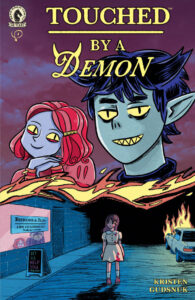 Touched by a Demon #1
Cartoonist: Kristen Gudsnuk
Publisher: Dark Horse Comics
Review by Tim Rooney
Ensign’s Log — Stardate 12026
As IDW’s Star Trek comics continue to expand, Ensign Avery Kaplan has enlisted here to keep a careful log!
Star Trek: The Last Starship #4
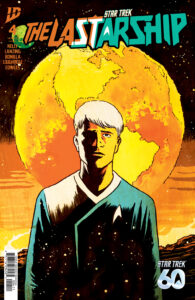 Star Trek: The Last Starship #4
Written by: Jackson Lanzing & Collin Kelly
Art by: Adrián Bonilla
Colors by: Lee Loughridge
Letters by: Clayton Cowles
Design/Production by: Neil Uyetake
The second chapter of Star Trek: The Last Starship opens with an excellent issue that hints at the potential the story possesses. While we get some brief scenes with Kirk and Jurati, this issue is focused mainly on Wowie (as suggested by the main cover).
The story is based around a solid science fiction trope: time dilation due to faster-than-light travel. While the static warp bubble generally protects Starfleet ships from this temporal distortion, the Borg’s transwarp technology doesn’t concern itself with time in the same way Federation technology does (or did).
This allows us to see Wowie’s relationship with his parents over the course of several decades, as they quickly age and he stays the same age. It’s an excellent use of the concept, and the art in particular rises to the occasion, specifically by using sequential graphic narrative visual techniques with aplomb to tell an affecting and interesting issue-long story. The coloring (and how it shifts over the course of the pages) is excellent, and Cowles’ lettering is reliable as ever.
While this issue feels complete in and of itself, it also leaves me hungry for more of the story. Although we’re still in the early days of the series, comparatively speaking, this journey seems more promising with each passing panel.
The Prog Report
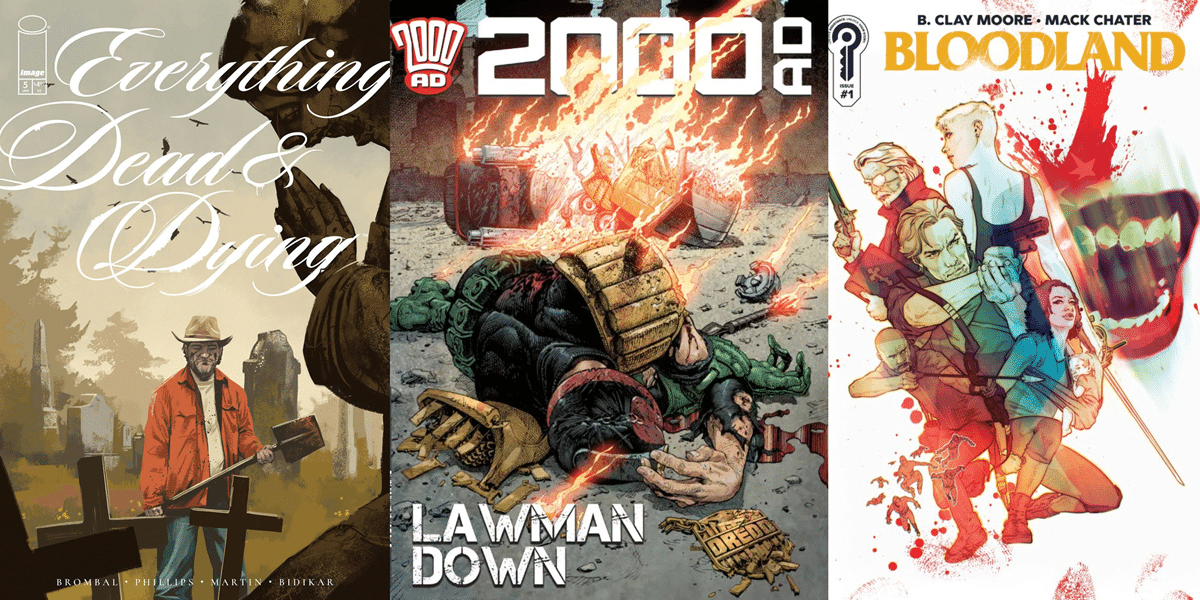
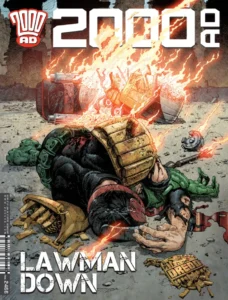
 2000AD 2466 (Rebellion): Throughout the two years and change I’ve been reading weekly, Azimuth has been a strip I’m always glad to see, and then sad to see when it wraps up again. This week we see Azimuth wrap up a quick mini-arc in three parts, written by Dan Abnett, illustrated by Tazio Bettin, colored by Matt Soffe, and lettered by Rob Steen. There’s an unpredictability to Azimuth — in its genre, its cheeky names, its thematic interests, and even the characters it centers — that makes it a great read in the week-to-week format. I’ve said this before, but Bettin’s work in Azimuth is also a real treat, keeping up wonderfully with the unpredictability and the tone-shifts of the scripting. Here’s hoping its back again soon. This week also saw a new Future Shock, which is always fun. This one was pretty well done, occupying the space where nostalgia and politics intersect. This, I think, is a much smarter way to tackle nostalgia than to tie it to goofy pop culture interests (as is often done), and it works decently here. This Future Shock is titled The State of Nostalgia, and it comes to use from writer Ned Hartley, artist Steve Roberts, and letterer Simon Bowland. Finally, the last thing to address is how the cover makes it look like Judge Dredd is dead, within a storyline titled Death of a Judge. And I won’t spoil that but I will tell you that your guess over whether he’s actually dead in this issue is probably right. This week’s cover (above) is by Cliff Robinson with colors by Dylan Teague. As always, you can pick up a digital copy of The Prog here. —Zack Quaintance
 2000AD 2466 (Rebellion): Throughout the two years and change I’ve been reading weekly, Azimuth has been a strip I’m always glad to see, and then sad to see when it wraps up again. This week we see Azimuth wrap up a quick mini-arc in three parts, written by Dan Abnett, illustrated by Tazio Bettin, colored by Matt Soffe, and lettered by Rob Steen. There’s an unpredictability to Azimuth — in its genre, its cheeky names, its thematic interests, and even the characters it centers — that makes it a great read in the week-to-week format. I’ve said this before, but Bettin’s work in Azimuth is also a real treat, keeping up wonderfully with the unpredictability and the tone-shifts of the scripting. Here’s hoping its back again soon. This week also saw a new Future Shock, which is always fun. This one was pretty well done, occupying the space where nostalgia and politics intersect. This, I think, is a much smarter way to tackle nostalgia than to tie it to goofy pop culture interests (as is often done), and it works decently here. This Future Shock is titled The State of Nostalgia, and it comes to use from writer Ned Hartley, artist Steve Roberts, and letterer Simon Bowland. Finally, the last thing to address is how the cover makes it look like Judge Dredd is dead, within a storyline titled Death of a Judge. And I won’t spoil that but I will tell you that your guess over whether he’s actually dead in this issue is probably right. This week’s cover (above) is by Cliff Robinson with colors by Dylan Teague. As always, you can pick up a digital copy of
 Column edited by Zack Quaintance.
Read past entries in the weekly Wednesday Comics reviews series or check-out our other reviews here!