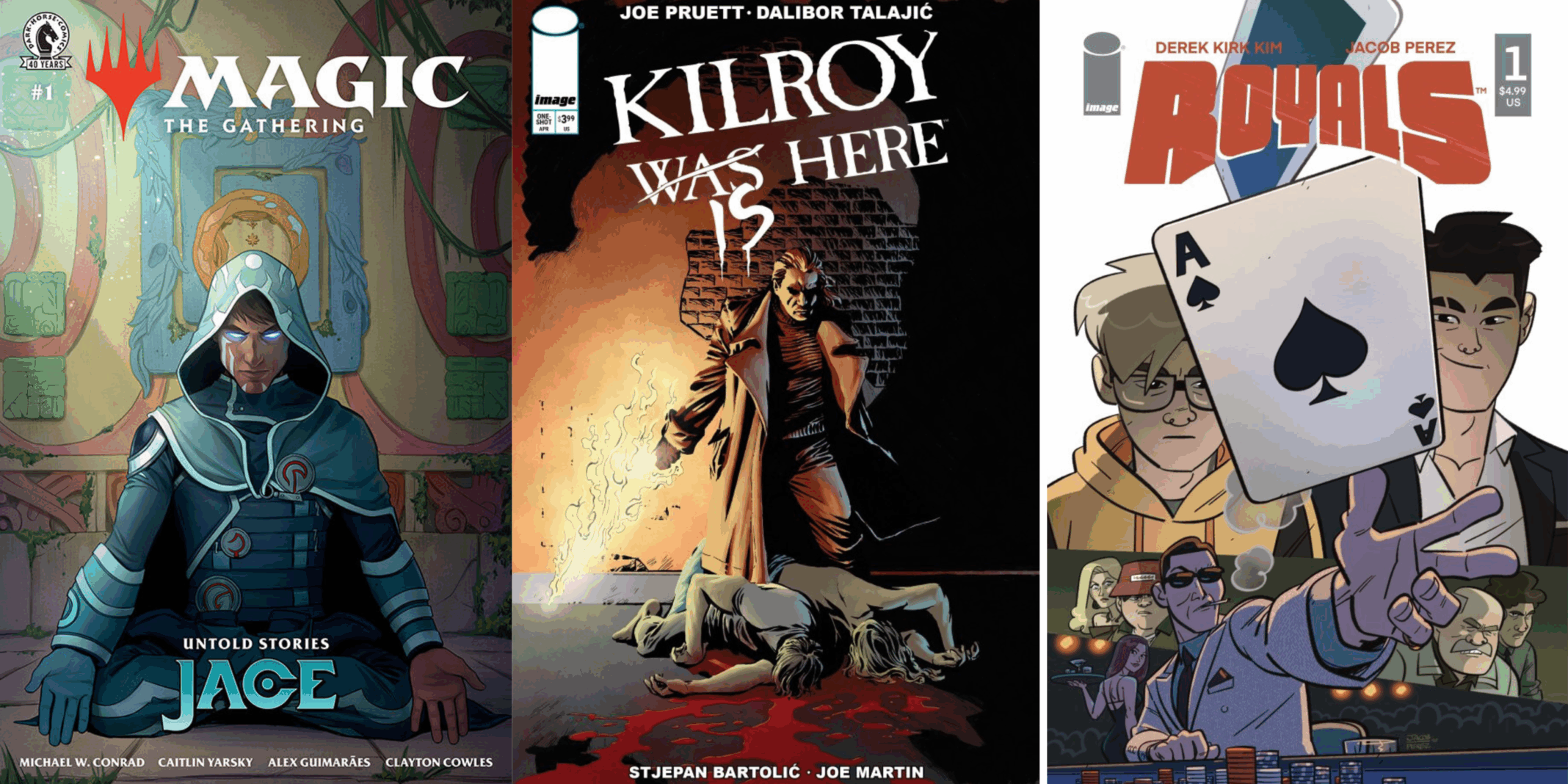

In this week’s Wednesday Comics column, we are all in on Royals #1, we are folding on Killroy Was Here, and more! Plus, The Prog Report!
 Royals #1
 Royals #1
Story: Derek Kirk Kim
Art/Letters: Jacob Perez
Publisher: Image Comics
Review by Zack Quaintance
There are a few story elements that just do it for me. Casinos as settings are always fun, providing as they do high stakes, the possibility for total oblivion, schemes, and faceless goons who can just show up whenever and start whaling the main characters. In the casino setting, poker is a lot of fun too, feeling like just a bit less of a game of chance than craps, blackjack, or slots, with a set of rules that feel custom-made for showing mettle and pitting characters against each other.
I’m also a big fan of stories about brothers, especially brothers who in adulthood are very different but clearly love each other and are trying to do something big by working together. Finally, I wouldn’t be writing and/or editing like four weekly comics columns for The Beat if I didn’t think superpowers weren’t a lot of fun in comic book stories.
Well, this week I got a book that combined all those things with Royals #1, which is scripted by Derek Kirk Kim (most recently of The Last Mermaid fame) and illustrated/lettered by Jacob Perez. So many of my favorite ingredients together don’t automatically make me like a book, though. In fact, there might be a higher bar when I come into a story like this, because I’ve seen (and appreciated) these things done so many times.
Fortunately, Royals #1 is a very well-executed comic book, one that I think is very much worth reading even if you don’t think casinos are interesting, don’t have a brother, and think superpowers are a bit hokey.
First of all, the superpowers thing is used more interestingly than superpowers often are in monthly comics. The powers really aren’t the point here. The brothers have a psychic bond, one where they can communicate silently and from a distance. In that way, the powers are more about enabling the heist elements and also metaphorically conveying just how close these two brothers are. They’re bonded by shared parentage and childhoods, as well as a literal mind link. It’s good.
Secondly, the casino setting really isn’t the point either. It’s colorful and tense, to be sure, but the real point is that two very different brothers are entangled in games of self interest, with their very different personalities complicating things as they go. It’s really just a fun, well-paced story that puts its leads in a lot of tricky situations right from the jump.
And of course, none of this works so well without Perez’s fantastic cartooning. This is my first real exposure to Perez’s work, and I’m immediately a fan. He’s got a great style with his people, one that maybe owes a slight debt to artists like Michael Avon Oeming, and he does a lot visually to emphasize the lead characters’ different personalities, even in the talking head panels.
Perez is also not afraid to hit us with great backgrounds, and his backgrounds are defeinitely great. Finally, he takes on lettering here as well, and it’s tricky business, given that he has to handle the brothers communicating telepathically. But the lettering in this book keeps things clear and simple, a great choice for a comic that moves so rapidly with its pacing.
Overall, I had a blast with Royals, and I’m excited to keep following this story. DC Comics has really exhausted this phrase, but you could even say, given the poker stuff, that I’m all in.
 Killroy Was Here #1
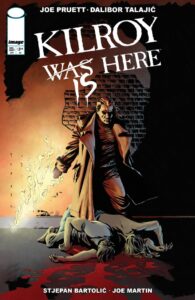 Killroy Was Here #1
Writer: Joe Pruett
Art: Dalibor Talajić
Colors: Štjepan Bartolić
Letters: Joe Martin
Publisher: Image Comics
Review by Clyde Hall
Writer Joe Pruett returns to the first comics character he ever created, one he hasn’t produced new material for since 1999, with this Kilroy Is Here one-shot from Image. As he recounts in the book’s afterword, Kilroy premiered at Caliber Comics in 1992 and had his own title there from 1995 to 1999. Image also collected a TPB of those earlier Kilroy tales into a 2006 volume. For fans of the series or the collection, this continuation of the Kilroy chronicles is likely a must-read based on concept alone.
As an introduction to that concept and to the Kilroy character, this stand-alone may be a more difficult sell. The beginning sets a mood, making an attempt at eerie foreboding in lieu of action which has already occurred offscreen. And honestly, the establishing dialogue which follows is a lot. In fact, the antagonist makes a point of telling Kilroy he’s pretentious, and that ain’t wrong. Main character and opponent verbally hash that out for four pages meant to intrigue us regarding who and what they are before we adjourn to another conversational scene trying for more of the same.
This approach may work for those familiar with Kilroy and the previous adventures. For others, these panels and the accompanying stilted bits of dialogue require patience. Especially when second scene folds into a third with…yes, more discussion tugging away slowly at the main character’s nature, purpose, and the pantheons of preternatural forces surrounding him.
In short, Kilroy isn’t entirely human. Or perhaps not even partially so. Ageless, timeless, he’s been in the company of angels, both the Host and Fallen varieties. That is, until his true nature was hidden from him and he began enacting retribution for the deaths of innocents. Never able to prevent the killing but cursed to appear in the aftermath and exact vengeance, strike karmic balance, or accomplish something ranging between the two.
Pruett does deliver a showdown clash in the final act and it’s a conclusion that begs a follow up. Its success is that, despite a magnifying glass, partly cloudy day, and tissue paper slow burn, the story still hooks enough based on concept. With pull enough to invest us in another issue, though maybe not a miniseries.
Dalibor Talajić and Štjepan Bartolić on art and colors succeed against the odds in bringing satisfying layers of moodiness to the pages. They create for Kilroy a misty, moonlit landscape only granted sepia interruptions via wan lamplight. All of which makes the supernatural powers manifesting in crackles and fiery swords impressive and effective.
The bottom line is, Kilroy Is Here looks better than it reads. And this surprised me because Joe Pruett has substantial writing chops. He’s worked for every major comic company and several independents. He has multiple award nominations as a writer and editor. He received an Eisner for Best Comics-Related Book in 2007 for his work on The Art of Brian Bolland.
In the mentioned Afterword, Pruett may have edged close to the truth about returning to his first creation. He muses that, while it’s said you can’t go home again, he hopes that isn’t true so far as Kilroy’s concerned. The final product here might have received top marks as a late-1990s comic read. It may still resonate nostalgically for fans of the series back then. But it may also have trouble finding a new audience in 2026.
Magic, The Gathering: Untold Stories – Jace #1
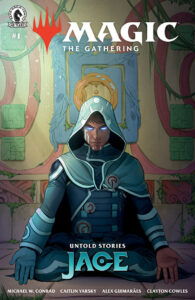 Magic, The Gathering: Untold Stories – Jace #1
Writer: Michael W. Conrad
Artist: Caitlin Yarsky
Colorist: Alex Guimaraes
Letterer: Clayton Clowes
Publisher: Dark Horse Comics
Review by Jordan Jennings
Magic: The Gathering: Untold Stories– Jace #1 is a continuation of the latest Magic: The Gathering comic project that focuses on fleshing out various backstories of key characters from the game. This time, we get a look at Magic’s mysterious planeswalker posterboy- Jace Berlen. Jace’s importance to both the story and the card game itself cannot be understated. The official font of Magic: The Gathering is called Berlen, for example. So, it is fitting we get a comic focusing on Jace’s backstory. See, in Magic, Jace is something akin to Marvel’s Wolverine. He’s a mysterious character with a mysterious past that he can’t remember. For a character who calls himself the “Mind Sculptor” Jace sure has his mind sculpted a lot.
Background aside, the issue focuses on Jace’s time on the plane of Ixalan as he begins to regain his memories. As such, the issue is mostly told through flashbacks. Writer Michael W. Conrad does a solid job interweaving Magic lore throughout the plot.There are references to several key Magic plotlines up to this point, but not in a way that reads like a wikipedia article. Conrad wisely frames the narrative with Jace and Vraska’s romance. Their romance is deep, especially for a fictional world set around a trading card game. Conrad’s decision to cast Tezzeret as the villain of the story is a welcomed one. Tezzeret is a dark mirror of Jace in a lot of ways with a corrupt pursuit of knowledge and adventure.
The art by Caitlin Yarsky is successful, but there are times I feel like they are playing it safe. The page layouts are well constructed and figure work is well done, but I found myself wanting to see more of Jace’s illusionary powers on display or to see the Blind Eternities rendered with some sense of scale. However, for the lack of pushing the limits there were several visual callbacks to famous Magic cards that really worked well in the comic. I loved seeing the millstone reference when Jace is trying to recall his memories.
Honestly, Magic: The Gathering: Untold Stories– Jace #1 is clearly made by people who have a love of the game. There are some deep cuts to the lore and cards throughout. Now, does this make the comic an easy read for the uninitiated? Probably not. There is no context in the comic to establish the era of the story or even an explanation of some of the principal cast members. That said, as a near life-long fan of Magic,I enjoyed this issue. This comic is for my fellow Vorthos aka (those who are fans of the Magic story.
The Prog Report
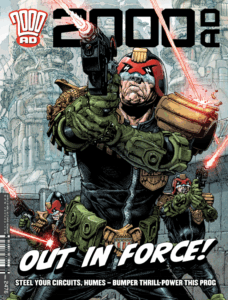
 2000AD 2476 (Rebellion): This week brings us a new bumper issue, loaded as always with jump-on points and a few extra pages. As bumper issues go, this one felt a bit less exciting than some of the others in the recent past. The two highlights for me were Brink — the one story in here that’s not a jumping on point at all — and Red Dragon, a one-off strip that ties back into a series that has concluded. The Red Dragon story, however, was fantastic. It’s written by Rob Williams, with art by Steve Yeowell and Patrick Goddard, colors by Dylan Teague, and letters by Simon Bowland. Essentially, it fills in some of the gaps from the concluded series, and it’s done well. It also ends in a way that suggests there might be some more gaps to fill in as well, which I would welcome, as I’ve enjoyed every chapter of this one to date. This week’s cover (above) is by Cliff Robinson with colors by Dylan Teague. As always, you can pick up a digital copy of The Prog here. —Zack Quaintance
 2000AD 2476 (Rebellion): This week brings us a new bumper issue, loaded as always with jump-on points and a few extra pages. As bumper issues go, this one felt a bit less exciting than some of the others in the recent past. The two highlights for me were Brink — the one story in here that’s not a jumping on point at all — and Red Dragon, a one-off strip that ties back into a series that has concluded. The Red Dragon story, however, was fantastic. It’s written by Rob Williams, with art by Steve Yeowell and Patrick Goddard, colors by Dylan Teague, and letters by Simon Bowland. Essentially, it fills in some of the gaps from the concluded series, and it’s done well. It also ends in a way that suggests there might be some more gaps to fill in as well, which I would welcome, as I’ve enjoyed every chapter of this one to date. This week’s cover (above) is by Cliff Robinson with colors by Dylan Teague. As always, you can pick up a digital copy of
 Column edited by Zack Quaintance.
Read past entries in the weekly Wednesday Comics reviews series or check-out our other reviews here!