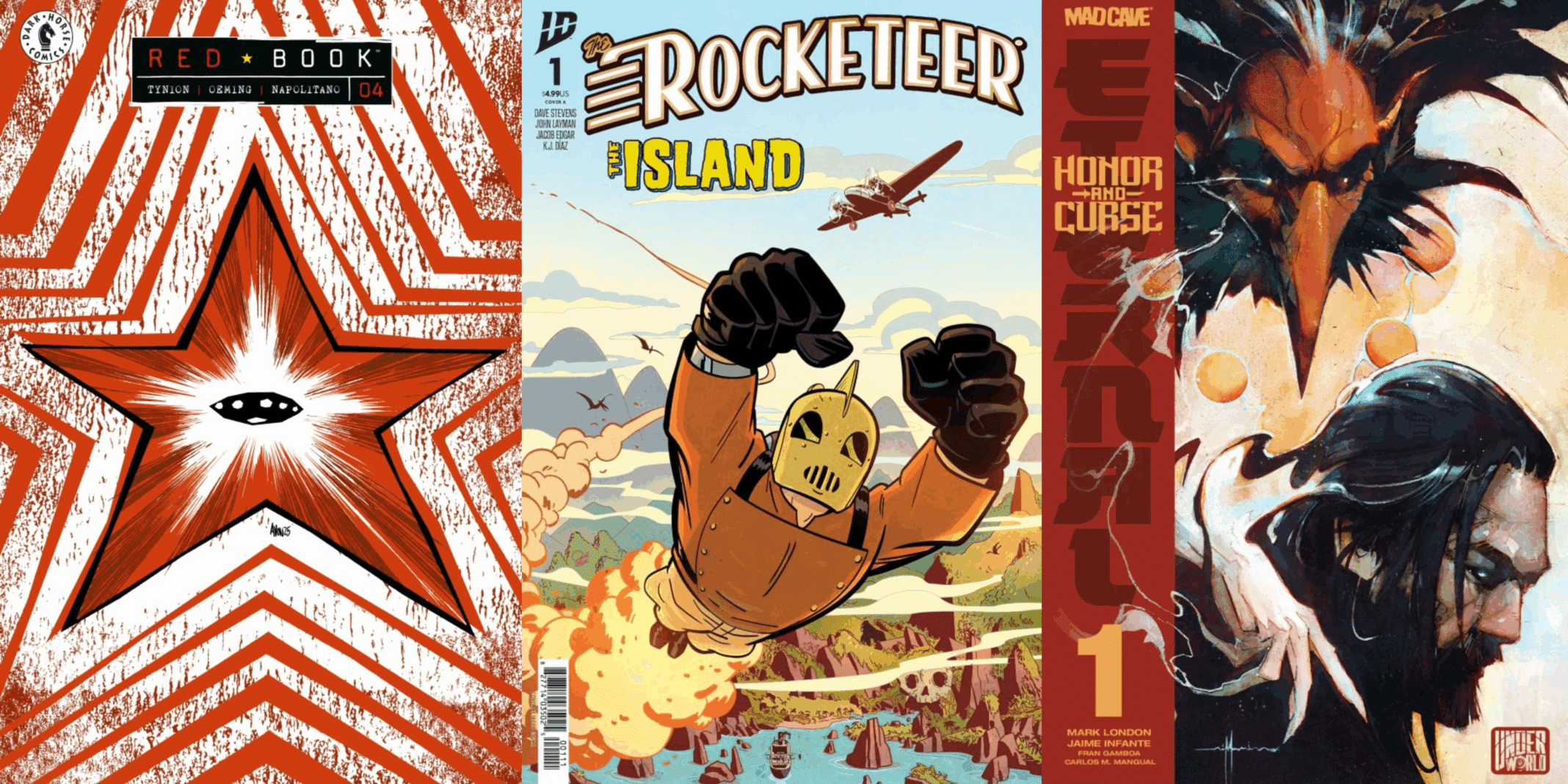

In this week’s Wednesday Comics column, we take a trip to The Rocketeer — The Island #1, we take stock of our mind state with Is Ted OK? #1, and more! Plus, FOC Watch and The Prog Report!
 The Rocketeer — The Island #1
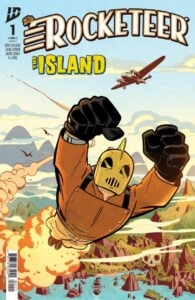 The Rocketeer — The Island #1
Based on Story By: Dave Stevens
Writer/Letterer: John Layman
Artist: Jacob Edgar
Colorist: KJ. Diaz
Publisher: IDW Publishing
Review by Jared Bird
The Rocketeer, the cult favorite superhero originally created by Dave Stevens, returns in a brand new adventure based on an unpublished outline by Stevens. Sent on a dangerous search and rescue mission in the attempt to locate the missing pilot Amelia Earhart, The Rocketeer has to balance uncovering one of the century’s biggest mysteries alongside winning back the woman he loves.
In 1933, when he was still a pilot himself, Cliff Secord raced against Amelia Earhart and lost. Now, five years later, and one year after she mysteriously vanished over the Pacific ocean, Secord is recruited in an attempt to find her. Initially hesitant, he joins in on the promise that his girlfriend Betty is also traveling to the region, and he’ll be able to win her back while she’s there. Along his journey, he’s somewhat bafflingly joined by other comic characters from the public domain, most notably Elzie Crisler Segar’s Popeye the Sailor Man and Herge’s Tintin (alongside his faithful dog, Snowy). Their inclusion may be justified by the long-term overarching narrative, but at least within the limitations of the first issue, it’s jarring and completely took me out of the narrative, a seemingly random bit of fanservice with no real rhyme or reason behind it. When the story is focusing on the characters related to Cliff directly, and not coming in from elsewhere, is when it’s at its pulpiest and strongest, including a love square and some good old fashioned fast-paced Rocketeer antics.
The script, adapted from Stevens’ outline by John Layman, is solid throughout. At its best, it has the pulpy adventure tone locked down to a science, with wit and humour and efficient storytelling. At worst, it’s clunky in its deliverance of fan service. There is also the question of using a real, formerly alive person at the crux of the narrative; whilst so far it seems like a loving ode to Earhart, that may change, especially given how much of the narrative is questioning whether or not she was some kind of spy. That’s not to say historical fiction has no place here, it’s always been an element of The Rocketeer, it’s just an interesting tightrope the series will have to walk.
Jacob Edgar’s artwork is by far the highlight of this first issue, bubbly and energetic and stylish in the best way. He captures the bright, explosive energy of the franchise well and leans into the old-school cartoon-like elements of it all in the best way, visually nodding to series such as Archie when handling the more comedic or romantic moments in a stroke of genius. Colored by KJ Diaz and lettered by Layman, the entire visual element of this comic pops off of the page.
Overall, The Rocketeer: The Island #1 is a fun but flawed first issue to the latest incarnation of the character. Held down by some clunky fanservice, it’s at its best when it focuses on being a fun pulp narrative with Cliff and his supporting cast, going on an explorative adventure to somewhere entirely unknown and new. Whilst it’s unclear yet what direction the story will go in, and whether it will succumb to some of the historical elements at play, there’s sure to be more exciting, action-packed issues to come.
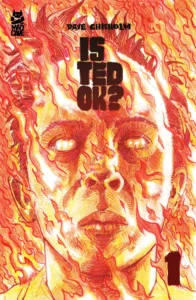
Is Ted OK? #1
Cartoonist: Dave Chisholm
Publisher: Mad Cave Studios
Review by Tim Rooney
After Spectrum, Dave Chisholm’s sci-fi music odyssey with writer Rick Quinn, I will follow Chisholm anywhere he goes. That series was one of 2025’s best titles and Chisholm’s new solo book (he writes, draws, colors, and letters every page) Is Ted Ok? is already shaping up to be a worthy follow up. Set in a dystopian future, the title’s Ted works at megacorporation Ayn-Styne, where he dutifully churns out marketing posters, stopping only occasionally to doodle the same picture over and over. Every day he works on his own, speaking to no one, his headphones pumping the same classical song on repeat. As he leaves his office, a voice reminds all employees not to fraternize with other employees so as not to diminish efficiencies. Ted’s only friend is a stray cat.
Watching over Ted from afar is Sarah, who works for the company to keep an eye on select employees and flag anyone who might potentially pose a danger to themselves or others. Sarah, keeping a constant watch on Ted from cameras that track him in his office, throughout the city, and even in his home, worries about Ted’s mental state and decides to break a few rules to try to help him.
There’s a lot going on in this first issue, which opens as a very intimate story of isolation and digital estrangement and slowly unravels itself into something complex and otherworldly beyond the standard scifi trappings. Chisholm’s art is gorgeous and lovingly hand-rendered. The use of colored pencil grants a humanist softness to Ted’s cold and rigid world. It defies the conventional polished sheen of modern comics art, directly at odds with the hyper-corporatized world that Chisholm creates. It reminds us our experience is being mediated by a creator, drawing attention to the artificiality of the work we hold in our hands. It adds to the dissociating and surreal mundane horror that so oppressively dominates Ted’s every moment—whether asleep or awake.
It’s easy to identify with both Ted and Sarah as they are overwhelmed with surveillance and propaganda. Ted waking from a dead sleep in terror and rage feels too real as we are reminded of all the muck we live through on a daily basis. Chisholm peppers in small details to tap into contemporary social and political issues that grant a dark and recognizable reality to this dystopia. And as he leads us on throughout the book, he constantly forces us to question the reality of what we see. Chisholm makes the subtext and themes literal text as he plays with form and structure with stunning results, particularly in this issue’s breathtaking climax.
Is Ted Ok? #1 is a gripping, tense introduction and the best debut so far this year. The kind of comic whose narrative is propulsive and engaging in large part because of the specific ways it uses the medium to tell its story. It is comics at their best.
Red Book I #4
 Red Book I #4
Writer: James Tynion IV
Artist: Michael Avon Oeming
Letterer: Tom Napolitano
Publisher: Dark Horse Comics – Tiny Onion
Review by Jordan Jennings
James Tynion IV and Michael Avon Oeming latest series exploring the paranormal events and the various governmental efforts to cover them up concludes this week with Red Book #4. Red Book has served as a companion piece to the previous Blue Book series by the same creative team. The difference being that instead of focusing on the US Government’s own cover-ups and paranormal stories, Red Book focuses on how communist countries like China and the former USSR handled their close encounters of the third kind.
The narrative of Red Book is a free-flowing stream of stories and accounts of alien encounters ranging from the 1950’s all the way to today. The final issue is no different with the bulk of issues detailing the events around Xiaoshan Airport in China on July 7th, 2010. The rest of the issue ends up coming together to form the thesis of the series and in the process help the series stick the landing. While I appreciated the sprawling narrative, the lack of a singular focus point or even a framing device made most of the series feel scatterbrained at times. The ending transforms the comic into a narrative being shared with the reader by a little gray man in black. On top of that new wrinkle, the narrative being shared becomes less about these various encounters and more about how the governments of the world, be it Western or Eastern tend to use UFOs to fit their needs. There is a lot of effort to set up a comparison of the similarities and contrasts of differences between the two governmental ideologies. Tynion and Oeming weave these tales together in a satisfying and engaging way throughout the series that when the twist hits, it all comes together with a beautiful and singular focus.
The star of the issue is Oeming’s art. Oeming leans heavily on communist style propaganda iconography coupled with stark surrealism to hammer home the supernatural bizarreness of it all. Oeming manages to make the most mundane congressional hearings seem absolutely out of this world impressive. The page construction and layout complements the stream of consciousness style of story telling. How the page effortlessly travels from one panel to another all while overlaid on top of another is just breathtaking. Combine that with Oeming operating under an intentionally limited monochromatic color palette and you have yourself some of the best art in comics today.
Red Book #4’s experimental storytelling and art may make it difficult for some readers. I insist that you still give this book a chance. It is delightful, weird, and thought provoking. I am admittedly the target audience for the book given that I am a sucker for all things paranormal and fan of Oeming’s art style. I think most readers will find something to love about this series, too, if they give it a shot. I highly recommend checking this one out.
FOC Watch
The below title is currently available for pre-order at your local comic shop!
 Honor & Curse: Eternal #1
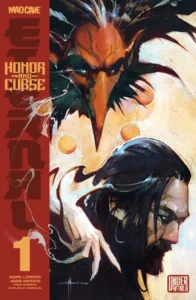 Honor & Curse: Eternal #1
Writer: Mark London
Artist: Jamie Infante
Colorist: Fran Gamboa
Letterer: Carlos Mangual
Publisher: Mad Cave Studios
Due Out: March 25, 2026
Review by Zack Quaintance
Honor & Curse: Eternal #1 is a new comic from Mad Cave that has a couple of continuity connections, mainly to previous volumes of Honor & Curse, as well as the publisher’s ongoing interconnected Underworld series of comics. But you don’t really need to know anything about either of those to enjoy this book. At its core, Honor & Curse: Eternal #1 is a fast-moving, gritty action-adventure comic.
Fans of Valiant’s Eternal Warrior will absolutely love this book, which feels like that property but with connections to feudal Japan. I think Valiant is an apt comparison as well, because these new Underworld series really do feel like Valiant of the 2010s, when that publisher was putting out a number of loosely-connected must read comics.
Honor & Curse: Eternal is great though, and I really think Mark London deserves credit for how much Mad Cave — as well as the books he writes himself — have grown in the last decade-plus. It’s very impressive.
The Prog Report
 2000AD 2471 (Rebellion): This week’s mag sees a new story start in Judge Dredd: Climate Crisis, by writers Rob Williams and Ned Hartley, artist PJ Holden, colorist Jack Davies, and letterer Annie Parkhouse. It’s an intro chapter, so kind of hard to tell what this story is getting at yet, but it’s got face-changers, weather control, and disaster, so all that is nice. Of the other strips, I thought Herne & Shuck: Power Trip was fairly strong, or maybe I just like King Arthur to be a rascal (spoilers). That one is by writer David Barnett, artist Lee Milmore, colorist Gary Caldwell, and letterer Annie Parkhouse. Finally, Terror Tales: Fountain of Youth was a fun short comics take on the Tom Hanks movie, Big, which I award extra points for having a main character named “Zack” (my name too!). That strip was by writer Andi Ewington, artist Mike Walters, and letterer Rob Steen. This week’s cover (above) is by Cliff Robinson with colors by Dylan Teague. As always, you can pick up a digital copy of The Prog here. —Zack Quaintance
 2000AD 2471 (Rebellion): This week’s mag sees a new story start in Judge Dredd: Climate Crisis, by writers Rob Williams and Ned Hartley, artist PJ Holden, colorist Jack Davies, and letterer Annie Parkhouse. It’s an intro chapter, so kind of hard to tell what this story is getting at yet, but it’s got face-changers, weather control, and disaster, so all that is nice. Of the other strips, I thought Herne & Shuck: Power Trip was fairly strong, or maybe I just like King Arthur to be a rascal (spoilers). That one is by writer David Barnett, artist Lee Milmore, colorist Gary Caldwell, and letterer Annie Parkhouse. Finally, Terror Tales: Fountain of Youth was a fun short comics take on the Tom Hanks movie, Big, which I award extra points for having a main character named “Zack” (my name too!). That strip was by writer Andi Ewington, artist Mike Walters, and letterer Rob Steen. This week’s cover (above) is by Cliff Robinson with colors by Dylan Teague. As always, you can pick up a digital copy of
 Column edited by Zack Quaintance.
Read past entries in the weekly Wednesday Comics reviews series or check-out our other reviews here!