
A year has now passed since Diamond Comic Distributors announced they were filing for Chapter 11 bankruptcy on January 14th, 2025. An event which once seemed unthinkable – and once thinkable, catastrophic – has come to pass and as we look out at the industry, Diamond Comics is no more. Only some warehouses and a lot of lawsuits remain.
From those early confident “business as usual” days, what unfolded has been a comedy of errors and in-fighting that no one could have foreseen. As the scraps of Diamond went up for auction, several suitors appeared – Alliance Entertainment, Universal Distribution, and Ad Populum. Both Alliance and Universal had been interested in Diamond prior to the bankruptcy: the company had been seeking a buyer late in 2024, but the underlying business was so unstable that no one would buy it for the price they wanted.
Instead, a bankruptcy auction led to a baffling series of events: first Alliance was named the winner, but then Diamond rejected that bid and named a joint bid by Universal and Ad Populum the winner. Then Alliance sued. Then the court named Alliance the winner after all. But then Alliance decided they didn’t want Diamond after all. Then Alliance sued Diamond and Ad Populum again. Then Diamond chose the Universal/Ad Populum-Sparkle Pop bid. On May 15th the sale became final and mass layoffs and business closures began at Diamond. Then Alliance began hiring ex-Diamond employees and Ad Populum sued Alliance for stealing trade secrets. Then nobody got paid. Then Dynamite and New Diamond went at it. (And later on, Ad Populum would sue Dynamite.) And then, on June 25th, old Diamond announced a plan to sell off consignment inventory to pay off their debts and things REALLY went crazy.
What a time to be alive.
I can truthfully say there was never a dull moment at Stately Beat Manor for that six month period. The number of phone calls, DMs, emails and other communications that I had with participants, observers and victims was endless. And edifying.
A lot of things DIDN’T happen. Tons and tons of publishers did not go out of business. In fact, comics had one of their best years of the century sales-wise.
Now when I say tons and tons of publishers, I mean the major publishers that make up the top 20 of the imaginary industry sales charts. Diamond carried hundreds of very small publishers, some of which were just a person with a garage and a dream, and what has become of most of those is an open question. A lot of them had sporadic publishing schedules to begin with. I’m sure we lost some friends along the way, but the net result has mostly been consolidation – Ablaze buying NBM, Massive Indies – but as far as I can recall, the only company that specifically announced that they were shutting down due to Diamond was Blood Moon. With all the legal wrangling there will likely be more companies falling by the wayside, and it’s very clear that small indie comics publishers are definitely the ones who took it in the shorts from the Diamond Debacle. Which is ironic, because Diamond as a big monopoly was thought to be promoting the biggest brands like Marvel and Dc. It turns out they were also floating an entire sub-culture of micro-publishing.
Another thing that didn’t happen was a lot of comics shops shutting down. Yes there were some losses and tough times along the way, but not a mass culling such as some had predicted.
Things that did happen: Lunar picked up a lot of publishers, including Dynamite, Mad Cave and Vault and had some growing pains but managed to ramp up their operations to keep pace with the influx of new publishers. PRH picked up DSTLRY. Universal entered the US market, with DC and Dynamite to start, and they bought Free Comic Book Day to keep promoting comics. And several smaller entities opened up to distribute those small publishers we alluded to above: Massive Indies, Philbo Distribution, Power Pulp, and most recently, CRWN Studios. Will any of these become major players? It’s too early to tell.
Other business units had different fates. Diamond Select Toys went away, as did most of Diamond’s other collectible businesses, but Diamond UK sailed right on through without much turmoil.
The biggest loss of all was one that most people didn’t think of when they complained about the Diamond monopoly: the information infrastructure of the comics industry. No more 400 page Previews catalog listing everything coming out. No more Previews World offering metadata and release dates. No more Comic Shop Locator. No more Diamond Retailer Summits.
The Previews World website is still up and a ghostly dropdown menu shows the world that was.
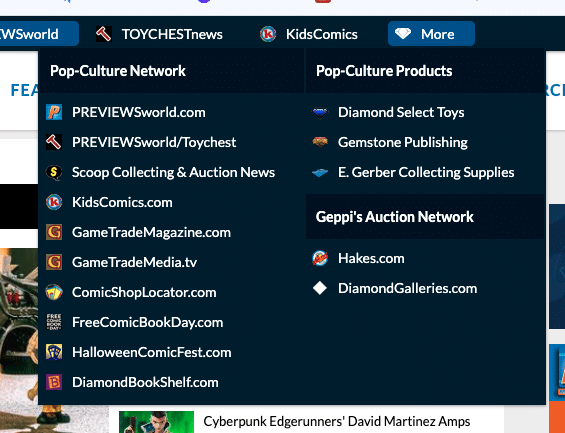
Clicking on one at random gets an insecure connection warning. Diamond’s website was extremely vulnerable long before it went bankrupt.
All of these things were bedrock tools that everyone in the industry used. Once again, over the years of its monopoly, countless comics industry people complained about Diamond, including many who would later mourn its loss. For a time, it seemed too big to fail, but the foundation was never as solid as we thought.
While the loss of Diamond as the central information storehouse of comics wasn’t planned for, a lot of people are trying to fill the gap with their own takes on catalogs and comics locator services. I know of at least three entities working on release date resources, and I’m sure there are more.
As bleakly amusing as this all is, the outcome as it stands right now, is an uplifting one. The unthinkable happened – Diamond Comics went bankrupt – and the comics industry had one of its best years in modern times. The state of the comics is strong.
But a lot of pieces still have to be picked up. There’s still that consignment inventory. Publishers very much want to get it back, not only to get their inventory but to prevent it from flooding the market with cheap product.
There’s still the matter of what happened to Sparkle Pop/Nu Diamond. What was left of Diamond and its last remaining employees including President Chuck Parker, was shut down on December 31st. Sparkle Pop doesn’t respond to press inquiries but I understand that they have been doing what they normally do when they buy a bankrupt company: liquidating the stock that they did own. Other Diamond brands are now being run as Diamond Select Brands under Enesco, a gift company:
Separately, Diamond II also sent a message alerting customers that it is partnering with Enesco for future marketing communications related to Diamond Select Brands, which will come from Enesco email addresses. Ad Populum company Enesco is a wholesaler serving over 44,000 customers worldwide in the giftware and home and garden décor industries. Enesco systems will be used to modernize Diamond processes, according to the message. Based on the Diamond Daily messaging, it appears that Diamond Select Brands will include all of the business formerly conducted by Diamond II.
The business of the bankruptcy trudges along, now converted to a Chapter 7 final liquidation. The easy to navigate and expensive Omni Agent Solutions website which once housed all the filings of all the lawsuits is no more – CORRECTION It’s still up but no filings past December 31. (They’re still available here.)
There is a tiny, but ironic update to all the above. A new trustee has been named by the court to oversee the Chapter 7 process, Morgan W. Fisher. And a lawyer has been assigned to represent the trustee, Zvi Guttman. But a tiny hitch with this: Guttman once represented NECA, a creditor in the bankruptcy, and another company owned by Ad Populum, in these bankruptcy proceedings. According to an affidavit by Guttman, his employment was merely procedural.
Other than as set forth in this paragraph, neither I nor the Firm have any connection with the debtor, creditors, any other party in interest, their respective attorneys and accountants, the United States trustee, or any person employed in the office of the United States trustee, and represent no adverse interest to the debtor or the bankruptcy estate. (a) I serve on the Panel of Chapter 7 trustees in the District of Maryland for over thirty (30) years and in that role, I had extensive interactions and involvement with the Office of the United States Trustee in Baltimore. I have also represented Trustee Fisher in other unrelated cases. (b)
Early on in this case I served as local counsel to NECA LLC (f/k/a National Entertainment Collectibles Association, Inc.) whose affiliates include WizKids/NECA, LLC, Sparkle Pop, LLC, and Kidrobot, LLC. I never spoke to the client or any of its affiliates. I received no confidential information. Rather, my services consisted of the following: (i) I filed Motions for Pro Hac admission of the client’s New York counsel (ii) I made a few phone calls in an effort to put New York counsel in touch with committee and Debtor’s counsel, (d) I communicated with the courtroom deputy to assist New York counsel in attending a telephonic hearing (that did not take place). The former client has waived any perceived conflict.
While the lawyer for the Chapter 7 having also worked for NECA seems troubling given the charges of “the fix being in” along the way, the truth is probably much simpler: there aren’t that many qualified lawyers who are allowed to appear in Maryland bankruptcy courts.
Indeed one thing that I have learned in covering this story is that the world of bankruptcy administrators, trustees and courts is not that big. Kind of everyone knows everyone. Guttman’s statement is proof of that.
So anyway, one year later, there are still some matters to be solved.
What happened to the money? I was talking about this with my colleague Brett Schenker as this solemn anniversary approached, and he pointed out that a lot of money had changed hands. Diamond now has NO operating capital, hence the Chapter 7, but it wasn’t always that way. They borrowed $41 million from Chase. They sold DCD, DST and Alliance Games for around $50 million. There was some cash on hand to begin with and sales up until May 15th. Of course they had to pay Chase back, and fees for lawyers and other administrators come to about $16 million according to the latest filings, and they continue to be paid. Most likely it was that “business as usual” period – salaries and leases – that ate up the rest of the money. Creditors have yet to see a dime aside from some money that Sparkle Pop sent them after improperly selling consignment inventory.
Unfortunately, lawyers making all the money while creditors get nothing is quite common in bankruptcies. It’s part of our wonderful system of capitalism
Why did the people running the bankruptcy (Getzler Henrich and Raymond James) do everything they could to reject the $80 million bid by Alliance Entertainment in favor of the $50 million combined Universal/Sparkle Pop bid? This remains the central mystery of all of this. Alliance, mostly known as a music and media distributor, has been quite open about wanting to move into the collectibles space, and they have hired a bunch of ex-Diamond employees and put out a catalog and continued on with that plan. It seems plausible that if they had won the bid, there would have been layoffs and consolidation, but Diamond would have continued on in some form. Instead, there’s been nothing but chaos and confusion and Chapter 7.
I’ve asked some of the smartest people in the business this question (including ex Diamond employees) and no one ever has a solid answer. In my mind, three theories have emerged.
- Once Alliance found out that Diamond no longer had a contract with Wizards of the Coast, they would have cancelled the sale anyway. The bankruptcy team knew this, and went with the other bid. This is the root of the Alliance vs Diamond lawsuit, which alleges Alliance was kept in the dark about the end of the WotC contract. This theory has been advanced to me by some very knowledgeable people and seems to be the most supported.
- In a sort of Occam’s Razor theory, maybe the bankruptcy team always planned to sell the consignment inventory and knew that Sparkle Pop would go along with it but Alliance would be less likely to? This is a theory that I came up with after a lot of reading and talking, and a few other people circled around. It remains just a thought experiment to solve a perplexing situation.
- There was some kind of sneaky collusion along the way. I examined some of the evidence for this here, but the evidence is mostly people alleging that there was skullduggery. Court documents show that the bankruptcy team believed Alliance had withdrawn their $80 million bid, but Alliance’s lawyer claims that they were still ready to negotiate. Whether it was a plan or just something that slipped between the cracks, something weird occurred on that fateful day. And maybe we’ll never know what really happened.
And so we pass the one year mark, and sadly, no end is in sight. I’ve looked up comparable bankruptcies and they can drag on for years. This one most likely will. But publishers and distributors who remain have proven surprisingly nimble. They’ll all be reuniting next month at the annual ComicsPRO meeting, and I’m sure I’ll have an even fuller picture of where this all landed once everyone is in the same room.
I’ll leave you with a couple of links. Brett Schenker has his own look back at The Year in Diamond Bankruptcy, and he even managed to get it out on the actual anniversary.
I also asked for some thoughts about the lessons learned on Facebook, and there are some interesting answers, but mostly people saying “what a cluster.” I won’t quote them here since I didn’t post it with that plan, but I will give the last word to comics veteran Chuck Rozanski, who always his his own unique take on things, and he has some sage words of advice:
Never, EVER, give other people your stuff on consignment. I see people consigning every day without the slightest realization that they have only limited recourse to get their stuff back, or any legal guarantee that they will ever get paid. Even if you have a filed UCC-1, as the Diamond fiasco has clearly shown, you may end up being just another unsecured creditor if the person and/or company with whom you have a trusted relationship gets into financial difficulties. In effect, the minute that the consignor gains physical possession, your assets are encumbered by their pre-existing secured debt. They can also simply sell your assets, and leave you with no recourse but ruinous litigation. After several very negative outcomes early in my career, I categorically refuse to consign items, or to accept consignments from others.







I will say that without the monthly Diamond catalog it has been a hunt and search for sites that show the comics and books coming out. When I first started getting the catalog it showed what DVDs were coming out then that ended. DC Comics, IDW and Marvel and some others publish their own comic previews I get through the comic shop but I have found some online groups showing what is coming out. A weekly comic lister shows what is coming in two weeks also helps.
“The biggest loss of all was one that most people didn’t think of when they complained about the Diamond monopoly: the information infrastructure of the comics industry.”
Shortly after AdPop took ownership of Diamond, laid off a bunch of people, and saw the print publishers flee pretty much en masse, I was asked to explain to higher ups why Pullbox wouldn’t work any longer. My answer, basically, was this: “It works from the data we have, and when we had data from the publishers Pullbox would work. We even maintained DC data, even though they left us in 2020. And while we could maintain data in our system for the PRH publishers, etc., it doesn’t make any business sense. We’d be spending time and money and not making any money from it.”
There was some discussion about continuing PREVIEWS as a distributor-agnostic publication when AdPop let the PREVIEWS team go in September. Any vendor who wanted to be in a catalog for consumers could buy space, Diamond would package it, and PRH and Lunar would be able to sell the catalog to their accounts. This would have partially dealt with the data issues that made Pullbox and PreviewsWorld useless, but it never got far enough for anyone to run the numbers on whether it was possible.
Chuck Parker, when he let me go, said that Steve Bieg, the AdPop finance guy who Chuck reported to, said that AdPop saw value in the catalog, but they still had to let the team go because it was a tough market and a difficult business situation.
Meanwhile, over in the library space, Baker & Taylor, one of the largest distributors to the book trade, ceased business in January, leaving many libraries scrambling for other distributors. Of particular concern: B&T’s in-house cataloging service, which reduced the workload for many library systems.
Comments are closed.