
This week we look at the return of Marvel’s Golden Guardian of Good in The Sentry #1 by Paul Jenkins and Christian Rosado. Our rapid rundown looks at the final issues of Black Panther: Intergalactic and Planet She-Hulk, while also peeking into The Ultimates. So buckle up, we’re in for a ride this week!
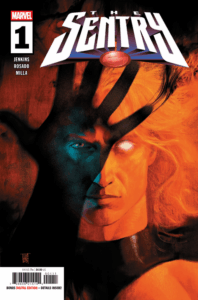 The Sentry #1
Writer: Paul Jenkins
Artist: Christian Rosado
Colorist: Matt Milla
Letterer: vc’s Joe Carmanga
The Sentry, the 2000 mini series by Paul Jenkins and Jae Lee, remains one of the most unique characters to enter modern Marvel. Created by Jenkins and Rick Veitch, the original series inserted the “lost” Superman-like Robert Reynolds aka The Sentry into the history of the company’s characters. Then he revealed them as both its greatest hero and its worst villain, The Void.
That internal conflict revisited the idea that Marvel heroes are their own worst enemies. It returned a psychological complexity long missing from that stable of heroes. As much good as The Sentry does in the world, The Voice must do an equal amount of evil.
Jenkins once again returns to the character, this time with artist Christian Rosado in tow, revisiting that idea. Balance was always the key to this character and Robert Reynolds greatest struggle was not letting either side win. Now we learn The Void acts on his own, threatening the Kingpin, and causing disasters around the world.
The star of this book is the moody art by Rosado. The original mini series featured Jae Lee providing pages that focused less on superhero struggles and more on internal battles. The art once again focuses on that the internal battle.
There are big super heroics in this issue such as when the Sentry disrupts a tsunami or the Avengers fighting a rampaging Hulk. So much of the issue though exists in little moments that Rosado renders such beautiful character acting. The Kingpin being terrified of The Void. Reynolds wearily looking out on New York City.
Jenkins again feels invigorated to revisit one of his best stories. The idea that Reynolds now lies to himself, and thus others, over his control of the Void is terrifying. How much damage has he caused as the Void? What guilt has this caused the character’s more altruistic side? This is a superhero story as character study.
Where this falters in this first issue is in attempting to get into the origins of Reynolds guilt. Jenkins tries to pin it on a specific moment in history while also tying it to something going on in Reynolds life. And honestly, at least in this issue, it comes across as heavy handed.
One of the great tragedies of Superman is that he can’t save everyone. This weighs on that character and applying that to the Marvel version of the character makes sense. It’s in the execution where it falters at least in this issue. Trying to explain the origin of the darkness in a man relating to one moment seems a little too simplistic for a morally complex character.
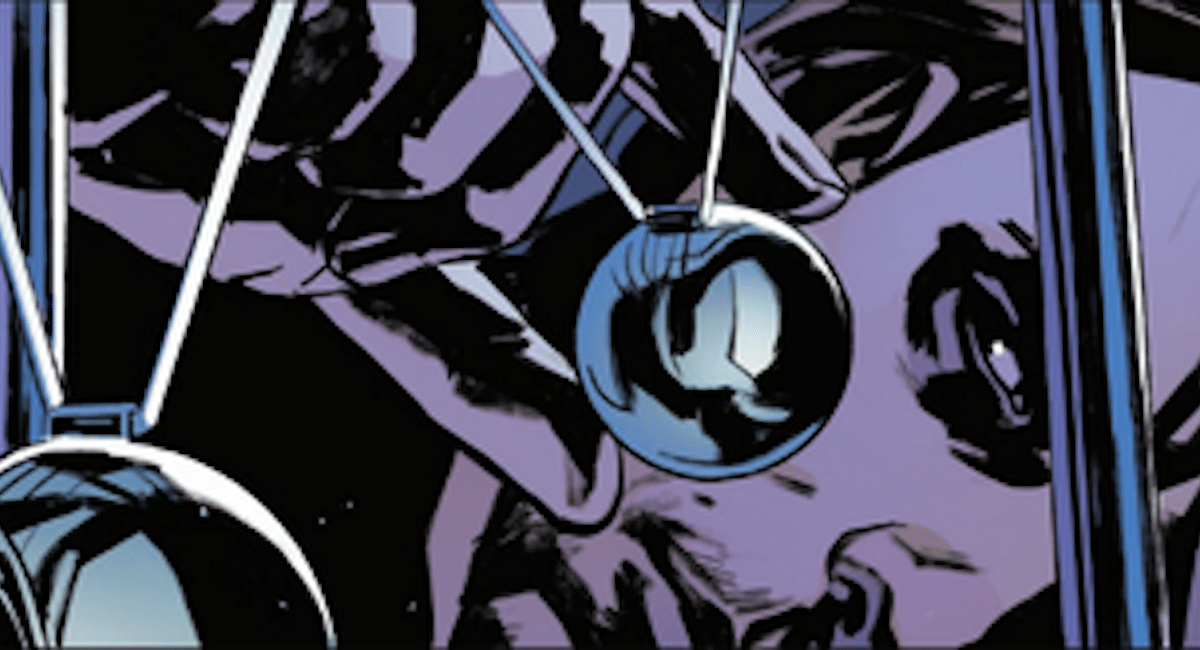
Still The Sentry is an ambitious comic in an era where many other books Marvel comics seem afraid. Jenkins once again crafts a story about a psychologically damaged hero expected to be the apex. Rosado renders it all in deep shadows (with suitably bleak colors provided by Matt Milla) and psychological imagery (lots of Newton’s cradles). There is darkness underneath the idea of heroism and The Sentry is the perfect vehicle to explore that.
Verdict: Strong Browse
Rapid Rundown
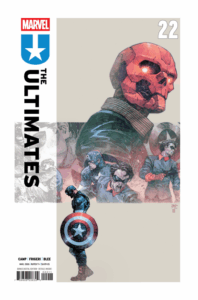 Ultimates #22
In a heartbreaking issue, Ultimates 22 from writer Deniz Camp and artist Juan Frigeri focuses on Captain America, one of the strongest and best-written Ultimate variants of the entire series. Finishing up the story set up by the reveal that the Grand Skull was Steve’s old friend Bucky Barnes, a twist on the Winter Soldier plot famous in the main verse. Color artist Federico Blee uses wonderful colors when exploring Steve and Bucky’s past, giving it a softer palette that contrasts with the present-day war the Ultimates are under. The art alone in this issue is enough to bring you to tears. Panels like Steve standing amongst the dead, the charge of the Ultimates into the main base, and the final fight between Captain America and the Grand Skull are all fantastic. Camp, Frigeri, and Blee really know how to paint the war the Ultimates are on against the Maker as brutal and awful. And the final conversation between Steve and Bucky, yeah, I shed a tear or two, and I’m not even the biggest Bucky fan. It’s issues like this that really show what the Ultimate’s universe can do with some unique storytelling. Taking what we know and twisting it in a way that’s refreshing and intriguing. I’ve said it before, and I’ll say it again, it is going to be a damn shame when Ultimate‘s is gone. Sidenote, teen Wanda and Pietro are extremely cute, and Ultimate Hawkeye has the best line in the entire issue. – LM
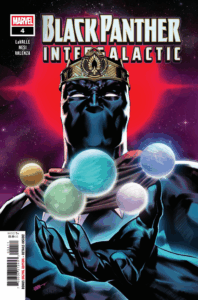 Black Panther Intergalactic #4One of the high points with the conclusion of Marvel’s mini-series Imperial was a return to the Intergalactic Empire of Wakanda, with a world-building master like writer Victor LaValle at the helm, and we’ve got something. Unfortunately, we only get 4 issues of that something, most of these spinoffs have been cut to 4-6 issues. Stranded on an alien world and cut off from any support, T’Challa has been surviving wild battles with artificial beings built by a brilliant Wakandan scientist based on other Marvel Heroes and Villains, all in a race to control the power behind the science that created the beings. A race with an artificial version of himself, looking to claim the Wakandan “Crown”. And this is where artist Stefano Nesi and color artist Bryan Valenza join the fun with their zippy Manga styling and linework. A favorite page is the one with T’Challa and Shuri’s reunion hug, it does this amazing thing of conveying their heartfelt sibling love in a dynamic pose. I vaguely remember Marvel editorial stating that books would get at least a 10-issue run to let it find a readership, this book is an incredibly strong case for this, as LaValles’ take on the Pather is a mixed bag of empire building, superhero action, nerdy fun, and I can only imagine what the next chapter of this title would have looked like. – GC3
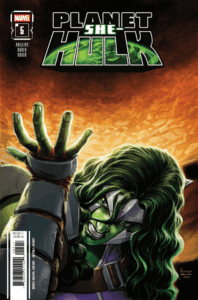 Planet She-Hulk #5
Imagine my surprise when reading the final page of this issue, the best issue of a great series, to discover that Planet She-Hulk and every other book spinning out of the Imperial event is canceled. It’s not terribly surprising but it is galling that what has been one of Marvel’s most original books, which has leveraged a character and her familiar traits in brand new, unexpected situations, was so unceremoniously cut short. Throughout this series, writer Stephanie Phillips has tapped into what makes Jennifer Walters so endearing and entertaining even as she is forced into situations outside of her comfort zones. These kinds of big swings are too few and far between in superhero comics. This is a big city, freewheeling, lawyer trapped on a gladiator planet ruled by violence and brute strength. How does a character who has spent her publishing history subduing and subverting the expected savagery of her Hulk lineage to prove her intelligence and wit operate when it is just those traits that are most prized? It’s a great hook! As you close this final issue knowing a longer run has been cut short, it’s hard not to be disappointed. But this issue itself? It’s a thrilling dramatic turn punctuated by an incredible showcase for artist Aaron Kuder, who returns after a brief absence, to go absolutely buckwild on a massive action setpiece. Sonia Oback’s colors look great, too. As do Joe Caramagna’s letters. Let this review be my formal plea to Marvel editorial: find a way to keep this story going, Queen She-Hulk of Sakaar the War Planet is too cool to squander. – TR
Can’t wait for next week’s books? Catch up with past editions of the Rundown!
And check out most recent comics reviews from The Beat!