
Here’s the second part of my interview with Steve Moore, with more to follow. The first part can be found here, along with some explanation of how the interview came about.
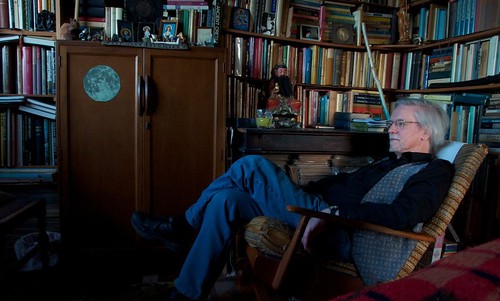
PÓM: Did you go to many SF cons?
SM: Only two or three, I think … at least, that’s all I remember! They were all in the mid-60s, and after that I started losing interest in SF in favour of comics. And by the end of the decade I’d pretty much lost interest in conventions in general.
 PÓM: You were involved in the first British comics conventions as well, I believe?
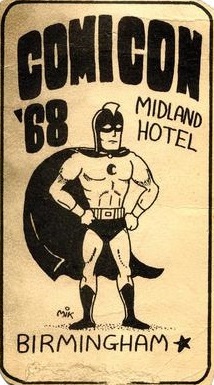
SM: The first two, yes. The first one was at the Midland Hotel in Birmingham in August 1968, and the organising committee was Phil Clarke, his then girlfriend Kay Hawkins and myself. Being on the spot in Birmingham, Phil and Kay did most of the actual organising, while I helped out with publicity (mainly through Odhams’ Power Comics line) and printing with my ‘trusty’ Roneo. I’d already printed off a couple of personal sales-lists for Phil called The Comic Fan, which we then turned into two issues of The Comic Fan Special, which was our news-bulletin, and also listed comics (mainly Phil’s) that were being sold to raise money for expenses. Looking at the second issue of this, I see there was going to be a convention booklet, which I wasn’t going to be printing, but if I still have a copy of that, it must be somewhere in the loft.
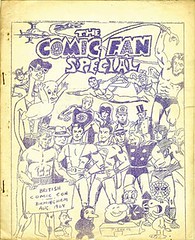 I remember very little about that first convention (for many years I thought it had been in 1967!), though I recall the hotel as being big, old and gloomy. I think there may have been about 50 or 60 people there, and a few ‘non-attending’ members. There was the usual stuff: movies, panel discussions, auctions, but I only know this from looking at the bulletin, not from memory! It was all very small scale, and modelled on what we knew of SF conventions, but we had a good time and that was how it all started. I’m afraid I’m one of the guilty men …
Anyway, I obviously hadn’t had enough, as I got involved with the second one as well, at the Waverley Hotel in London, the following year. This time the committee was Frank Dobson, Derek Stokes, Alan Willis (of whom I remember nothing whatever), and myself. It was bigger, more organised … and again I remember virtually nothing about it, though this time that was mainly because I was in a blind, exhausted panic through most of the weekend, trying to make sure that everything worked. And that was enough organising for me. I went to the third in Sheffield, and I think to another one at the Waverley. And then I’d really had enough of conventions in general, and entered my ‘reclusive phase’ … which has lasted for about 40 years so far!
->PÓM: You have been a recluse, apparently, ever since then. Did you just decide it all wasn’t for you, or what happened?
SM: I’m basically a recluse as far as comic conventions and personal appearances go, that’s all. I have a number of very close friends, some going back decades, who I like to see as often as possible, and I’m certainly not agoraphobic in terms of not wanting to leave the house! But by the time we got to the comic cons I was working in the business, which made me a bit of a ‘celebrity’, and I’ve never had any interest in that. And the idea of being in a large room full of people who know me, when I don’t know them, just makes me uncomfortable. Besides, by 1972 I’d gone freelance, and I made a conscious decision to stop reading other people’s comics so I could develop my own style, so what was the point of going to a convention to discuss things I was no longer familiar with or interested in? By then I just wasn’t ‘a comic fan’ any more. So I just withdrew from that whole scene.
PÓM: Do you remember who attended those early comic cons?
SM: Well, looking at the membership list published in an issue of The Comic Fan Special, I see that a number of notable fans were due to be at the first one, like Dave McCullough, Nick Landau, Pete Phillips and Paul Neary. But if you’re asking me who I remember, apart from Phil, Kay and myself, it basically comes down to Jim Baikie, who was living not far from me in South Norwood at the time, and with whom I developed a fairly close friendship, before he moved back to the Orkneys.
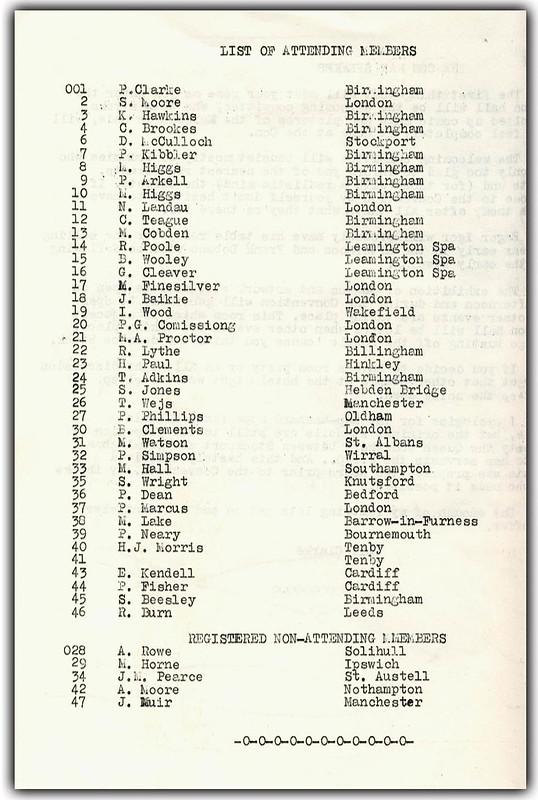
The membership list for the first Comicon
As for the second one, like I said, it was pretty much of a blur. But among those there were Alan Moore, Steve Parkhouse, Barry Smith and Bob Rickard, the future founder of Fortean Times, none of whom I had as much time to talk to as I would have liked. I also remember shouting at a young kid called Dave Womack, who was making a rather loud nuisance of himself throughout the weekend, and being baffled by an Edgar Rice Burroughs fan called Frank Westwood, who asked me where he could find a Roman Catholic church on the Sunday morning; something which had simply never occurred to me to find out (and which, at the time, I actually thought was pretty weird; after all, when there was a comic book convention going on, why would you want to go to church?).
PÓM: What do you think drove you to want to produce all those fanzines?
SM: Essentially, it was what fans did in those days. There was no internet, no blogs, so if you wanted to do stuff about comics, you did fanzines. It was a mushroom industry in the late 60s, early 70s, especially as cheap offset printing started to come in. Everybody seemed to be doing it … some people were doing four or five at once, on different topics, and the adzines were both offering comics for sale, but advertising all the various fanzines as well. And fanzine editors would trade both copies and adverts with one another, as well as offering space for articles, etc., that you might not have wanted to do in your own fanzine. In many ways it was a bit like an early version of the internet, but done with printed paper, envelopes and postage stamps. It’s how we kept in touch.
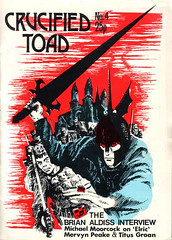 As I’ve said, I was mainly interested in getting new material together, rather than articles, and I don’t think I wrote much about comics, preferring to contribute stuff to magazines that fringed away from comics into fantasy and underground material, like John Muir’s Crucified Toad. A strange man who, I’m told, ended up in some sort of shady business in the East, and got himself murdered for it. Or so I’m told.<-
PÓM: Wasn’t it around that time that you first started working in comics yourself?
As I’ve said, I was mainly interested in getting new material together, rather than articles, and I don’t think I wrote much about comics, preferring to contribute stuff to magazines that fringed away from comics into fantasy and underground material, like John Muir’s Crucified Toad. A strange man who, I’m told, ended up in some sort of shady business in the East, and got himself murdered for it. Or so I’m told.<-
PÓM: Wasn’t it around that time that you first started working in comics yourself?
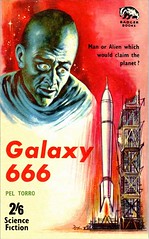 SM: That’s right. If we backtrack to autumn 1966, I’d been stuck in the laboratory job for a year. So I decided to write letters to half a dozen comics publishers in London (yes, there were actually that many comics publishers in those days) and simply asked them if they had any jobs. I got polite replies (‘no’) from a couple of them, and one offer of an interview, from John Spencer & Co., the publishers of Badger Books, who at the time were publishing a couple of really bad black-and-white superhero books, which in the end only lasted a couple of issues each. So I made my way over to West London one evening to their tiny premises, which I think was pretty much one office and a storeroom, but it turned out they basically wanted a warehouseman, which really wasn’t what I was looking for. So I knuckled down to the flour samples and sulphuric acid fumes again.
And then six months later, out of the blue, I got a letter from a lady at Odhams Press, saying they had a vacancy for an office junior. At the time, they were publishing their ‘Power Comics’ line, which revolved round reprinting Marvel strips in black-and-white, which was right up my street. I went for an interview and was told I was a bit too old, being nearly 18, but I was enthusiastic, knowledgeable about American comics, and I could show them Ka-Pow. So they offered me the job. Everyone at Rank’s told me I was making a really bad mistake, giving up a job with ‘prospects’ to be an office boy, and for less money too … but I was off as soon as my week’s notice had run out.
I started at Odhams, in their offices at 64 Long Acre, on 1st May 1967. The date sticks in my mind because the first thing they did was send me over to Blackfriars to join the NATSOPA trade union and, of course, being Mayday, the offices were shut. Perhaps not the best of omens to start my career with …
Having arrived, I found that I was actually the junior office junior, there being another guy who’d already been there a year or two. My duties were pretty much getting post in and out of the building, running errands, and so on, but I adopted a simple strategy: when I didn’t actually have any specific tasks, I’d head for the offices of the various different comics and asked the editors if there was anything they needed me to do for them. So within three months I’d leapfrogged the other guy (who I don’t think ever did get beyond being office junior) and got myself promoted to junior sub-editor on Pow! and Fantastic. Both of these were run from the same office, under the editorship of long-time professional scriptwriter Ken Mennell who, I see from looking on the web, sadly seems to be far more honoured in France than in the land of his birth … probably as a result there being no credits for writers and artists in those days. We were a team of four: Ken, who was also contracted to write a couple of adventure scripts a week as part of his duties, a senior sub-editor called Jane, another sub-editor called Paul, and myself. And I was working in professional comics …
PÓM: What did all those sub-editors actually do, or was that just a catch-all title for anyone who worked on a given title?
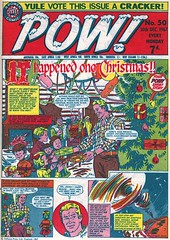 SM: Well, we were producing two titles a week, Pow! and Fantastic, so everything was on a pretty tight schedule. Ken Mennell was in overall charge and made the ‘strategic’ decisions, like which strips we’d run, in collaboration with managing editor Alf Wallace. I think Jane was mainly responsible for Fantastic, which, being mostly page-for-page reprints of Marvel Comics in black-and-white, with only one original strip (‘The Missing Link’, which later evolved into ‘Johnny Future’; written by Alf Wallace and drawn by Luis Bermejo), was a relatively simple, one-person job. Paul and I worked on Pow! which was a bit more complicated, being more a of traditional British comic apart from the ‘Spider-man’ reprint, which had to be resized to fit a British page format. It was mostly one or two page humour strips, with one or two original adventure strips, so that meant a lot to keep track of. We had a large-format ‘make-up book’, with two pages per issue and a sort of grid system on them, in which we’d write the dates that scripts arrived; when they were sent to the artist; when the artwork came back; when the pages were sent to the letterer (all hand-lettering in those days; no computer setting) and when they came back; and so on. Scripts had to be read and edited before they were sent out, and when the finished, lettered pages were in they had to be proofread and sent to the art department (the ‘bodgers’) for correction. I think we all proofread the pages to make sure nothing got through that shouldn’t be there, as the letterers were known to be occasionally mischievous … particularly John Aldrich, who seemed to take every possible opportunity to letter ‘public’ as ‘pubic’, and so on, just to see what he could get through … and Ken, as editor, certainly checked all the pages after we juniors had been through them. It was also drummed into us that we should never allow the use of the word ‘flick’ or the name ‘Clint’, which, when lettered in capitals were dangerously liable to turn into something quite unsuitable for a kid’s comic. Another maxim I learned very early on was ‘all printers are bloody idiots’, which meant their instructions had to be spelled out absolutely precisely, especially when it came to things like marking up the artwork with its reproduction size. Again, all this was pre-computers, so we were sending original artwork to the printer, and all the corrections had to be done by hand, rather than on screen. Obviously we also got proofs back from the printers that had to be checked through as well. ‘Editorial’ largely consists of reading stuff over and over again.
So, all that had to be controlled, and artists and writers phoned up and chased to make sure everything was on schedule. Then there was the mail to go through (perhaps a hundred letters and postcards a week, most of which was unusable) and pick out possible items for the letters page, and we’d ask the kids who wrote in to include a coupon on which they named their three favourite strips; so these had to be added up to give us an idea what was most popular. And at the same time we were working on a new project, a much more traditional adventure comic in the Lion mould called Spitfire, which had no Marvel reprints; but that never got beyond the dummy stage, as by then the Power Comics line was starting to contract. So we had plenty to keep us occupied, though we always left the office on time; I don’t remember us ever being pressurised into actually doing any overtime.
That was also when I got my first freelance work, though it wasn’t writing. As the Spider-man material we were reprinting in black-and-white was merely the line-work for something had originally been drawn for colour, we used to give it a bit more body by applying Zipatone (an adhesive film that had to be imported from the States at the time, which was then laid on the artwork and cut to shape with a scalpel) to various parts of the pictures. I managed to persuade the art editor, John Jackson, that I could do that, and did so for a number of months. It paid a massive 5/- a page, but to put that in perspective, my weekly salary was only something like £15.
PÓM: What was the Power Comics line, which you mentioned above?
 SM: Basically it was Odhams’ attempt to model itself on Marvel Comics and included a fair amount of Marvel reprint. The titles involved were Wham! and Smash! , which were already established as more traditional British comics, but then started to include one or two Marvel reprints, with the American material resized to fit a British page; Pow! which was in the same format, but was first published at the beginning of the Power Comics line, and Fantastic and Terrific, which were in a more American format, each page reproducing a single American page, though each carried one original, British-created strip. There were letters pages, and all the comics carried a half-page news section, in imitation of Marvel’s ‘Bullpen Bulletins’, ‘From the Floor of 64’, which was named after 64 Long Acre, the office address; while instead of ‘Smilin’ Stan’ Lee, we had ‘Alf, Bart and Cos’: Alf Wallace, the managing editor, Robert Bartholomew, his No. 2 and editor of Eagle, and Albert Cosser, editor of Smash! and Terrific (who later went on to edit TV Times for several years). I’m not sure why Ken Mennell wasn’t included in that lot, but maybe they couldn’t fit him in with the ‘A, B, C’ of the other three.
As I said, the offices were at 64 Long Acre, an old newspaper building on the edge of Covent Garden. The ground floor was full of loading bays and was still in use for storing enormous rolls of newsprint, etc. We occupied the entire first floor, which was divided up into smaller offices with metal and frosted glass partition walls. The place was actually a listed building, but it stood on a very prime piece of real estate. A few months after we moved out of the building, it burned to the ground, thus allowing a large and costly redevelopment to take place. Curious, that …
PÓM: What other comics were Odhams producing at the time?
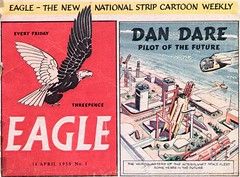 SM: Eagle and Robin, which Odhams had taken over from their original publisher, Hulton Press, in 1959. Their companion papers, Swift and Girl had already folded by then. Eventually all the Power Comics titles started to suffer from declining sales, and merged with each other until there was only Smash! left. Then in 1969 Odhams and Fleetway were merged to become IPC Magazines, and that was pretty much the end of the line. For the last few months of Odhams’ independent existence we moved from Long Acre to offices in High Holborn, and then with the merger everything was transferred to Fleetway House in Farringdon Street.
PÓM: What was the British comics industry like at the time?
SM: It was in pretty good health, which was probably about the last time you could say that. There were Odhams and Fleetway in London, and D. C. Thomson in Dundee, all with a sizeable number of titles, and a few smaller publishers. Of course, Odhams (and IPC after 1969) was the only one I had direct experience of, and that was also the first one that really had any awareness that there might actually be ‘fans’ to be catered to, rather than just kids who bought the comics off the newsstands. But all the creators were anonymous, this being long before anyone got credits, so there was far less egotism than there is in present-day comics. I tend to look back on it as ‘days of honest toil’, when you had a bunch of solid, professional writers and artists who’d turn in their material on time and take their pay-cheques without ever thinking they were doing anything particularly interesting, because they were working for children’s magazines, and that was how they made their living. I think I was pretty much the first fan to get into the business, and after that there were a few others, but in 1967 things were pretty much a closed shop, often with people introducing friends or members of their own family to the editorial staff. Ken Mennell’s son Ian ended up on editorial at IPC, while the writer Ted Cowan’s son Geoff was on the editorial staff of Eagle. At the time no one thought there was anything ‘special’ about comics, and I think a number of the editorial staff just considered it a relatively easy way to get their press cards from the National Union of Journalists, which they could then use as a stepping stone to move on to a better job as a magazine journalist.
PÓM: Did you sell any of your stories at that time?
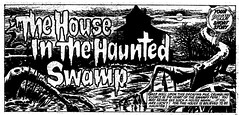 SM: The first story I sold professionally was a three-page ‘Pow Short Story’ called ‘The House in the Haunted Swamp’, that appeared in Pow! No. 45, late in 1967. It was drawn by a Turkish artist living in this country, called Ayhan Basuglu, and taught me a swift lesson, similar to the one about all printers being idiots … which was that you had to write for artists as if they were idiots as well, especially if English wasn’t their first language. It was set in a decaying house full of barrels of paraffin, and I’d told the artist to draw a guy exploring the place with a torch in his hand … meaning, of course, an electric flashlight. Mr. Basuglu promptly drew him with flaming torch, which wasn’t quite what I’d intended with all that paraffin around, so I had to do a bit of rewriting on the dialogue. By one of those weird symmetries, the same sort of thing happened on the last comic strip I wrote as well, Hercules: The Knives of Kush. On one issue they brought in a couple of Mexican artists to fill in, as Cris Bolson was getting behind schedule. My script asked for some characters wearing skullcaps, by which I meant close-fitting felt caps covering the cranium, and they drew a bunch of guys with actual skulls on their heads. Fortunately we managed to catch that at the pencil stage, so it wasn’t a problem, but with 40 years between the two events, you understand my feeling of déjà vu …
I know I wrote another ‘Pow Short Story’ called ‘The Hunter out of Time’, which, like the first one, suffered from the usual beginner’s error of having far too many words per panel, and there may have been one or two more. Those are the only two I know I wrote, because in those early days I’d keep a scrapbook of the stories I’d done, but after I’d been freelance a few months there got to be so many of them I just gave up. When I was on editorial for Whizzer & Chips at IPC I wrote a four-episode fill-in on ‘Wonder-Car’, which I really enjoyed as it was drawn by Ron Turner, someone I’d long admired. But I didn’t really write a great deal while I was working in-house, and when I went freelance in 1972, it was pretty much a leap in the dark. I thought I could write, but I didn’t actually have any sort of track record that said I could. It was pretty much the way I blundered through my career. ‘You want a prose story written (or a novel, or a movie script, or whatever)? Oh yeah, I can do that …’ I never had any prior experience of doing them, but as it turned out, I could. Looking back, I seem to have got away with an awful lot, somehow. It’s just that I’m not sure how I did it!
PÓM: Do you remember many of the people who worked on the comics?
SM: As for the in-house staff, apart from the people I’ve already mentioned I mostly just remember first names, though the overall art editor was John Jackson, his assistant Roger Barnden. One of the senior sub-editors on Eagle was a guy called Dan Lloyd, who also happened to be the assistant editor on Flying Saucer Review, and when I was still the office boy I’d sometimes have to run UFO stuff between him and the editor, Charles Bowen, who worked at South Africa House in Trafalgar Square. At one point Dan had his new toy set up in the Eagle office, which was next door to ours … a ‘flying saucer detector’, which I think was some sort of magnetometer that FSR was promoting, so Roger Barnden used to sneak into our office and slap a powerful magnet on the metal partition wall, just to wind up Dan by setting off his detector.
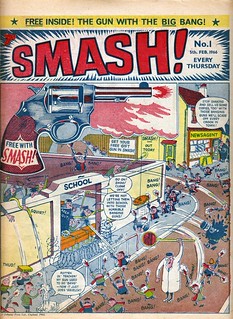 As for creators, a lot of the humour strips were written by Walter Thorburn, who we’d lured away from D. C. Thomson, who were notorious for paying less than their London-based competitors. They’d also lured away Leo Baxendale, though I think he worked mainly for Wham! As for the adventure strips, I think Ken Mennell wrote mainly for Smash! … I’m fairly sure he wrote ‘Rubber Man’ ‘Bunsen’s Burner’ and ‘Cursitor Doom’ for them. Another string to his bow was coming up with plot outlines for thriller novels for the publisher W. Howard Baker, who had a stable of writers who’d then write them up. Ken would knock out the outlines in his lunch hours, at £30 a time, and I was obviously impressed by his productivity. Other adventure writers were Tom Tully and Scott Goodall, but I can’t remember which strips they were responsible for. As for humour artists, there was Mike Brown, who was very much a Leo Baxendale clone, and who I suspect may well be the artist on some material that’s been mistakenly identified as Baxendale. There was Mike Higgs, writing and drawing ‘The Cloak’, and the brilliant Ken Reid on ‘Dare-a-Day Davy’, who was actually a bit of a nightmare to work with, as he’d rewrite all the scripts he was sent, and we’d get back this lovely artwork with tiny pencilled dialogue in the balloons that was twice as long as would actually fit if lettered properly, so we had to cut it in half to make it work. There was Graham Allen and Terry Bave, who also wrote his own stuff. As for adventure artists, there were John Stokes and Eric Bradbury, though a fair number of stories were by Spanish artists, working through agencies like the Temple Art Agency.
It was while working on Pow! and Fantastic in 1967 that I first met Steve Parkhouse and Barry Smith (this was before he moved to the States and started calling himself Barry Windsor-Smith). They turned up one day as a writer-artist team, trying to sell us an SF strip as a ‘Pow Short Story’. It wasn’t accepted, but Barry ended up drawing the pin-ups of Marvel characters on the back cover of Fantastic and Terrific. I’m not exactly sure when he started, but the early pin-ups were drawn in-house by John Jackson.
PÓM: Did you end up working with any of your professional colleagues on any of your fan publications?
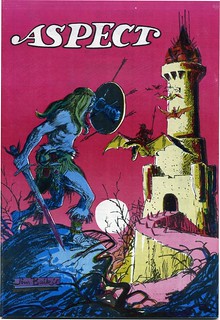 SM: Eventually, yes. I’d started another fanzine called Aspect, the first issue of which appeared in September 1969. It was the first comics fanzine I’d done using a Gestetner duplicator, and was run off for me by Derek Stokes, but I wasn’t at all pleased with it; in fact I was rather embarrassed at the way it came out. But by the time I got round to doing the second issue, in March 1970, I’d got in touch with the guys at Orion Press in Manchester, who were essentially fan printers, but who could do justified typesetting and litho printing, including fairly primitive overlay colour covers. Steve and Barry had been working on a large Kirby-esque epic called ‘Paradox Man’ which I was quite eager to run, but instead Barry decided to intercut pages from that with a number of apparently unrelated other pages and the whole thing ended up as a sort of 20-page montage called ‘Tales of Hyperborea’, which looked very nice, so long as you didn’t expect any sort of connected narrative. There was a prose sword-and-sorcery by Chris Lowder, who I was by now working with at IPC, and who later started calling himself Jack Adrian, with a career as a writer, anthologist and critic; that was illustrated by Steve Parkhouse. And there was an article on Frankenstein movies by Denis Gifford.
For some time, Steve and Barry had been intending to do a magazine called Orpheus, along with Bob Rickard, who they’d actually got in touch with after seeing a letter that Bob had had published in a Marvel Comic. So at that point we decided to merge and brought out the first issue of Orpheus in March 1971, nominally edited by Steve and myself, though we all had an input into the issue. By that time Steve was working at IPC with me on Whizzer and Chips and Cor!! So we roped in a few of our friends from there as well, like Chris Lowder and Robert Knight, and again we had strips by Steve and Barry. We actually managed to get a second issue together and printed by Spring 1973, which featured some very early art by Ian Gibson, but Steve and Barry then decided they weren’t satisfied with it, so it was never released, though I managed to nab one copy for my own files.
Eventually Barry moved to the States and Steve to Carlisle, and, sadly, we lost touch. But Bob’s remained one of my very dearest friends for the last 45 years and, of course, it’s because of that that I’ve had a long-running association with Fortean Times since it began in 1973.
PÓM: Were they good times or bad times at Odhams, do you think, looking back?
SM: Certainly good when I was working on Pow! Ken Mennell was a nice man, London was a hip place to work in 1967 and I was doing what I wanted to do, which was working in comics. As things started to shrink Ken left and I ended up working on Smash! , which wasn’t quite so much fun, simply because I didn’t take to Albert Cosser (who was always called ‘Cos’ rather than Albert) quite as much as I did to Ken, though we got on well enough. By 1969 the writing was on the wall, and we knew about the upcoming merger with Fleetway, and for the last few months we moved from Long Acre to offices in High Holborn. For the last month of its life I worked as extra editorial staff on Eagle, which was quite nice, as I’d grown up with the title, but it was pretty much just a case of giving me something to do. Except for a couple of people, virtually everyone at Odhams took redundancy pay, but I’d only been there a couple of years, so that wasn’t worth anything to me and, besides, I wanted to stay in comics. So I hung on and moved over to Fleetway House as part of the new IPC Magazines set-up where, at least to start with, I wasn’t anywhere near as happy.
PÓM: Why not?
SM: Well, I’d basically gone over to Fleetway House as ‘superfluous editorial staff’, and they promptly put me on Valiant, which already had a full staff so I was, basically, superfluous. And while Odhams had been quite relaxed, the whole ethos at Fleetway was much more old-fashioned, with very rigid and strait-laced working practices. The managing editor was a guy called Jack LeGrand, who looked like a rather beaten-up old newspaper hack. He was probably perfectly nice, but I seem to recall there’d be a vague tremor every time he’d walk into an office. The editor of Valiant, Sid Bicknell, was a complete martinet, and I think his chief sub-editor, who was probably only about 30, used to turn up every day in a three-piece suit and a bow-tie. So I got dumped among a staff like that with my lengthening hair and vaguely hippy notions, and we spent six months in mutual loathing.
Valiant was probably the most old-fashioned of the Fleetway boys’ adventure weeklies, and I particularly detested their lead strip, the ‘jolly’ World War II hero Captain Hurricane, which I thought was nauseatingly jingoistic and downright racist (‘Take that, you piano-toothed rice-noshing baboons!’). I seem to remember working for a couple of weeks on Tiger at the end of my stint on Valiant, but then, without asking me what I thought, they suddenly decided to move me on to War Picture Library, which, of course, I hated even more. For those who don’t remember them, these were pocket sized-comics about seven inches by five, with 56 pages plus covers, and usually two or three panels a page.
Working on War Picture Library was even more dire than Valiant. I remember early on having proofread an issue in 25 minutes, and then being told that I couldn’t have read it properly because all the other staff there took 45 minutes. So after that I had to spend 45 minutes on a book regardless of whether it needed it, and some of the stuff was reprint that had already been subbed anyway. I was bored rigid and hated the subject matter, with its constant references to ‘Huns’ and ‘Nips’, and the typical World War II story is something I’ve always refused to write. Mind you, I’ve never written sport either, but that’s mainly because of ignorance rather than any moral scruples.
PÓM: Did you end up working at IPC Magazines for long?
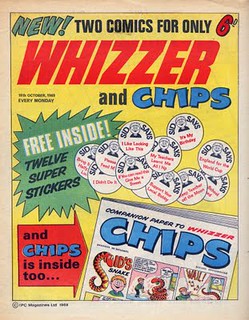 SM: Fortunately, after two months of misery on the War libraries, they decided to bring out a new humour weekly called Whizzer and Chips, under a relatively young editor called Bob Paynter; the idea being that Chips was somehow a ‘separate’ comic that was bound inside Whizzer. As was usually the way, they advertised the job of sub-editor in-house first, and I naturally applied for it, and got it. So that’s where I spent the next two years, until I finally left to go freelance in the summer of 1972. During that time, we also added Cor!! to our line-up, which was another humour title. Both were pretty much modelled on Buster, but perhaps with a slightly younger appeal. They were virtually all humour (a lot of which was written by Roger Cook, who’d formally written TV Comic just about single-handedly every week) with, I think, one adventure strip.
We were down on the second floor (most of the comics were on the top floor, which I can’t remember whether it was the 5th or the 6th, with the libraries on the floor below that), so we were pretty much a separate production unit, cut off from the others (which suited me). And in the time I was there, we ended up with Steve Parkhouse and Dez Skinn on editorial (I think Dez was mainly on Cor!! ), and Kevin O’Neill as art assistant. With the usual nepotistic way of taking on staff, we also had an art assistant called Tony Jacob, who was the son of a cartoonist, I think called Peter Jacob, and there was a rather cute artist/letterer called Diane Flowers, who was developing an interest in palmistry and wanted to read my palm (offhand I can’t remember what she said, just the inky palm-prints … though I think it was more about character analysis than prediction). I don’t think Chris Lowder worked with us, but I think he hung around quite a lot, mainly because of the aforesaid palmist. So we had a decent team there, and Steve Parkhouse and I became quite good friends. And I was reasonably happy for a while.
To be continued…



Comments are closed.