
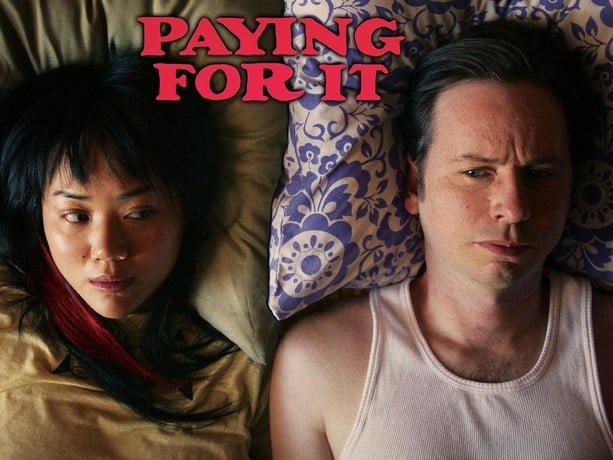


Chester Brown’s 2011 graphic novel Paying for It was part politics and part memoir: the story of Brown’s decision to forego traditional dating and rely on sex workers for sex.
Somewhat astonishingly, a few years ago word spread that Sook-Yin Lee, a filmmaker who was once Brown’s girlfriend was making a movie adaptation of the book. Lee’s break-up with Brown is the inciting incident for his switch to becoming a john, so the idea of a person involved in the story making a movie about it just seemed wild.
Paying for It, the movie, opened at the Toronto Film Festival last year and has been touring at theaters and festivals in Canada since. It’s yet to come to the US, so when I saw that it was playing next door to TCAF’s venue – and that Brown and Lee would be doing a Q&A after the 4 PM Sunday screening, I knew I had to pay for my $7 Canadian and get the full experience.
I’ve been a fan of Brown’s cartooning ever since I picked up issue #5 of Yummy Fur and experienced the saga of the man who couldn’t stop shitting who has Ronald Reagan’s head on the end of his penis in monthly installments. His switch to deeply personal and sometimes disturbing memoir comics – I Never Loved You and The Playboy – was something of a revelation, with the result that we know more about Chester Brown’s sex life than that of perhaps any living cartoonist (he does have a lot of competition, it must be admitted.)
The book drew heavy criticism for Brown’s decision to obscure the faces of the sex workers he visits. While he said it was a privacy issue, it seemed to display his inability to relate to women in an unintendedly revealing way.

But Paying for It the movie humanizes the story and presents the Sook-Yin character and Brown himself – as well as the sex workers – as real people, and likable ones at that. Filmed on a shoestring in various Toronto locations – including Lee’s actual apartment where much of the real story took place – it’s a charming character study of a place and time – the late 90s early 00s. And oh man that apartment: it’s only 11 feet wide and I can’t imagine anyone actually living there!
On my one trip to Vancouver many years ago, Brown and Lee were living there and still dating and I spent a very pleasant afternoon hanging out with them. I’ve hung out with Brown several times over the years, and even had dinner with him. He’s a kind, caring person, despite what you might think based on his work. Lee clearly feels the same about him, and that comes across loud and clear in the movie, as demonstrated by the way he treats sex workers with respect and consideration.

The story is pretty much as the book tells it, lightly fictionalized. Brown (Dan Beirne) hunches over his drawing board making comics, listening to classical music and occasionally masturbating. Emily Lê plays Sonny, the Lee character, a VJ on Canada’s version of MTV. (A few videos from contemporary bands will rocket you back to the era of videos and rock bands in a stunning time switch.) The movie crucially expands on her role, contrasting a series of fairly disastrous boyfriends with Brown’s seemingly chipper switch to being a john. Andrea Werhun, a writer and former sex worker who was a consultant on Anora, plays “Denise,” an escort who eventually ends up becoming Brown’s monogamous partner (although he still insists on paying her for sex.)
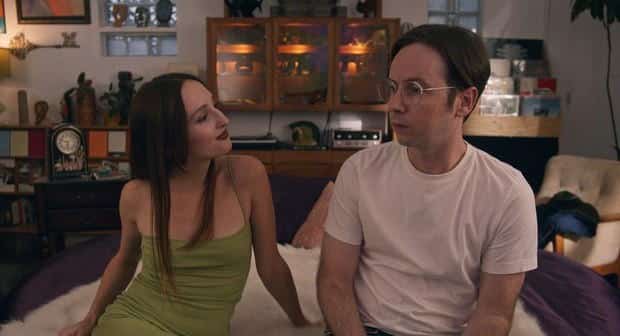
The movie received strong reviews in Canada, but they didn’t mention the easter eggs for comics fans: in the movie Chester hangs out with a posse of fellow cartoonists. In real life, this was the late Joe Matt (the film is dedicated to him) and Seth. In the movie, the Matt character is a bit creepy, just like the real Joe Matt, Seth has been effectively race swapped – being effete and dressing well is a universal trait. Lee added a female cartoonist she says is based on Jillian Tamaki, which is a change from real life that adds dimension, especially in the scenes set at various comics events.
I loved watching this all unfold: it’s funny, humane, and probably the most accurate portrayal of a cartoonist’s life yet put on film. But what really sold me was when Lee and Brown came out at the end and did the Q&A. Their connection and friendship was palpable and watching the two goof off and make jokes afterwards is the only true way to watch this movie.
Because here’s the thing: Paying for It the movie isn’t really about going to prostitutes. It’s about how your ex can still be a good friend. The book was the former, but Lee’s movie is more like a reverse When Harry Met Sally And Things Didn’t Work Out. The film is made with such sympathy for the characters, seeing them act it out in real life after the movie made the message even stronger.
The kicker to it all is that Chester and “Denise” are still together all these years later. They have been together for 21 years!!! They even came to one of my panels at TCAF this year. Chester is a lot more monogamous than he thinks.
I think Paying for It is one of my favorite comic book movies, although I’m probably prejudiced by my familiarity with the subjects. It certainly joins a small list of movies based on “indie” comics: American Splendor, Ghost World, Art School Confidential, Wilson. What am I forgetting? Lee says she would like to make a movie out of Brown’s I Never Liked You, a memoir of his troubled childhood. She demonstrates solid filmmaking chops in Paying for It and I really hope she gets the funding to make this movie! As for Chester Brown, I hope he keeps making comics. I doubt too much can stop him.








I’m so happy you saw it Heidi! I love it too, and agree it’s one of the best adaptations.
Great review, both as a review of the movie and a look back (a re-view) of Brown’s body of work. Yummy Fur 5, I remember it well.
hadn’t heard of this. wow! can’t wait to see it. thanks, heidi!
another indie comic film of note is shortcomings based on the book by adrian tomine. while not based on an actual indie comic, the crumb documentary is certainly fascinating and related, not the least of which because the director terry zwigoff went on to direct ghost world and art school confidential from your list.
Technically, Seattle is in the US!: there were two sold-out screenings at Seattle International Film Festival last month. Based on the audience responses at the second, 98% of the audience were not there based on familiarity with Brown or his work.
Comments are closed.