
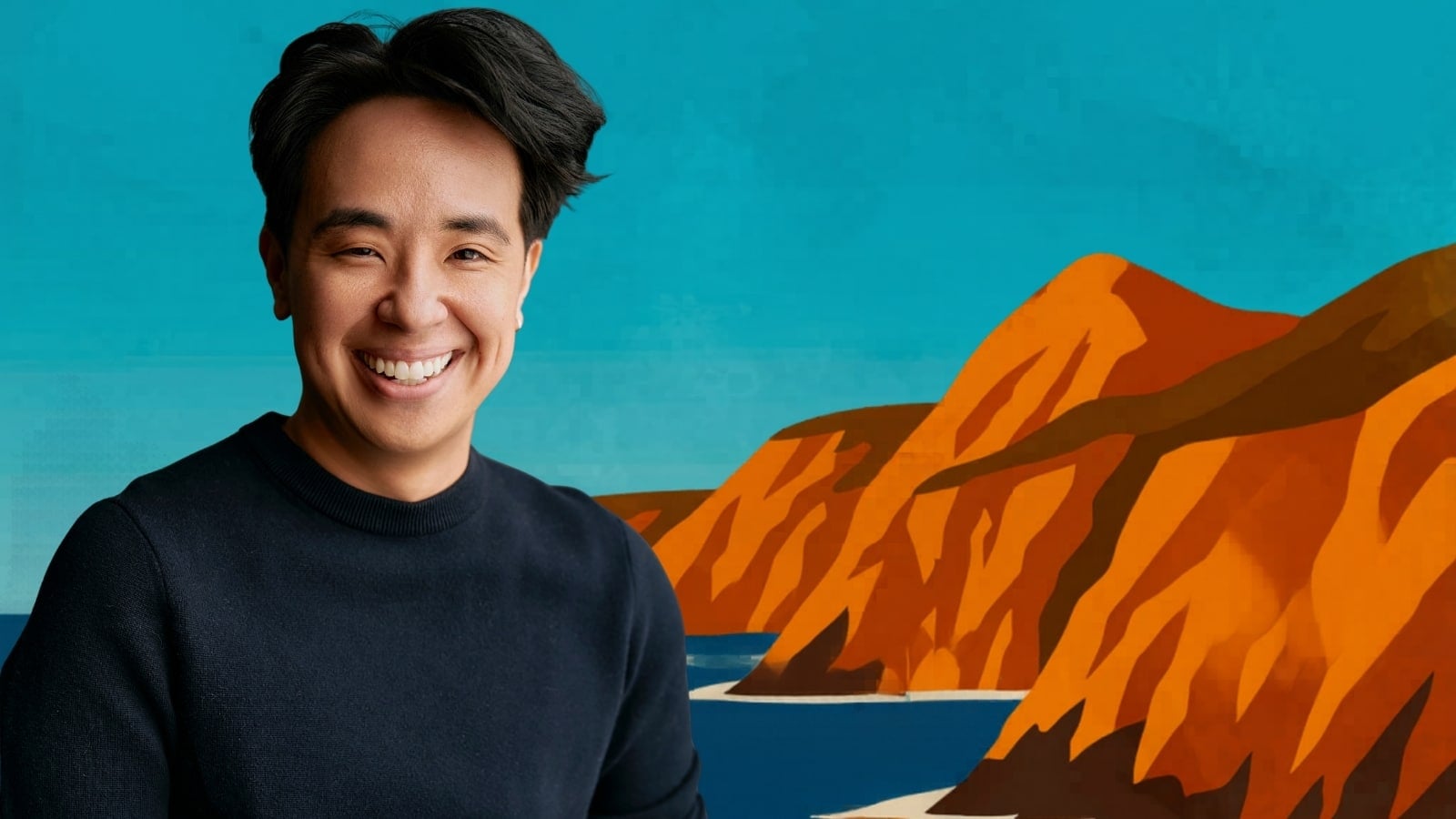

Ash Perez of the Try Guys says he “wants to be the queer Nora Ephron.” He goes for that dream in his debut fiction audiobook, Speak Now, from Simon & Schuster.
The story follows culinary genius Alex Perez, who’s close to becoming the youngest-ever head chef at a prestigious restaurant at a boutique hotel in Big Sur. But when a real estate mogul offers to put a sizable investment into the property in exchange for a perfect wedding—including catering—it becomes the ultimate test. His fiancée is Alex’s “one who got away,” Genevieve Jones.
Alex and Genevieve haven’t spoken in over a decade, but their chemistry hasn’t diminished. Suddenly, Alex—who never has time to think about romance—finds herself falling all over again.
Speak Now is a full cast audiobook led by Jena Malone and Arienne Mandi. The Beat spoke with Perez about writing a queer rom-com, how the audio format differs from other types of fiction, and why Ephron has become a voice in his head.

Samantha Puc for The Beat: What was the writing process like for Speak Now?
Ash Perez: I’m a TV and film writer, and what gets drilled into you is to make the story visual. Don’t say it. Use as few words as possible. Writing Speak Now had so many of the same elements of TV and film and the same structure of a play, but with completely different rules.
It was definitely an interesting challenge trying to write for an audio medium, and particularly in this genre, because romcoms are so dependent on looks to each other and for glances and pinkies touching and that kind of thing. Romcoms are also dependent on voiceover and montages. All of that had to be reimagined.
One of the biggest breakthroughs I had was when I was trying to figure out how the VO would work. I landed on Alex, since she’s a chef, using voice memos as a way to communicate. She can’t be physically writing, so this was a big aha moment for me of translating something native to this storytelling. I didn’t want to do was just retrofit something in a different story idea into this format because that doesn’t seem very fun.
Puc: How did the idea for the book come about?
Perez: Despite not wanting to retrofit it, Simon & Schuster approached me right after the writer’s strike and very smartly were like, “Oh, I know you guys can’t be writing this stuff now. Do you have any ideas that you think might work for an audio format?”
Speak Now was something that I had originally outlined as a movie and brought to S&S as an idea, then went back and re-imagined it for this format. I’d been messing with the idea for a long time. To me, it feels like a formative story in that I think every author—especially first-time narrative authors—you have to really tell the story of yourself to get started. And this one, for me, was so deeply personal. It was the story of my younger self that I needed to tell in order to be able to tell other stories.
Puc: Did you face any particular challenges during production?
Perez: Editing and recording was really fun. I thought it would’ve been more challenging from the beginning, but the actual challenge was creating an audio language that would make sense, continuity-wise, throughout.
In the scripting process, I had to consider, “What types of sound effects do I write in? What are gimmicks or gags that will add to the fullness of the story?” It was similar to the way you would try and figure out for a TV or movie, “Where we put the camera in this scene? Where is the microphone? Whose perspective are we hearing?”
No matter the medium, storytelling has been the same for thousands of years. You have a beginning, middle, and end. Speak Now was more about finding the specific audio language that would give the readers something to delight in as they’re going along.
Puc: What were the tropes or romcom elements you wanted to include?
Perez: I think part of the reason that romcom as a genre has been looked down on is because some people see it as just a bunch of tropes strung together. But to me, it’s just like any other genre: there are beats that you want to hit, and it’s a matter of how you hit them.
For me, I wanted to hit friends-to-lovers and slow burn. More than anything, I wanted to be able to capture that sense of yearning and also time. This audio story uses flashbacks as a convention, which I think helps to add to the sense of time passing. I wanted the audience to understand the first love part of it, not just so that you also have a contrast to who Alex and Genevieve are now, in their adult lives.
Yearning was the biggest thing I tried to track throughout the story. In terms of plotting, for there to be enough tension, you need to have real moments where the audience fears that the story could go another way.
I didn’t want there to be a villain. A lot of times in rom-coms, it’s very obvious that you don’t want the protagonist to be with a certain person. Speak Now is supposed to include the mess. Sometimes, to get your happily ever after, it’s messy. It’s not an easy A to B. Sometimes, you have to blow up your life a little bit. I wanted to make sure that felt true in this storytelling.
Puc: Did any media or creators inspire Speak Now?
Perez: I have always said that I want to be the queer Nora Ephron.
If you listen to the way that Alex monologues, there were a few moments when I was listening back where I said, “Oh, this sounds a little bit like Meg Ryan in You’ve Got Mail.” That is not at all to toot my own horn, but to show how deeply Ephron’s writing has affected me. She has essentially become the voice in my head and the way I think through things. There’s a romanticism.
Something I have always appreciated about Ephron is that of course, her movies have romance, but they always seem to slip in monologues or soliloquies of the character’s broader thoughts about life or New York or the fall or their own observations. I think I was able to sneak into these monologues observing what passage of time might feel like.
If I did my job right, I hope you can feel Nora Ephron in Speak Now.
Puc: Were you involved in casting?
Perez: It was collaborative. Simon & Schuster obviously have done this, so I wrote out character descriptions and they came back to me with ideas. We really wanted to have an a cast of all queer people reading queer roles, so everyone who is in these roles is outwardly queer in some way. It just came together perfectly.
Arienne Mandi, who plays Alex, was one of the first people I heard. I said, “Oh, that’s me. That’s my voice. That’s exactly who I want it to be.”
When Jena Malone said yes, it was an obvious no-brainer. I’ve grown up watching so many of her movies. Two of my comfort movies are The Hunger Games and Pride & Prejudice (2005), in which she plays completely different roles. Well—Lydia Bennett maybe has some Hunger Games in her. But she just brought such a spark to Speak Now.
All the credit to Arienne and Jena because we tried to get them to record together, but it didn’t work out. They recorded completely separately. Arienne got to listen to Jena when she recorded, but I read for Jena and she brought so much reality and groundedness to it. I think that’s going to be fun for the listener. There were moments when I was in the studio with Jena and I was just captivated by how she got there and gave a performance worthy of being on screen for audio.
Puc: Looking to the future, are you working on anything in this vein, or do you see yourself writing more audiobooks in the future?
Perez: Absolutely. What’s funny is that Speak Now started as a movie, then was converted into an audio play. Now I’m in the process of turning it back into a feature film to see what that would be like. It means rethinking the core of the story again and letting each format shine on its own.
I hope this is a long career into writing romance. I have always loved romance and wanted to write romances, but it was looked down on by a lot of traditional people in Hollywood. Cisgender men often don’t understand its value and think it’s just for women, since they’re the majority audience. I’ve really returned to myself in coming to this genre. I hope to do so much more. I’m really excited for what audio can do. This was just the tip of the iceberg for me.
I’m also thinking through what other stories can be best served in this format. Audio deserves to be treated with its own reverence. Romance, in general, is a great genre for audio.
Puc: Do you feel the demeaning attitude toward romance has shifted?
Perez: In some ways, it has, mainly because the thing that speaks loudest in Hollywood is money. It’s been proven over and over again, whether it’s Heated Rivalry or Red, White, and Royal Blue or To All the Boys I’ve Loved Before that romance is not dead and is still a very viable market. Honestly, it may be more commercially viable than other genres that require a lot of investment up front.
It’s a weird moment for me now, as a trans man, to be in this space that is predominantly women. When we were recording with some of the actors, I don’t think a lot of them knew I was trans. I could feel a sense of, “Why did you write this?” Or, “It’s kind of weird that a guy wrote a love story about lesbians.” Then I would tell a story about being in a sorority and I could see the relief.
It’s interesting to be a man in the romance space, as if that adds any credence to it. Honestly, that’s upsetting more than anything because I think it’s stupid, but I’m honored to be here and I hope more people take romance seriously as a genre.
We’ve also seen a lot of bad attempts to write romance. I think it’s a genre where people think, “Oh, AI can write this crap.” But capturing real romance and managing to get that feeling of emotional satisfaction for for an audience… It’s one of the hardest human emotions to capture. It’s the opposite of surface level. It requires so much depth. I hope some respect gets put on romance’s name.
Puc: Do you think the prominence of trans and queer authors like Casey McQuiston and Mason Deaver has helped expand the romance genre and its audience?
Perez: Definitely. Trans and queer writers are finally getting a shot at a genre that is about as competitive as it gets. That’s brought with it so many interesting conventions. The most interesting thing about queer relationships in general is that gender is not the main dividing point of what makes you different. There’s a different negotiation to what queer relationships can look like.
I think a lot of cis, straight people are interested in exploring those ideas. One of the biggest audiences of Heated Rivalry is straight women, who I think are interested in what love or sex might look like when there’s not a clear sense of dominance or gender roles. It’s no coincidence that queer people are coming to the forefront of romance, because we’ve put a new spin on an old genre and can breathe new life into it.
Puc: Are there other genres you’re interested in exploring?
Perez: I don’t write by genre necessarily. For each story, I try to find the most appropriate tone. Getting into this has reminded me that I was a victim of the millennial girl boss self-help diet of reading books to better myself and I got out of reading fiction for a good 10 years. I convinced myself that reading fiction wasn’t productive or proactive—very capitalist. Now I’ve seen how much I missed. I’m learning so much more by getting back into fiction—about myself, about other people’s perspectives. There are so many genres I want to tackle now.
I just read Olivia Waite’s new novella, Murder By Memory, which is a cozy sci-fi detective story. I love that you can mix all of those words together and have them make sense. I think this is just the beginning of what I can write.
In film and TV, a lot of money is required to get something greenlit. In a lot of ways, you might be selling things that never get made. Speak Now has reminded me that part of the beauty of audio or print is that you don’t need a budget. It’s just as much about how big your imagination will go. I’m excited to let mine run wild in a way that’s maybe been held back writing for TV and film because of the question, “How the hell are we going to produce this?”
Puc: What do you hope listeners take away from Speak Now?
Perez: Two things. I hope listeners feel the joy of a romcom that—spoiler alert—has a happy ending. I’m all for post-modern or feminist romcoms where the romance isn’t centered, but I would argue that isn’t really a romcom. Anyway. I hope people enjoy the journey of how two people get back to each other.
The second thing, which I didn’t even realize as I was writing it, is that each character in Speak Now has something they’re not saying—out loud or even to themselves—that is holding them back from being the best or truest version of who they are. I hope the listener is reminded of something that makes them say, “I’m tired of not speaking up about this part of myself and Im going to put it out there, whether in a big way or small.”

Ash Perez (he/they) is a writer, director, author, and producer. A queer first-generation Cuban, Korean, and Filipino American himself, Ash is focused on telling underrepresented stories in every genre. He has written for ABC’s Home Economics and Freeform’s Good Trouble. In 2020, he served as a senior producer on the Biden/Harris campaign, where he codirected and coproduced “Michelle Obama’s Closing Argument.” Most recently he created New Guy Tries for 2nd Try TV, which follows his exploration of manhood as a newly-transitioned man. He is the author of Read This For Inspiration, published in 2020 with Clarkson Potter.
Speak Now starring Jena Malone, Arienne Mandi, Benjamin Norris, Inés del Castillo, Charles Linshaw, Ali Andre Ali, J.S. Arquin, Jason Culp, Kevin R. Free, Kelly Krauter, Jane Oppenheimer, Bahni Turpin, and Jesse Vilinsky is available now everywhere audiobooks are sold.