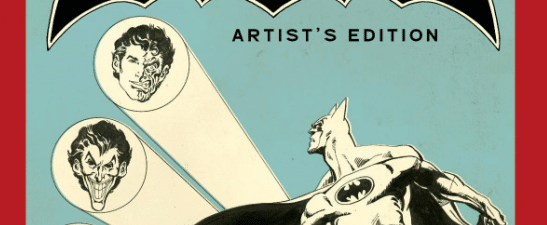

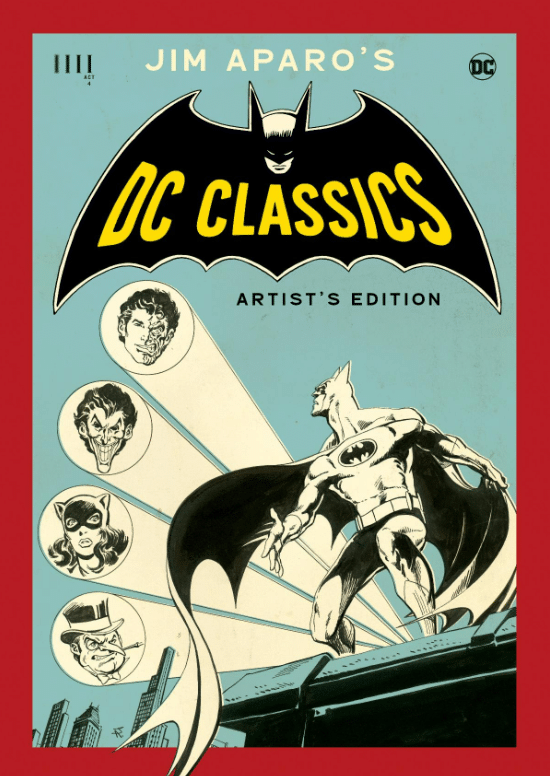
I recently sat down to speak with Scott Dunbier, the founder of Act IV Publishing, and creator of the Artist’s Edition. For anyone not familiar with Artist’s Editions, they are books that reproduce original comic art at full size and in color. Yes, most original comic art is black and white, pen & ink or pencil drawings. But by reproducing the art in full color, viewers are able to see every use of white out, every blue line pencil still on the page, and other imperfections that can make looking at original art so much fun. I spoke with Scott mainly about the new Jim Aparo’s DC Classics Artist’s Edition, which reproduces art from the legendary comics artist’s work on Detective Comics, The Brave and the Bold, and Adventure Comics.
 Billy Henehan: What number artist edition is this?
Scott Dunbier: We’re coming up on number 100. Which is kind of crazy.
Henehan: Is that going to be the Ditko one?
Dunbier: No, actually, I realized it a couple of months ago, and I have a list. I have to go through and check what the anniversary one will be.
Henehan: That’s exciting. Oh wow. I’m going to use that number with my wife next time she complains I have too many. I’m going to say, look, I have maybe 10%, 12% tops. With Jim Aparo, the guy has three decades of work at DC. How did you decide what to focus on for this one?
Dunbier: Of course, because it’s an Artist’s Edition, I’m limited in what I can include to what I can actually find that is original art. I wanted to go for what I felt was his best period, his work from the 70s and 80s. Specifically, I’m a big fan of his work on the Spectre for instance. There are five Spectre stories in the book. There are six Batman stories, five that are from The Brave and the Bold, and one that is from Detective Comics. It’s just a matter of whittling it down. It’s almost an embarrassment of riches. I had so much material that I almost have enough for a second book if I wanted to do one. For instance, I have a couple of complete Phantom Stranger stories that I didn’t put in the book. If I do a second one, they’ll go in that.
Henehan: It’s funny, when I mentioned a friend that this interview was going to happen today, he asked, “Oh, is there going to be Spectre stories in the book?” and I said, “Yeah! It’s like half Spectre stories!” And then he sent me an image of the cover of Adventure Comics #431 and said, “I had this book as a kid. I read it until it wore out.” I said, “You’ll be really happy. It’s in there.”
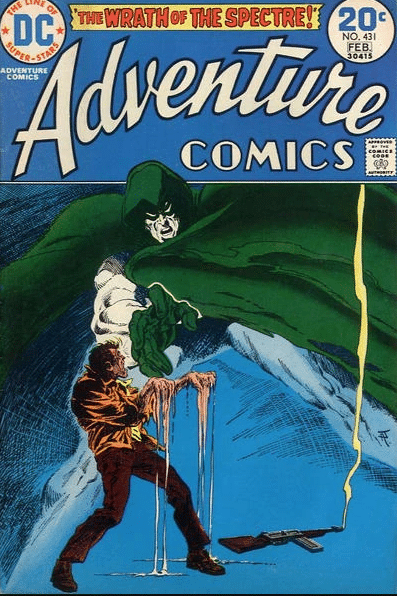 Dunbier: Those particular stories, that’s my wheelhouse for Jim Aparo. My favorite is that stuff. There are only 10 stories in the original run in Adventure Comics. But they were so creepy. Michael Fleischer did such an amazing job on them. I remember when I was reading them, when I was like 12 years old, I couldn’t believe this was in a DC comic.
Henehan: Yeah, that’s wild. And in regards to Jim’s Batman, what do you think makes him so definitive as a Batman artist?
Dunbier: He has such an atmospheric quality. The only artist that I can think of as suited or maybe a little bit more is Neal Adams, but maybe that’s a bit of a high bar. I can’t really think of anyone from that era that comes close to Batman, personally.
Henehan: Did you ever cross paths with Jim when he was alive?
Dunbier: Unfortunately, I never met him.
Henehan: When it comes to the business models of Artist’s Editions, with this one being sold in stores and the J. Scott Campbell one being sold on Kickstarter, do you have a preference?
Dunbier: Each book has its own path. For the Danger Girl one, my partners at Skybound were very excited about it. They brought up the possibility of doing a Kickstarter. They had an amazing couple of Kickstarters over the last couple of years with G.I. Joe and Transformers. They have it down to a science. Their team was very supportive. We had a very successful campaign. Hopefully we’ll do some more in the future. But for the regular books, they’ll be going to comic book shops through Lunar and bookstores through Simon & Schuster.
Henehan: Speaking of G..I Joe, any chance of us getting a Marvel G.I. Joe Artist’s Edition?
Dunbier: I can’t comment on that at this point.
Henehan: Sure. I had to try.
Dunbier: But anything is possible.
Henehan: Sounds good. That’s 100 times better than a no. If this one is successful, is there a chance we’ll get a modern Jim Aparo follow up, with some of his 80s and 90s work?
Dunbier: It’s possible. It depends on how well this one is received. I do have some complete modern stories that are exceptional. I have a couple of the death of Robin stories.
Henehan: Nice. Whole issues?
Dunbier: Yeah.
Henehan: Between that and Ten Nights of the Beast, that’s an Artist’s Edition right there.
Dunbier: Sure.
Henehan: I’m just throwing it out to the world.
Dunbier: All suggestions are welcome.
Henehan: Do you have folders of art files that are “maybe one day I’ll get to this”? Or with acquiring new art, is it very project based?
Dunbier: I have hard drives full of possible Artist’s Edition files.
Henehan: That’s awesome.
Dunbier: Every time I go to a show, people bring me up artwork and they say, would you be interested in this? And I say, Sure, sure. I don’t have a book planned, but this is great art. I’d love to get a scan of it. That’s sort of my philosophy. I’ve scanned many things that will never be in an Artist’s Edition. If they ever happen, that’s great.
Henehan: It’s good to have them. Can you walk people through the process of making an Artist’s Edition?
Dunbier: The first thing I do is figure out what artist and what book I want to do. If it’s a creator owned book, I approach the artist. For instance, with Mike Mignola’s Hellboy in Hell, which is coming out in a couple of months. I did the first half of Hellboy in Hell at IDW, and I wanted to do the second, the followup book. So I called up Mike and he said sure. Mike and Christine Mignola had scans of all the Hellboy in Hell stuff. That’s about half the book. The other half is stuff either that I had already accumulated or that I tracked down. A lot of covers. A lot of pages. If something isn’t creator owned, for instance, if it’s Marvel or DC, then that’s something we need to get contracts for. Marvel and Skybound recently worked out a deal for 9 Artist’s Editions.
Henehan: Wow!
Dunbier: Once the paperwork is done, I’m free to do books. It’s not something I take lightly. If we have a contract, it means I have to have the art or have access to the art. For instance, we just announced Paul Smith Dr. Strange. For that one, I have more enough to do that book, and I’m working on putting it together. The same thing with the George Perez Teen Titans book.
Henehan: I’m very excited for both of those. With original art prices seeming to skyrocket over the years, I feel like the Artist’s Editions really democratize the hobby. They make things available that I’d never get my hands on.
Dunbier: My wife actually says that when people mention to her that these books are so expensive, she says try to buy the art.
Henehan: Yeah! The cost ratio on either of the Marvel Covers books. Just wow, yeah.
Dunbier: The value on some books is tens of millions of dollars.
Henehan: I full believe it. It’s crazy.
Dunbier: The Ditko Spider-Man book, the amount of art that’s in that book, there are 176 pages of art. It’s a 192 page book. I hesitate to even guess what that would come out at if you had all that art.
Henehan: That would be a fun calculation. Back to your original art dealing days, is there a single page that you sold that you think I wish I still had that one?
Dunbier: There’s a lot of pages that I sold that wished I still had. I had the very first Enemy Ace cover by Joe Kubert. That one is one of the ones that I regret trading off to somebody. I traded it off for something I thought I really loved, but in retrospect, I should have kept the Kubert cover. There’s always stuff like that. The thing I don’t regret is the prices I sold art for. Even though some of the art I sold goes for ridiculous amounts of money now. At the time, I got what the going rate was. So I can’t complain for selling it for that at the time. Although one thing that is kind of funny, somebody posted one of my old ads on Facebook from the early 90s. There was a Girl Kane cover, the cover to Marvel Spotlight #32, which was the first appearance of Spider-Woman. It’s nothing I ever would have kept. It wasn’t my favorite cover by Gil Kane. But it sold at auction at Heritage for $700-$800,000.
Henehan: Oh wow.
Dunbier: It’s because it’s the first appearance of Spider-Woman, so.
Henehan: Sure. I do remember seeing that ad recently on Facebook. It got the wow reaction from me, I think.
Dunbier: It cracked me up.
Henehan: Yeah. Seeing any old ads, like Dark Phoenix Saga issues for $1. It seemed high in the early 80s. I assume the Skybound partnership is going very well.
Dunbier: They’ve been fantastic. Everyone there is very supportive. I work closely with Nachie (Marsham). Pretty much every day we communicate. Sean, Blake, Shannon, everyone there is great.
Henehan: Is there anything that they’re bringing to the table that IDW didn’t?
Dunbier: Not really, except they do things in a different way. I’m much more hands on with every aspect now. At IDW, I concentrated on doing the books. Here it’s much more intense. Because it’s myself.
Henehan: Gotcha. Do you prefer that?
Dunbier: I’ll tell you that when the sales numbers comes in.
Henehan: Sounds good.
Dunbier: You know, I mean it’s a lot of work. It’s a lot of work. It’s something that maybe I should have done a little bit earlier in my career. But it’s very exciting. It’s something new. It’s nice to have challenges.
Henehan: When did you first have the idea for the Artist’s Editions?
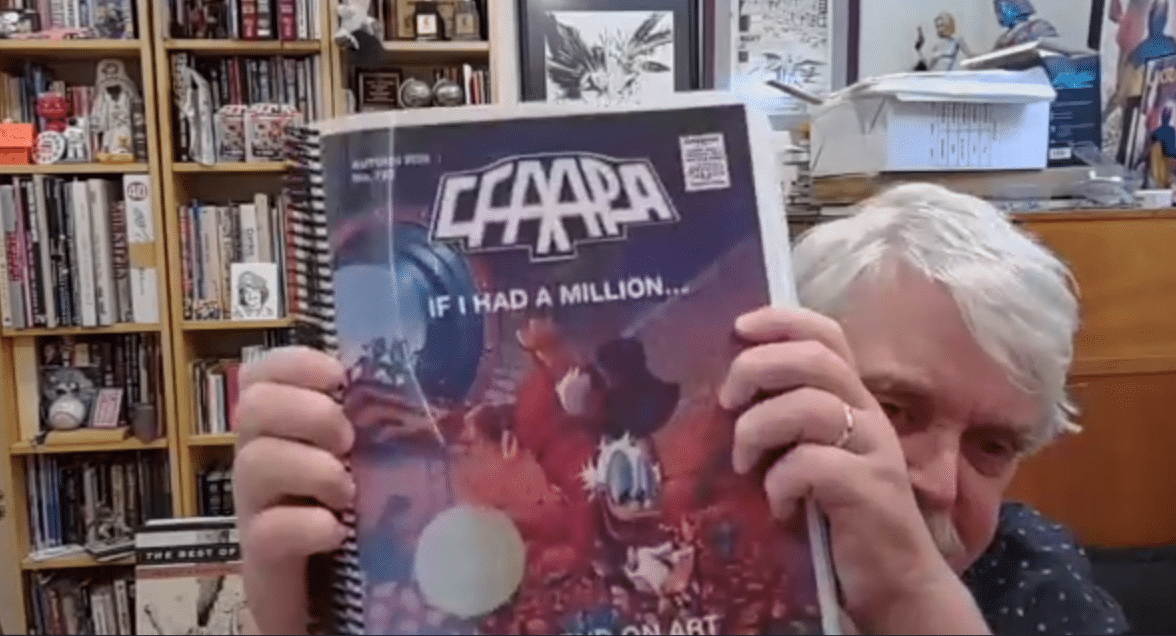
Dunbier: There were two distinct moments. The first one was in 1995, I was a member of the CFA APA. An APA is the ultimate nerd publication. It’s Amateur Press Association. It is literally a hand bound book. We used to mail contributions. Now we email them to a central collator. They put together this massive volume. I just got this in the mail. This is the newest issue of the APA.
Henehan: Oh wow!
Dunbier: It’s crazy.
Henehan: This is still ongoing?
Dunbier: This is still ongoing. This is #126. It started in the early 80s by a guy named Roger Hill. It’s great. You have people who love the same thing you do but in a different way. I have very specific things that I love. Other members have things that they love. I did an article in 1995 on Neal Adams. Each book is dedicated to a specific topic. This one was dedicated to Neal Adams, who was one of my favorite artists growing up. I did a 40 page interview with him. I sent in copies of original art to include with the article. But I had trouble with it. I had some pencil pieces, but they looked terrible. With photocopies, they didn’t capture any of the work to its full potential. It’s 1995, and you have to make 60 copies to send in, or at least then you did. I decided to have color copies made of each image 60 times, and I sent those in. Which was pretty costly back then. Color copies are fairly cheap now. They were more expensive then. I spent five or six hundred bucks on these copies, but it looked great. I remember looking at it and going, “Wow.” If you copy in color and presumably scan in color, it looked beautiful. That was the first part.
The second part was Chip Kidd had done a book on his Batman collection. In that was a professionally photographed page from a Neal Adams Batman issue. The Joker’s Five Way Revenge from Batman 251. If my wife was here, she’d laugh at me for remembering the number. But I remember looking at that in the book, and you could see all the white out on the page. You could see the terrible blue marker they were using at that period for editorial corrections. And you could see it so clearly. That was the second part. And then I pitched the idea to Wildstorm while I was there. It was rejected, to do an Artist’s Edition, as being something that was too expensive. When I got to IDW, I pitched it to Ted Adams. We had an agreement that anything that Ted didn’t want to do when he hired me as Special Projects Editor at IDW, I could do it on my own. I could do it regardless. I fully expected him to reject the idea of an Artist’s Edition because they are big and bulky and expensive as hell to print. They’re expensive to sell. But Ted, god bless him, approved it, and he believed in it. The first book was the Dave Stevens Rocketeer, and we were off.
Henehan: Yeah, and what a run its been!
The Jim Aparo’s DC Classics Artist’s Edition is in stores now!