
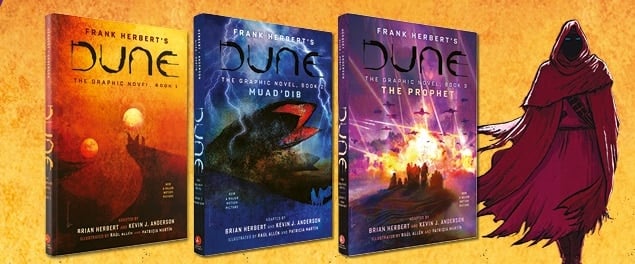
The three book series Dune: The Graphic Novel has been collected by Abrams ComicArts in a box set just in time for the holidays as the perfect gift for that geeky friend or family member who loves this sci-fi classic. Written by Frank Herbert‘s son Brian Herbert and sci-fi novelist Kevin J. Anderson, art by Raúl Allén and Patricia Martín, and cover art by Bill Sienkiewicz, this adaptation beautifully reimagines the legendary epic.
Since adolescence, Dune has always been a part of my life, be it the books, movie, or mini-series, there has always been a need for the Spice. When I got the opportunity to ask writer Kevin J. Anderson about this adaptation, I had to take the Water of Life, and he was kind enough to answer.
George Carmona 3rd: Science fiction has a strong history of telling stories that reflect our societal issues. How relevant is Dune in being that mirror for the generation coming up now?

Kevin J. Anderson: Dune is remarkable in that it has so many layers and so many interwoven contexts that if can indeed be a mirror for so many parts of society, for so many generations. It was seen as a cautionary tale on overdependence on oil, on climate change, on violent fanaticism, on political repression and manipulation. Frank Herbert was a deep thinker, and I have found something fresh and relevant each time I read Dune every few years.
Carmona: How did you come to the Dune Universe, first as a fan and then as one of the successors to Herbert’s legacy?
Anderson: I read Dune first as a wide-eyed precocious eleven year old, and I was blown away by the epic adventure story on a desert planet, which was a level above any other science fiction story I had previously read. Then I read it again when I was in high school and noticed all the politics and religion; I read it again in college and found another whole new layer. I avidly read each new installment as Frank Herbert published them, and I broke into the field as a published novelist just after Frank passed away. His final Dune novel, Chapterhouse Dune, ended on a cliffhanger and it was clear he had not finished the story. I waited a decade, built up my own career success, and finally through a mutual friend I approached Brian Herbert to ask if he intended to finish the story. We hit it off right away, and we decided to work together.
Carmona: What was your process for adapting the book into a graphic novel format?
Anderson: We wanted to tell the same story Frank Herbert had written, not change a lot of the basics to fit our sensibilities—we revered the original and weren’t arrogant enough to think we could “improve” on a masterpiece! But comics and prose are two different mediums and each has certain strengths. Frank’s prose is so deep and filled with complexities and philosophical insights, whereas a graphic novel could visually convey the spectacular alien landscapes of Dune.
In adapting the full novel, the most challenging part was the first section, which is filled with world-building and setup…very difficult to do in separate visual panels. But we focused on the real heart of the scenes, and our artists did a wonderful job portraying it in a visually interesting way.
Carmona: How much of an influence did the movies have on your vision of what the book should look like as far as the characters and settings, or did you trust Raul Allen and Patricia Martín’s design aesthetics?
Anderson: Not at all. We intentionally blocked out the familiar David Lynch film costumes and actors, and when we were writing the first volume of the graphic novel, no one had seen the new Legendary films yet. We worked with the artists to design the vehicles, characters, costumes, and kept them consistent throughout. Ours is the graphic novel of Dune, the novel, not connected to the movies.
Carmona: At the point of the final attack, Paul’s powers were undeniable. How did he not see the death of his son, Leto II? Do you think he sacrificed him, or was it a lapse in his ability?
Anderson: Paul’s prescience was always flawed and contradictory, yet it was a burden that nearly crushed him. At the final battle, when he is using atomics to blast the Shield Wall, then sending all his Fremen into the plains of Arrakeen to fight the Emperor’s forces, I think he may not have seen everything about every battle.
Or he may have been aware of the danger to his son—he does immediately know Leto II is dead as soon as the signal comes in—and it was a terrible price. (Paul certainly pays terrible prices for his visions, especially in DUNE Messiah when he knows all along that Chani is going to die in childbirth…)
Carmona: If there’s ever a Dune What If, how different do you think Paul’s path would have been if Leto had lived?
Anderson: I love the character of Duke Leto, and he was such a strong leader as well as a strong father figure. I think if Leto had lived and Paul had been his successor Duke, in the normal course of things, he would never have turned into such a harsh tyrant.
Carmona: Your passion for the Dune franchise is evident. If you could look at the body of work as a fan, which era in the timeline would you gravitate to?
Anderson: I really love the Butlerian Jihad time period. I think those are some of our best stories, with some of our biggest ideas.
Carmona: Bene Gesserit, Navigator or Mentat, if you could choose a “school” to have attended, which would you choose?
Anderson: I’m not sure I have the proper chromosomes to be a Bene Gesserit sister, though their schooling is fascinating! I’d probably choose Mentat…even if I often have trouble remembering my own phone number…
DUNE: The Graphic Novel: The Complete 3-Book Boxed Set is on sale now.