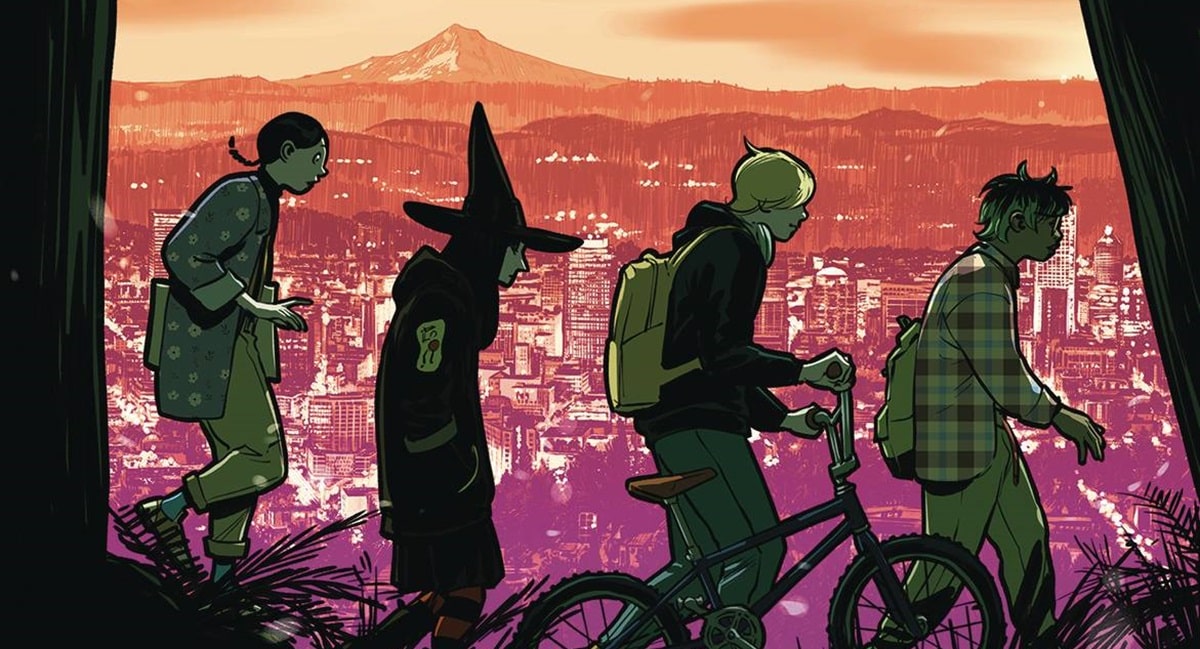

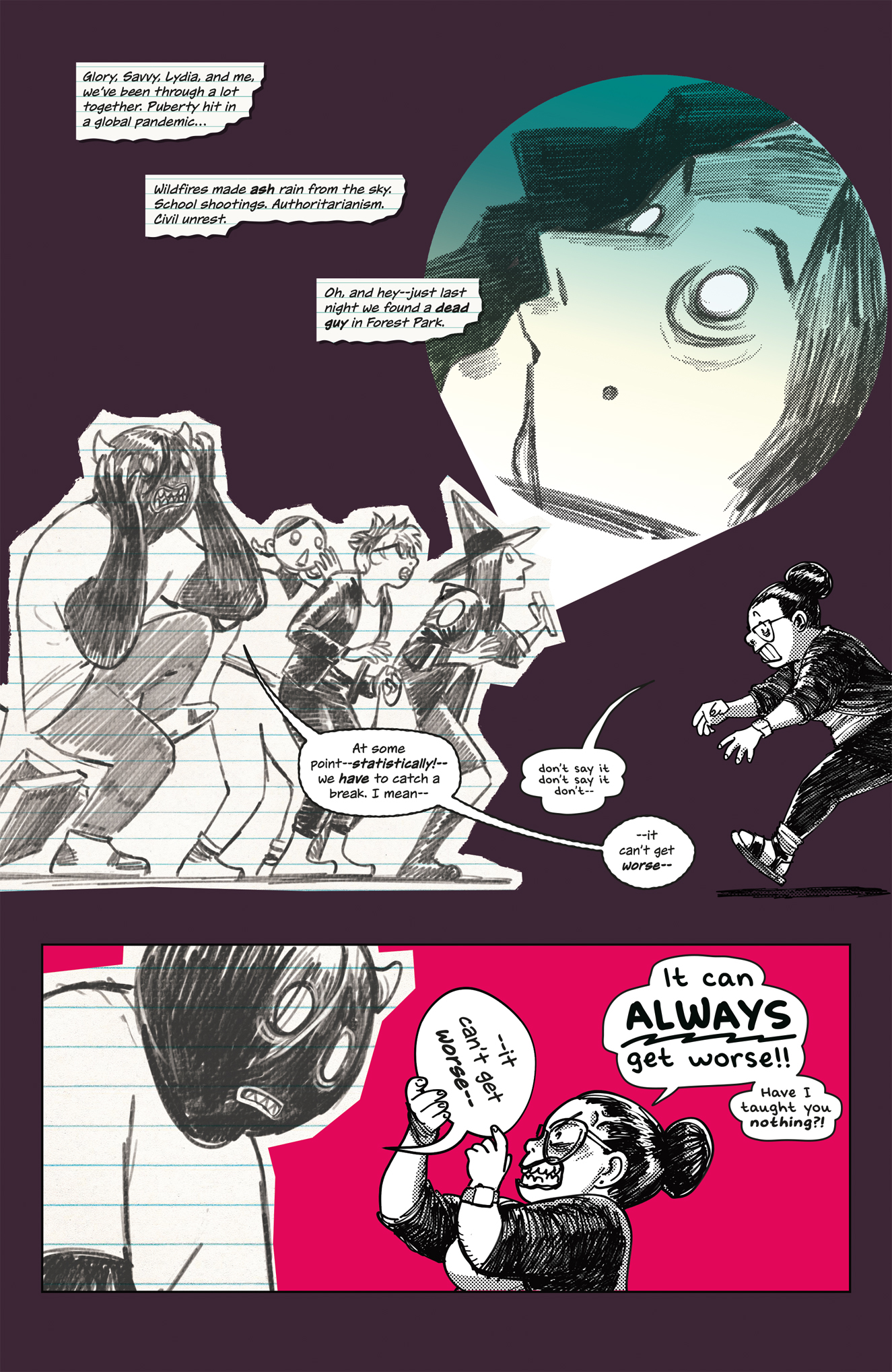
FML is a wonderful, surreal slice-of-life comedy from the award-winning team of Kelly Sue DeConnick (Bitch Planet) and David Lopez (Captain Marvel). Focused on the misadventures of a family and their friends in Portland, Oregon, it captures the electric and intense energy of how ridiculous, wonderful, and terrifying it is to be alive in the world right now. With stunning art that’s constantly re-inventing itself, and some of the strongest writing of DeConnick’s career, it’s an incredible comic and I would argue, essential reading for lovers of the medium.
The Beat sat down with DeConnick to discuss some of the emotional truths of FML, how to capture a world that’s exploding around you at all times, and just what it all means when it all seems like too much to bear.
This interview has been edited for clarity and brevity.
JARED BIRD: Thank you so much for your time. FML has just returned from hiatus on July 9th, kicking off its next four issues and published by Dark Horse Comics. To those unfamiliar, how would you describe FML?
KELLY SUE DECONNICK: Oh boy. You would think that at this point I’d have a good, sharp, short elevator pitch for it. The best line is my daughter’s description of it, which doesn’t really give you any info about the plot. She says “it’s a funny book about not funny things.” It’s so good that I kind of want to push her down and pretend I wrote it. She’s fifteen, so that would be bad form.
“It’s a surrealist, slice-of-life, family comedy set in Portland, Oregon in what feels like the end of the world.” How’s that for my version?
BIRD: Probably the best way to describe it. I do like the idea of it being a funny book about unfunny things.
DECONNICK: You’re not going to do better than that!
BIRD: What inspired the story of FML?
DECONNICK: It started because David Lopez and I wanted to work together again. We were throwing back and forth ideas, and David is a big fan of classic high fantasy, like Dungeons and Dragons, so I wanted to do something like that for him, but I was faking it. When you’re faking it, you can tell. (We have six or eight drawn pages of that version of the book, which we will put in the trade. They’re not finished art, but they’re more than layouts.) It wasn’t quite clicking, and it was obvious I was interested in the kid and not as interested in the fantasy elements. David told me to write what I was interested in, and that he’d find his way in. I decided to write about what’s really been on my mind right now, trying to capture not so much the literal truth of what the last five or six years have felt like, but a sort of “wind chill” version of it. Not really what has happened, but what it’s felt like.
BIRD: It’s the emotional truth. When I first read the book, it struck me deeply, and it felt like how my brain has felt for the last six years.
DECONNICK: Really, it’s going back to 2016, if we’re being honest.
BIRD: It captures that feeling of switching on the news for five minutes in 2025. Being a human being alive at this point in time.
DECONNICK: It’s madness! Absolute madness. As a parent, you’re trying to tell your child ‘this is fine! Don’t you worry, baby, we’ve got you!’ but then as a teenager, you’re aware it’s clearly not fine, but you’ve also only got one chance at being a teenager, and you don’t want to spend it entirely focused on how everything sucks. Trying to find joy in being a teenager even during the dumpster fire.
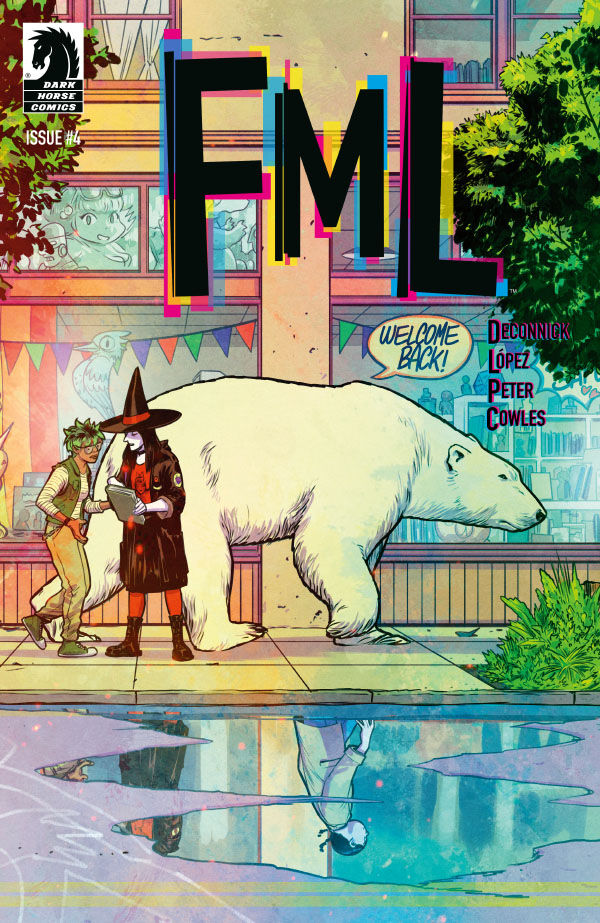
BIRD: What was it like to work with collaborator David Lopez once again?
DECONNICK: It’s a joy for me, but I think it’s a constant ulcer for him. I’m so fortunate with my collaborators. Part of that I get credit for, because I have very good taste!
I like to think I can write to anyone’s style, but I have to fall in love with their mind. I can write for anyone’s hand, it’s their brain that matters. I’m lucky to have people that I feel like I have that connection with – folks like Emma Rios, Valentine De Landro, Phil Jimenez, David Lopez, and Clayton Cowles, my under-the-radar constant companion. He’s always my first choice as a letterer, because he’s a good person and I enjoy his thoughts and his company as well as his artistry.
Anyway, David is really fast, and I am really, really slow. The classic thing is that it takes longer to draw a page than it does to write a page, but I’m not sure that’s the case with us.
BIRD: Fair enough.
DECONNICK: Not from his perspective, it’s not fair at all!
BIRD: Ahaha. What has it been like to work with Dark Horse Comics?
DECONNICK: It’s been my first creator-owned book with Dark Horse. I don’t want anyone to think that me taking this book to Dark Horse was a rebuke to Image Comics, because I love Image. Image has been very, very good to me! In the spot that I’m at in my life right now, I needed more of a machine. Image is not self-publishing by any means, you’ve got a great team of professionals and a lot of support and they curate their library very well, but you’re managing the book yourself. Most of the time, that’s great. And I think it remains the best deal in the industry. For a long time, it was the only truly creator-owned deal. But right now, I’m living the life that you see in FML. I’ve got plates in the air in every direction. Elder care responsibilities and teenager responsibilities and five dogs to look after and volunteering at the school and and and… and I’m tired. I can’t manage a book right now.
BIRD: I’ve felt that.
DECONNICK: In particular, I’d shoutout Daniel Chabon, our editor at Dark Horse, who’s been absolutely extraordinary. Really great.
BIRD: You mentioned in your answer just now that you’re living the life you see in the book. How much of the book is autobiographical in nature?
DECONNICK: A lot! A hell of a lot. We didn’t take great pains to hide it. It’s the emotional truth, right? When you draw from real life and you’re basing characters off of adults, with the exception of ‘don’t be an asshole’, ‘don’t break people’s confidences’, you don’t need to really ask permission. Use good judgement, don’t be a dick. When you’re talking about children, it’s another layer of responsibility. I got permission from our kids to base characters off of them. I’m fortunate because our kids – both of whom are teens at this point, one nearly an adult! – they both see themselves as writers. So I could talk to them about it from that perspective, as an exercise for young writers to think about. ‘I want to base these characters on you, we’re talking about basing them off of you, and they’re not you. If they were you, I wouldn’t be able to put them in the kind of danger I’m putting these characters in, but I also have no desire to embarrass you or make you feel as if you’re on display. I would like your permission and approval.’ I send them things to read and give me their thoughts, to make sure everything’s okay.
BIRD: I did an interview recently where we discussed autobiographical comics and how it’s sometimes easier to write about yourself through the lens of someone else. You write about your experience more authentically by not trying to write about yourself.
DECONNICK: Absolutely.
BIRD: You’re capturing more of the emotion behind it while detaching it from yourself and your concerns about yourself.
DECONNICK: Again, my daughter brought it to my mind. We were talking about it and she said ‘so Patty is you?’ and I stopped for a second and I was like, actually, they’re all me. There’s certainly things inspired by others, but it’s very personal. Both my feelings about them and my own imagining of how it feels like to be them in that moment, which is so inspired by my own experience of adolescence.

BIRD: The cast of characters in FML are so loveable and compelling. Is there anyone who is your favorite to write for?
DECONNICK: Ugh!
BIRD: The evil question.
DECONNICK: That’s so hard! I can’t say I have a favourite, but I can say that I was the most surprised by Lydia, who does not exist in the pitch and ended up becoming so important. I don’t know where she came from. She didn’t come into being until I was writing the scene in the classroom, and I needed a Hermione-type for that moment. She was just so weird, and I immediately was hit with ‘Oh my god, I fucking love her!’ The dynamics came about rather effortlessly. Savvy being really annoyed by her, but Glory, the coolest of cool girls, coming in to protect her no matter what. For Lydia to have something to teach Riley, about being okay being a weirdo, that really resonated with me. Fuck, I love Lydia. We are all Lydia, and we need Lydias. All of them delight me though.
There’s a character you all haven’t met yet, who comes in at the end of next issue, who was not what I expected him to be. We’ve talked about him from the beginning, he’s already appeared in the book on the map, so we know of him, he’s not a deus ex machina. We talked about him in a very specific way, but when he went to speak, his voice came out different to how I expected. It was way more interesting to me, so I decided to go in that direction, and it’s been really fun.
BIRD: I’m glad you mentioned her, because I felt so seen reading Lydia’s scenes. That was me in high school, absolutely. There’s something about the book that feels real and lived in and I love it.
DECONNICK: It’s amazing what that character has provoked. There’s always somebody who comes out of nowhere and steals the book. Penny in Bitch Planet comes to mind. She’s literally everyone’s favorite. I’ve had straight, white, conventionally attractive dudes come up to me at conventions and bring me copies of the Penny origin issue drawn by Robert Wilson and tell me how much the character means to them. How? Okay! Great! That’s the power of fiction. There’s some emotional truth to her that resonated with this dude who might’ve had an incredibly different life experience. There’s something in her resilience, or her humour. It always happens, and I love it so much. Lydia is the Penny of this book. People tell me either they are her, or they must protect her.
BIRD: Something I love about the series is how authentic it feels to the experience of being alive and young in the world today. How did you manage to capture that feeling?
DECONNICK: I think it’s just trying to find the thing that takes it far enough that it pushes it into how it feels. I have a Theatre degree; my background and what I thought I was going to do with my life is in theatre. I’ve always been drawn to elevated theatrical experiences. Comedia Dell’Arte is a big favorite of mine. Shakespeare. I love Opera. You have to turn it up for it to feel real, and then there’s something really interesting in how nuance functions in that elevated context. It’s an interesting thing to play with.
How much further can we take it? What could we use that would bring it to that place?
That’s another way I drive David mad, I’m afraid. In an upcoming issue, there’s a sequence where the STFU girls go into a bit of graffiti to commune with Aria and Cresenda as graffiti versions of themselves. I’m forcing him to adopt new styles constantly. I drove Phil Jimenez and Gene Ha nuts with this as well. I don’t care about the actual physics of it, but they astutely point out they do because they’re the ones who have to fucking draw it!
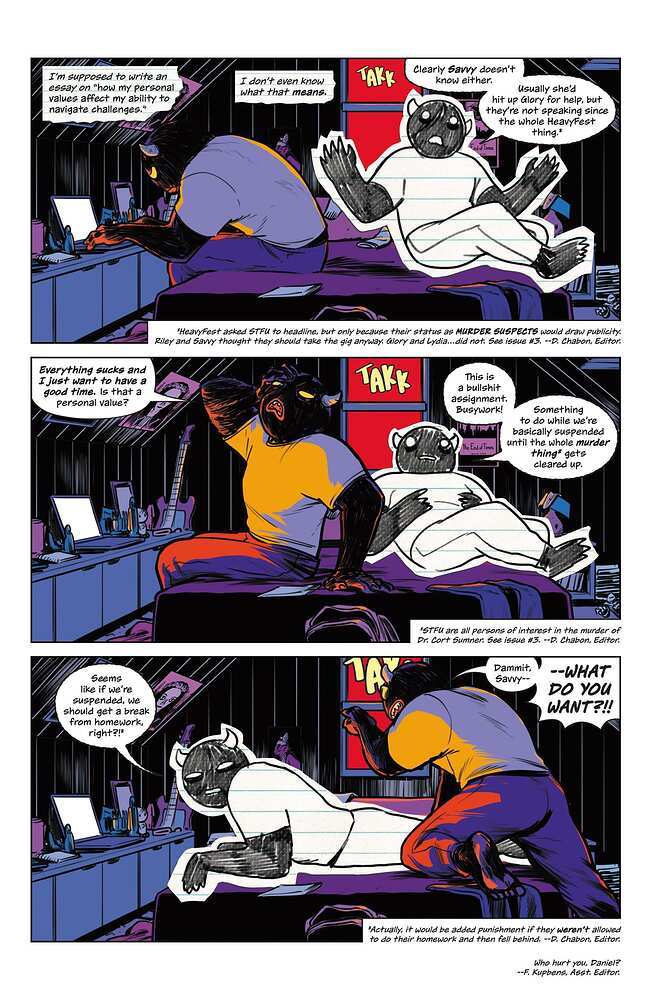
BIRD: That’s part of the beauty of surrealism. When things are so weird and obtuse, there’s an emotional reality you can get to without needing to consider the logic of it. No one quite knows what actually happens in Mulholland Drive, but you watch it and you feel it.
DECONNICK: It’s the beauty of art. I got to work with a bunch of dancers for a show that I did in Las Vegas, and it was a transformational experience for me…You know how Richard Feynman is a character in FML? Obviously he’s a dream construct in the book, but in real life he had this thing where he’d keep a list of his favorite questions—favorite problems. Whenever he came across a new idea, he’d run it through the list of his favorite questions to see if it unlocked anything. So along those lines: the art that tends to move me most powerfully is art that transcends language or narrative. I’m very moved by dance, for instance. There was a dance performance I saw in college by the Llory Wilson trope, who did a show about Frida Kahlo. A dance biography. No language. I think about it once a month at least. It’s not just dance, though — two of the most powerful pieces I’ve ever seen in my life were installations at the Venice Biennale in 1993.
One of my Feynman-inspired favorite problems isn’t formulated as well as I’d like, but it’s roughly this: how do I reconcile the fact that my work is rooted in language and narrative, but the work I find most powerful transcends those things? That is one of the frustrations of this book for me, especially as we try to stick the landing. So many of my favorite elements of the book have to be set aside in favor of plot, because we have an obligation in this medium to the reader to bring the plot home. That’s a tough balancing act. It is the part that is most frustrating to me.
BIRD: Silly little story stuff.
DECONNICK: I know a lot about it, I get it, but it’s the feelings and the ideas that mean the most to me.
BIRD: Something I loved about my literature degree was learning about mediums of art I knew nothing about. Reading and watching plays for the first time. Sitting down and analysing the stories of gothic paintings. It really made me further appreciate comics outside of just the words on the page and the plot and procession of it. Comics can break your heart, but they can also heal you and make you feel seen in a way that few other mediums can. Great comics combine the intangible beauty of visual stories with the power of words and language.
DECONNICK: We’re wired for it. The Comics Journal is going to come for me, because this is a subject of some debate, but if you go back to cave paintings you can make the case that some are comics. Not all of them, but some of them. We don’t know what genre they are. Are they religious texts? Are they diaries? Are they fiction? Science fiction? There’s countless ways to interpret them. Are they letters perhaps? I have no idea, but some of them seem to use sequential images to tell a story. My interpretation of that is that comics are our oldest storytelling form.
BIRD: I completely agree, by the way.
DECONNICK: When The Comics Journal comes for us, you’re right there with me. Side note; I love The Comics Journal. Please don’t come for me, Comics Journal.
Anyway, ours is this storytelling form that currently embodies a curious contradiction. It’s ancient and powerful, but is somehow considered a low art — because anyone can make comics, perhaps? They’re seen as cheap, fast and disposable pop art. They’re porn-adjacent and crime-adjacent. Rumrunners used comics to hide their booze! Our detractors aren’t wrong—comics are all of those things, which I love, but they’re also old enough and essential enough to border on sacred. I love that too.

BIRD: I did my undergraduate dissertation on comics. There was something that appealed to me about writing how comics can reflect the world they’re made in. Has your approach to the story of FML been impacted by the evolving state of the world since the first issue was released? There was a mid-series hiatus, and I wondered if the last six months or so had changed the way the book was going to go.
DECONNICK: No. That is true of Bitch Planet, which was disrupted by the state of the world. FML got interrupted by my inability to stay on schedule, due to all the things you see in the book. Not just all the familial obligations—I have other comics to write as well as TV obligations. I don’t know if this is clear from the page, but Patty also has a daily newspaper script, so she’s working on that while working on her book. I can’t deliver scripts that I’m happy with fast enough, so we took a break and I got caught up a bit. I’m really not built for monthly comics. Fortunately, with creator-owned there is some leeway. I love superhero comics. I think we can make art from superhero comics. I am in no way dismissive of them. But when you’re on a monthly superhero book, the train has to leave the station on time. It’s no coincidence that the best work I’ve ever done in the genre is Wonder Woman: Historia, where the train didn’t have to leave the station until we were happy with the book. We had the time to revise, and polish, and occasionally, scrap and rewrite. I’m not a good fit for monthly comics.
I don’t do anything fast. I don’t think fast, I don’t write fast, I don’t drive fast. The thing about creator-owned comics that is terrible for everyone in the pipeline but me is that you don’t have to call them finished until you think they’re finished. Once it’s done, it’s out there. In ten or fifteen years, people don’t remember what book was on time. But there’s some privilege there — it’s an easy thing for me to say. People’s incomes depend on the regularity of a monthly schedule. Not just creative partners, but stores. Trying to balance that responsibility is difficult, complicated. The last several years I’ve been weighing going straight to gn, but that’s a complicated decision as well, and sometimes one that’s above my paygrade.
So where were we? The break! Right. It wasn’t a response to politics or anything adjacent, it was just the reality of my life. Honestly? I think #5 is the weakest issue of the series. I’m still proud of it, but it feels rushed to me. I didn’t want that to happen again. I’m struggling with the balance of ending the plot whilst presenting the best parts of the book. It’s rough, but assuming I haven’t poisoned David, or he’s not done with me, we’re not done after the eighth issue. We’re just thinking of the book in terms of story arcs with breaks. We have a plan for the second story arc that no one will see coming, and I’m very excited about that.
BIRD: Brilliant. How exciting! What do you want readers to take away from the series?
DECONNICK: That we’re all in this together. Everyone’s doing their best. Even our villains. I’m happiest when I lead with compassion. That doesn’t mean standing by and letting people hurt others, but really trying to see that we’re all struggling and it’s okay to laugh. It’s okay to cry. It’s okay to not know. You’ll have more questions than answers, so be kind to each other.
BIRD: In this day and age, it’s strange and sad to see that kindness is almost a rebellious trait. It’s punk to be compassionate.
DECONNICK: Yeah!
BIRD: It’s rebellious to care about others. It’s sad that it’s gotten to that point, but you’ve got to choose to be kind. Sometimes you want to scream and cry and throw your head in a wall-
DECONNICK: Daily.
BIRD: But other times, it’s great and amazing, and everything’s fine for a split second. What other books of yours would you recommend to readers who enjoyed FML?
DECONNICK: I am a terrible person to ask this particular question to. We all have a bit of mirror blindness. I think all of my books are wildly different, because over half of their DNA comes from someone else. That makes perfect sense to me, but they’re probably not as different as I think they are. I look at the work of my friends and colleagues, and I can see the connecting lines. What are the chances that I just have tremendous range? I’m probably also writing about the same over and over again. But the most obvious choice is Captain Marvel, with David Lopez, because it’s the same creative team as this book. Those are fun books, and David’s style has an innate sense of humour to it. That’s the go to. If you like the Fuck-My-Life of it all, my husband Matt Fraction’s run on Hawkeye, with David Aja, is on par. It’s not mine, but it’s adjacent.
BIRD: One final, particularly evil question. If you had to pick a handful of bands to function as the soundtrack for FML, what would they be?
DECONNICK: Bikini Kill, for sure. Dragonforce. I listened to a lot of them for Riley. It’s metal but it’s nerdy. Nekrogoblikon, again a mix of metal and nerd. I fucking love them, too. They’re so delightful. Their hypeman, who sings now, John Goblikon, is this costumed goblin, like GWAR but funnier. No shade to GWAR, they’re fucking hilarious. I looked up the guy who plays John Goblikon, and he’s this handsome actor, and there’s some psychoanalysis potential there! There’s a classic rock side to Mom as well, so let’s say AC/DC. Maybe Led Zeppelin would be more in line with the book, though, so let’s say Zeppelin. For Dad, I’ll pick Neutral Milk Hotel.
BIRD: Ahah!
DECONNICK: Something sort of spooky for Lil, but maybe a little operatic.
BIRD: You could pick Ghost. Spooky but bombastic and operatic.
DECONNICK: Excellent choice. Have you ever seen Harold and Maude? Lil is not Harold, but she’s almost both of them. She’s got the dark side and the element of seeing through everything that Maude has. So I’m tempted to also give her Cat Stevens. I don’t know what my count is out now, so let’s go with that.
BIRD: Thank you so much for your time.