
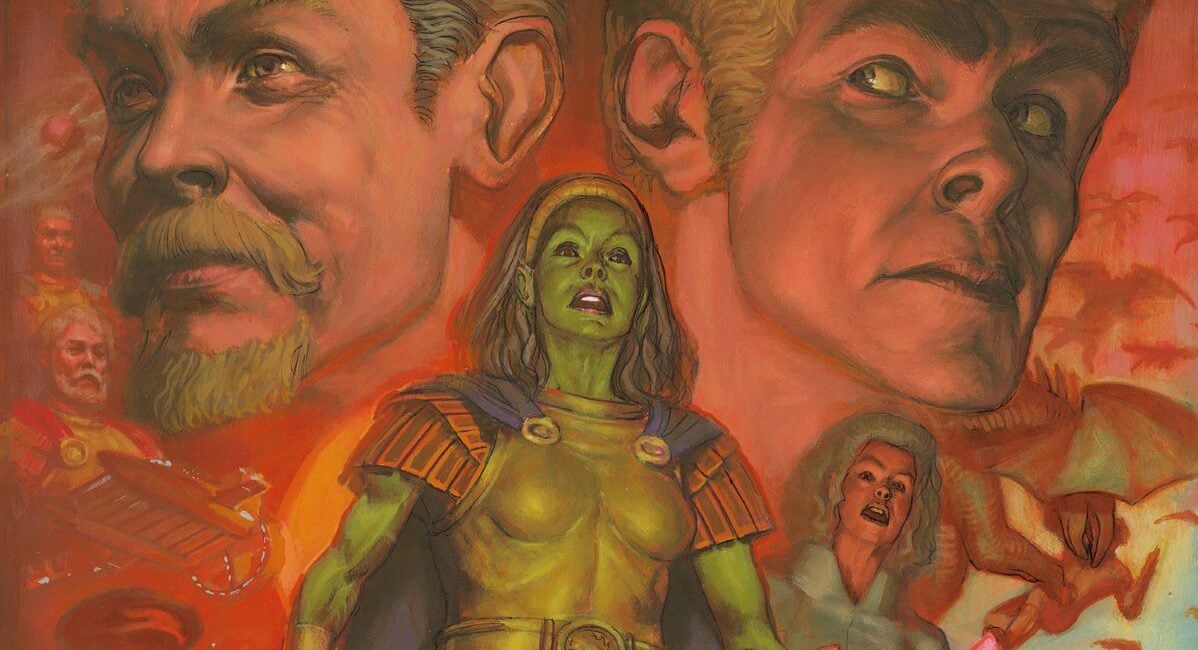

Long ago, in a galaxy far, far away…there was The Trigan Empire. A classic comic serialised in the United Kingdom between 1965 to 1982 in kids weekly Look and Learn. Full of classical dress, alien creatures and futuristic craft, written by Mike Butterworth and gifted with incredible painted art by the legendary Don Laurence, the series has for decades been described as one of the greats.
In 2020, Rebellion’s Treasury of British Comics began reprinting the original series and they sold like hotcakes – so strong is the memory of this distinctive strip. The reprint initiative now at its penultimate volume, it seems the saga is actually far from over.
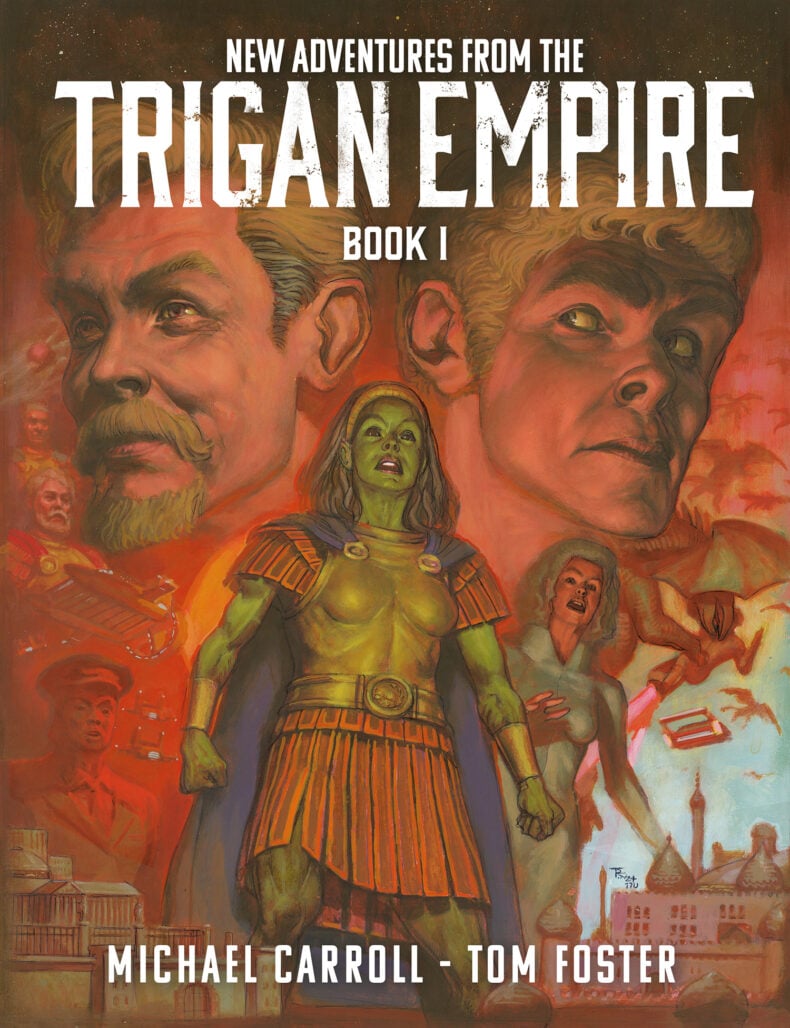
Early last year it was revealed that the series would return with critically acclaimed 2000 AD creators Michael Carroll (Dreadnoughts) and artist Tom Foster (Judge Dredd: The Penitant Man) taking on the herculean task of continuing the beloved British sci-fi strip. And, in deference to Laurence. even going old school – as Foster picked up the brush to give it that authentic hand-painted feel.
The Beat contributing writer Dean Simons spoke with Rebellion’s Head of Film, TV & Publishing Ben Smith, New Trigan‘s editor Oliver Pickles, and the creative team of Carroll & Foster to find out about the journey travelled to bring about The New Adventures From The Trigan Empire…
Dean Simons: How successful have the reprints of the original Trigan Empire been?
Ben Smith: The success of the original comics in the Rebellon collections has been incredible. The first book in 2020 was the #1 bestselling graphic novel in the UK the week it came out. This for a story that had not had a UK edition since 1978. Talk about pent-up demand! The sheer quality of Don Lawrence and Mike Butterworth’s work on the original run has seen these collections sell – and keep selling, not just in the UK and US but in translation across Europe.
Oliver Pickles: And the enthusiasm of readers for those initial stories ensured that we were confident enough to carry on the reprint programme beyond the Mike Butterworth/Don Lawrence era and collect the whole series through to the Ken Roscoe/Gerry Wood stories of the early eighties.
Dean Simons: What lay behind the decision to continue the Trigan saga at Rebellion, rather than leave the series as is or remake it?
 Ben Smith: We’re six volumes into the complete seven-volume reprint, so we always knew there was going to be a point where we either sat back on our laurels or found a way to bring new stories to the world. When you have an ongoing success, and experience doing celebrated new stories with characters across multiple decades as a publisher you want to make the most of an opportunity.
Oliver and I had a lot of conversations about what this new series could be; so that it was not just convincingly set in the world of Trigan, true to it but with a reason to exist of its own. It needs to not just repeat past hits, nor be a reboot. Oliver’s had a fantastic run with Garth Ennis taking this approach to our Battle Action characters. Saying, these are great strong characters who have more stories in them.
OP: The original run of the story didn’t end, so much as it just stopped with the cancellation of Look and Learn [in 1982]. There is a sense of guardianship of the series to some extent, and you start to wonder what would have happened if the series continued.
Now, the nature of comic-book story-telling back then (by which I mean, pre-Alan Moore Swamp Thing) meant that the characters sometimes had a kind of narrative amnesia: here is yet another story featuring Janno going under-cover to find out a secret plot against the Trigan Empire, that kind of thing. And rereading the stories as they were being prepared for reprint, it also became obvious that there were certain events that happen to characters that just wouldn’t really be acceptable today. So, there is an update in sensibility towards the storytelling, and Michael Carroll can pick up on story threads that were dropped for whatever reason, meaning we were able to update the series without throwing away all that had happened before.
Dean Simons: Surprisingly you are going immediately for the book. Why go straight for graphic novel instead of serialise first in 2000 AD or the Judge Dredd Megazine? Is it a bigger risk in terms of investment?
Ben Smith: There is a risk in original graphic novels that is offset by serialisation, especially fully-painted graphic novels. However in the 2020s the Trigan Empire is a graphic novel series. That’s the format it has been a hit in, so that’s the place where people are looking for the next story.
OP: Trigan Empire predates 2000 AD, it was never part of that comic, it felt right to keep it separate and make it its own event. I still hope 2000 AD readers will pick it up though. I would also say that Battle Action was relaunched as a Graphic Novel, and that original book from Garth Ennis and the gang has had very long legs (and once again, it is a different type of comic compared to 2000 AD).
On a creative level, it also allows for a slightly different type of storytelling, there is less of a worry that a conversation, or an action sequence, which stretches for a few pages isn’t taking up a whole ‘episode’ of a weekly instalment.
Dean Simons: How did you pick the creative team? Did you do an open call or had the team in mind from the get-go?
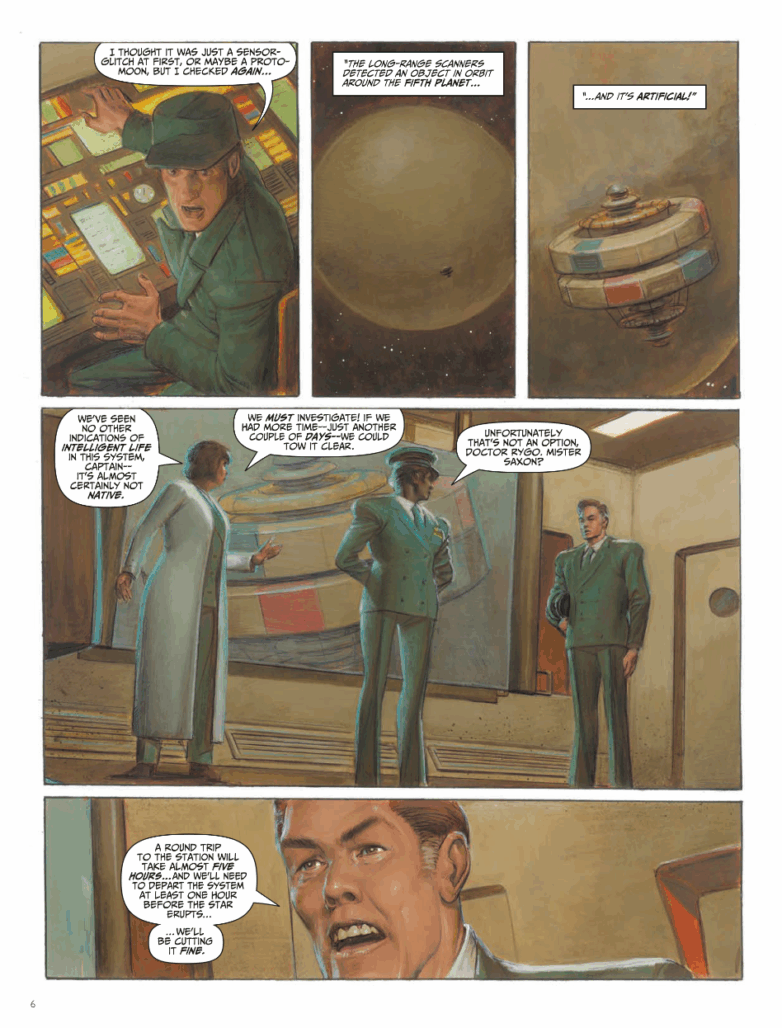 Ben Smith: No, we knew this was the kind of project where we had to approach people direct. Oliver and I discussed the challenges and which writer and which artist would be able to rise to them. From there Oliver put the shoe leather into taking those ideas and bringing a team together.
OP: I did enjoy Mike Carroll’s Dreadnoughts, where he is working backwards from Dredd’s timeline to tell the story of just how the judges came to have so much power. With Trigan Empire he is working forwards and telling a tale of terrible repercussions resulting from a past mistake that Trigo made in the original series.
Tom Foster is an artist who, after winning the 2000 AD competition in 2013, has just gotten better with time. His work on Judge Dredd evokes classic Cliff Robinson, Steve Dillon, and even Brian Bolland, artwork, while not looking too retro. And it is that quality that made him perfect for the job. He has moved slightly away from his Judge Dredd style for this Trigan Empire book, but only to evoke the painted quality of those classic Look and Learn era stories.
Dean Simons: How long has this project been in the works, and how far ahead is it planned?
OP: I remember having a conversation with an artist before the pandemic, there wasn’t a contract on the table, and nothing was set in stone, but we chatted conversationally about the idea of a future Trigan Empire story when I was showing him the first proofs of the first Don Lawrence collection.
Regarding the future, we will see. But narratively there has to be a ‘Fall of the Trigan Empire’ and it would be great to depict that. We have also left ourselves with a time jump between the classic series and the new set of stories, so there are opportunities for stories there too.
Dean Simons: Over to the new Trigan creative team, Mike Carroll and Tom Foster – what was your previous experience with Trigan?
 Mike Carroll: My earliest memories of the Trigan Empire are of reading some of the two-page episodes in issues of Look and Learn in the local barbers’ shop. This would have been in the early 1970s. My dad was friends with the guys who owned the place so they’d chat for ages and that gave me ample time to devour the strips. Unfortunately the comics were all over the place so I don’t think I ever read even two consecutive episodes—not until I acquired the reprint volume published by Hamlyn in 1978—but I absolutely adored the artwork and the basic idea. It was captivating stuff! Monsters, swordsmen and spaceships all in one comic-strip! Fantastic! How can you not love that?
Tom Foster: I didn’t have a lot of experience with The Trigan Empire. I had seen bits of it here and there and liked Don Lawrence’s artwork on it, but I only started reading it when I was contacted about working on this new installment. I really liked the sense of high adventure and the clear, illustrative visual style. It immediately gives a strong sense of story and draws you into the world very effectively.
Dean Simons: Michael, you’re a blogging connoisseur of British comics – can you explain the significance of the Trigan Empire for the uninitiated?
Mike Carroll: With all respect to the writer Mike Butterworth (and to his successor Ken Roscoe), I believe that it’s the artwork that has really given The Rise and Fall of the Trigan Empire its longevity, particularly that by co-creator Don Lawrence whose work graced the series’ first decade. Not that the stories themselves aren’t tremendous fun—because they really are remarkably inventive and thrilling—but the artwork is frequently astonishing, and brings the stories to life.
But that’s true of just about all comics: a potential new reader will initially be captured by the artwork because they can register its quality at a glance. That’s the hook that hopefully leads them deeper into the story.
The Trigan Empire doesn’t have a monopoly on excellent art for British comics of the era, of course: there were dozens of phenomenal artists producing work that would make any modern artist very proud. Frank Bellamy on Dan Dare and Ron Embleton on Wulf the Briton (also written by Mike Butterworth) are also personal favourites, but Don Lawrence really did bring something special to the story.
Dean Simons: With that history in mind, were either of you nervous about taking up the challenge – of a classic series with a solid artistic legacy?
 Mike Carroll: It was definitely a daunting task… the original series is so well loved that any attempt at a continuation is bound to be met with scepticism, if not outright scorn. I’m sure that there are die-hard fans who are going to hate what we’ve done because it’s not the same. But then it shouldn’t be the same: there’s no point in revisiting an established series if it’s not going to venture into new territory and/or shine a different light onto the past.
Tom Foster: It was just nice to be asked, to be honest. I was conscious of the strength of the artwork that came before, but the fact that I hadn’t grown up reading it made that more of professional consideration, rather than something I had deep-seated neuroses about. It’s always harder to follow artists who’re long-standing personal heroes – and I’ve had to do that enough times to learn that you’ve just got to get your head down and get the work done. Plus, there is such a sense of fun and escapism to the strip, that it’s difficult to agonise over it too much. You end up getting sort of swept up in the spirit of it.
MC: Also—and this is very important—we’re potentially battling nostalgia, which can be a hugely powerful and intractable foe! With a property like the Trigan Empire the fans sometimes love it not for what it really was, but for what it meant to them as ten-year-olds. They love the comic strip they think it was… when I re-read all the old strips in preparation for this new story I was surprised to find that there was a lot more to the tales than the “Roman-style soldiers versus monsters and/or spaceships” adventures that I’d remembered. There are plenty of considered and thoughtful moments scattered throughout that would have bypassed me as a kid.
Dean Simons: Was there a pitching process? How did you figure out your approach to the next phase of the continuing story and the visuals?
Mike Carroll: I don’t really recall a pitching process as such… Oliver Pickles, the editor, got in touch back in October 2022 asking me if I’d be interested, and we chatted about the series via e-mail. Before long he asked me to submit a detailed outline for a new story. But I don’t know whether I was the only writer doing so… Was I the only writer they approached? Did they approach lots of others but everyone else turned them down? I’d rather not know!
I do know, however, that my detailed outline didn’t hit the mark right out of the gate: we went back and forth a bit and there were plenty of solid ideas that we ended up side-lining or completely abandoning, but that’s part of the development process: sometimes if you can go anywhere you like, it can take a while to settle on the best place to go.
That said, with The Trigan Empire, we didn’t have a wholly blank canvas: we had the “baggage” of the stories that had gone before. There were certainly moments when I thought, “Yeah, wow, this would be so much easier if they hadn’t done that back in 1971,” but instead of wishing away a difficulty, it’s far better to see if we can build on it. Creativity comes from solving problems, not from ignoring them.
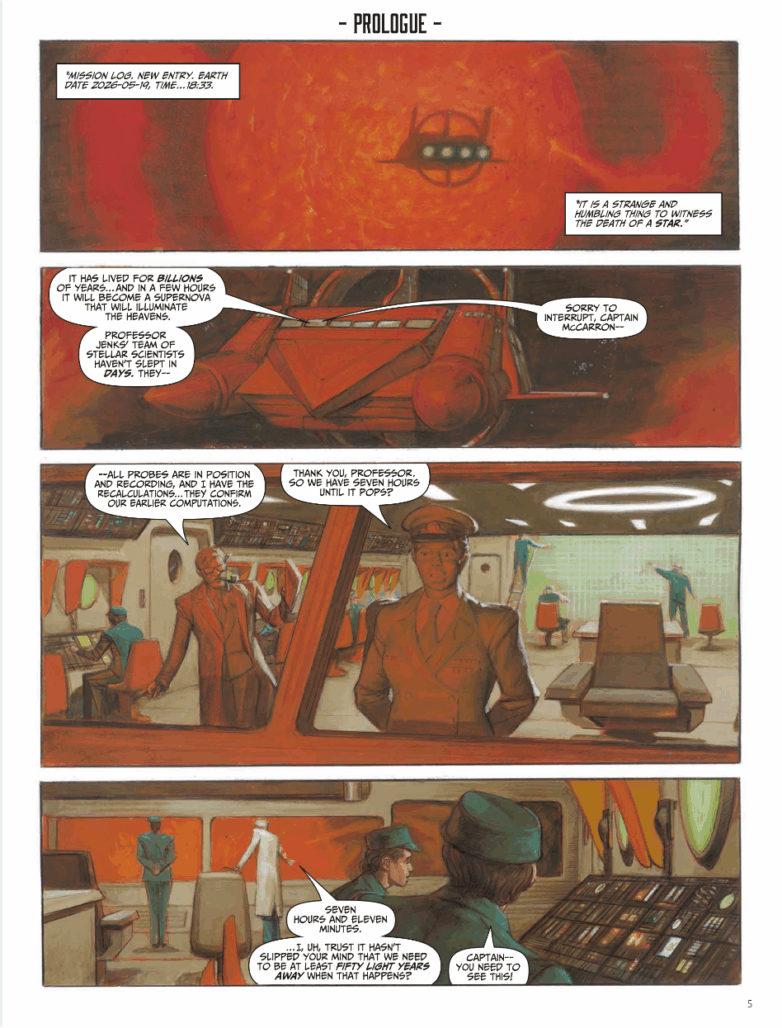
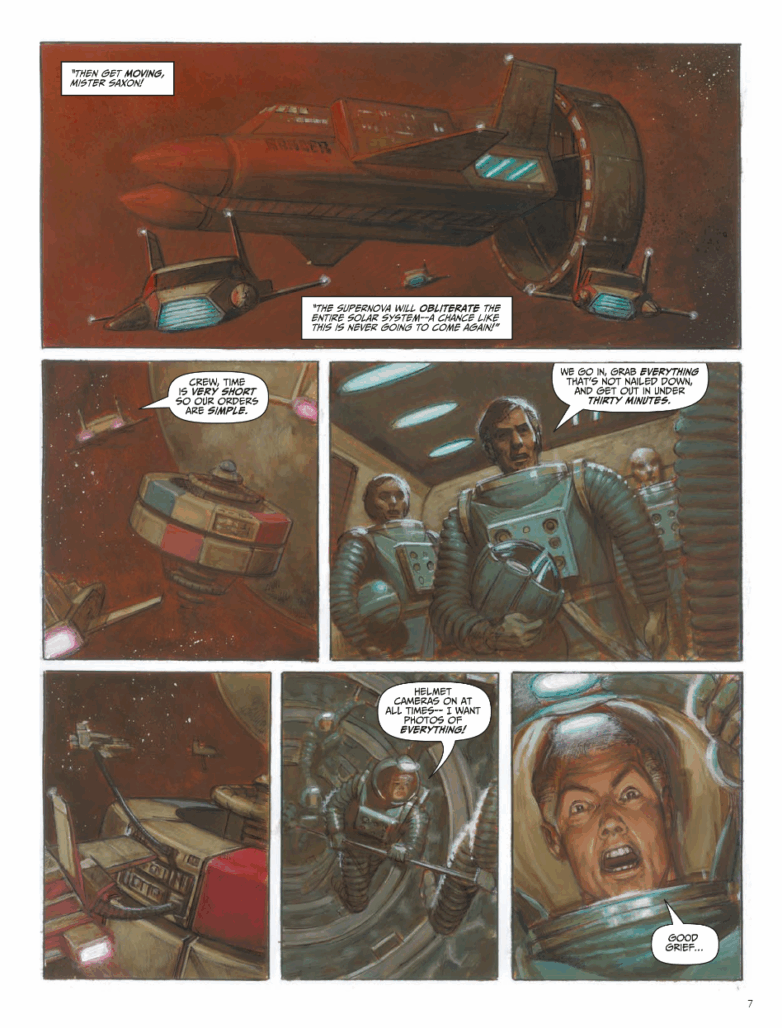
Tom Foster: The visual side was interesting. I had never fully painted a strip before, but part of the appeal of it for me was that I might get to improve my painting skills. So I did a few sample pages from the prologue, just to satisfy everybody (inculding myself) that I could produce the work to a high enough standard. On the basis of these, I was commissioned to paint the whole story. I knew that I was going to have to develop a painting style as I went, but I thought I could maybe retain the readers’ good will so long as the sensibility of the art seemed appropriate. I felt like, if I could nail the tone, I could keep them with me long enough to start producing some more impressive visuals.
Dean Simons: Did that make figuring out visual design easier for you, Tom? How’ve you approached this story?
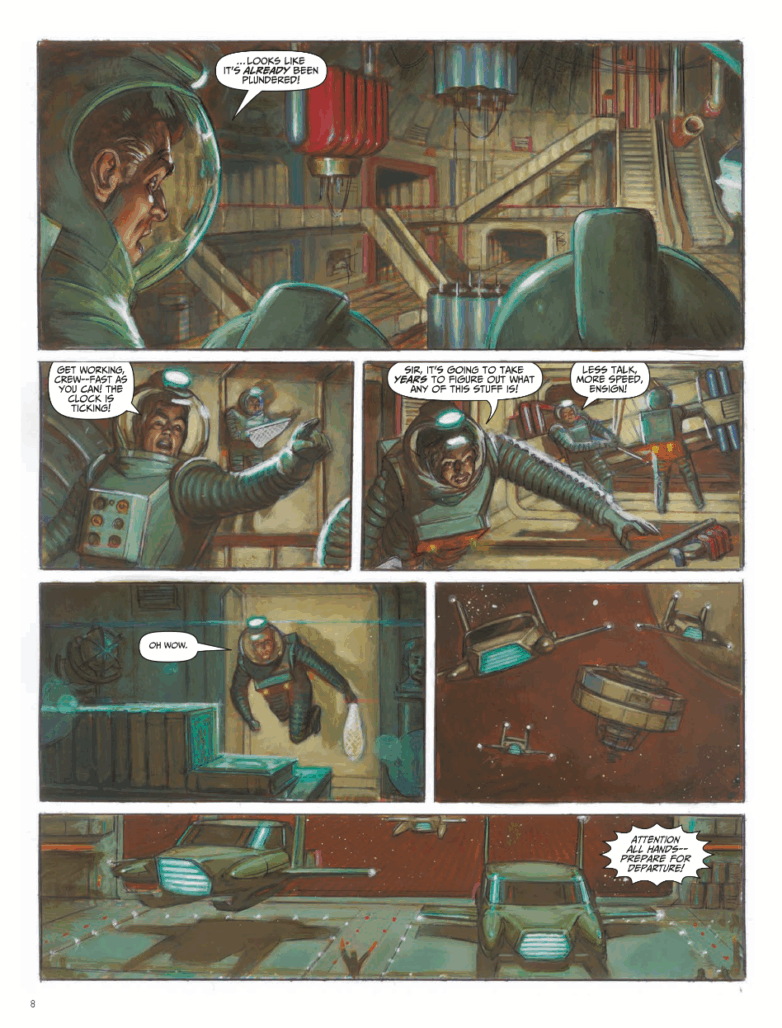
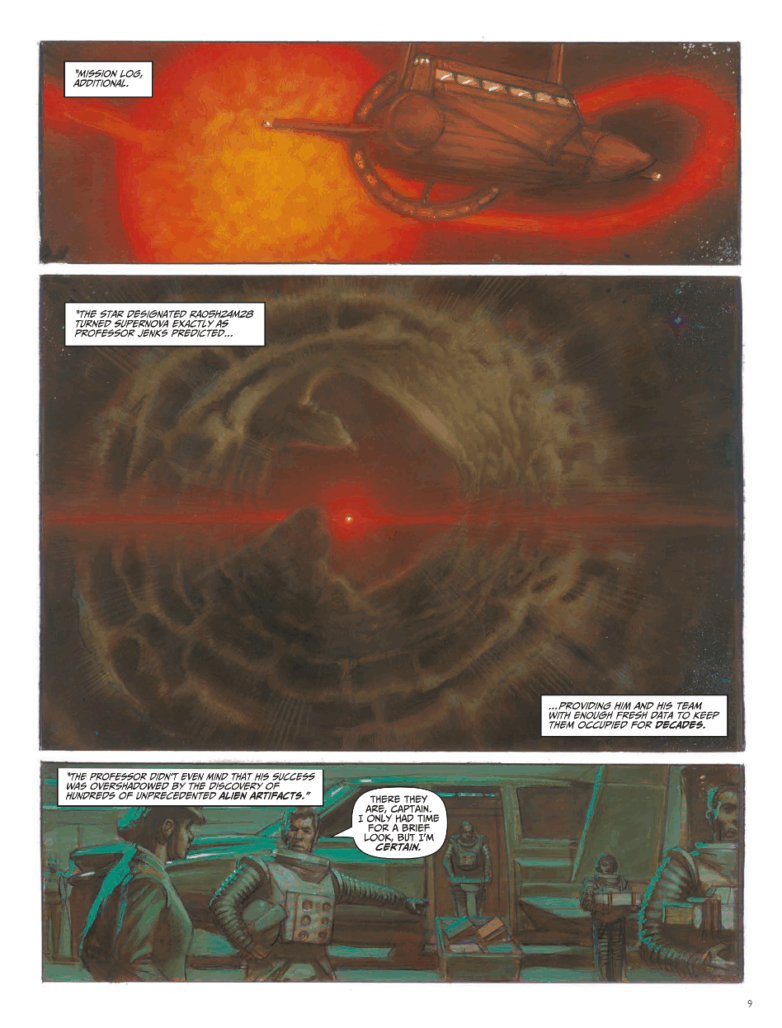 Tom Foster: I very much wanted to use solely practical materials to work on the book as I felt that a painterly look, even if it were a little different from the original art style, would best fit the feel of something that’s been on hiatus for such a long time. The artwork didn’t have to feel like it came out of the 1970s, but I didn’t want it to feel like it was specific to the 2020s either – that it could have been produced any time in the last 50 years.
I was very lucky to be given so much freedom with how I approached the visuals – it really allowed me to portray the story the way I thought it ought to look. I didn’t always land on the exact results I wanted, but I think, over-all, it was the best way to go about it. Even when I was struggling with working in a new medium, I felt like managed to communicate the tone that best fit a good, old-fashioned adventure tale.
Dean Simons: Is there a significant time jump from the last Trigan serial?
Mike Carroll: Definitely! Most of the original stories feature Trigo as middle-aged and Janno maybe in his very late teens/early twenties, but we’ve deliberately we’ve moved on a generation. Trigo’s an old man, Janno’s now middle-aged, married, with three children – two of whom are now adults.
Tom Foster: Luckily, the time jump is not so great that anything’s changed too drastically. The original characters are older but (mostly) still around and the new ones are only one generation removed. I think it’s enough to inject some novelty, but not so much as to break any sense of continuity.
Mike Carroll: Not all of the old characters will make a reappearance: after twenty-five or so years, many of them will naturally have moved on with their lives… I don’t want to say more than that for fear of spoiling too much!
Dean Simons: How accessible to new readers will the new Trigan be?
Tom Foster: While I didn’t want the art to be too jarring to those who followed the original strip, I didn’t want it to seem like just an exercise in reproducing a vintage style either. So, while it’s all hand-painted and has relatively straight-forward page layouts, the shot-choices and characterisation have all been influenced by the changes in comic storytelling during the intervening years. Hopefully, it shouldn’t seem out of place in a comics shop in 2026.
Mike Carroll: The reputation of the original series might help draw attention to this new chapter, but that alone won’t be enough to justify the publication! We knew from the beginning that the story had to be strong enough to stand on its own without the readers knowing anything about the original. I think we’ve achieved that… I certainly hope so!
If new readers enjoy this story enough to want to revisit the original material, I’ll be more than happy!
Dean Simons: How different is the planning process when writing a complete story for book rather than serialised for the likes of 2000 AD? Is it harder?
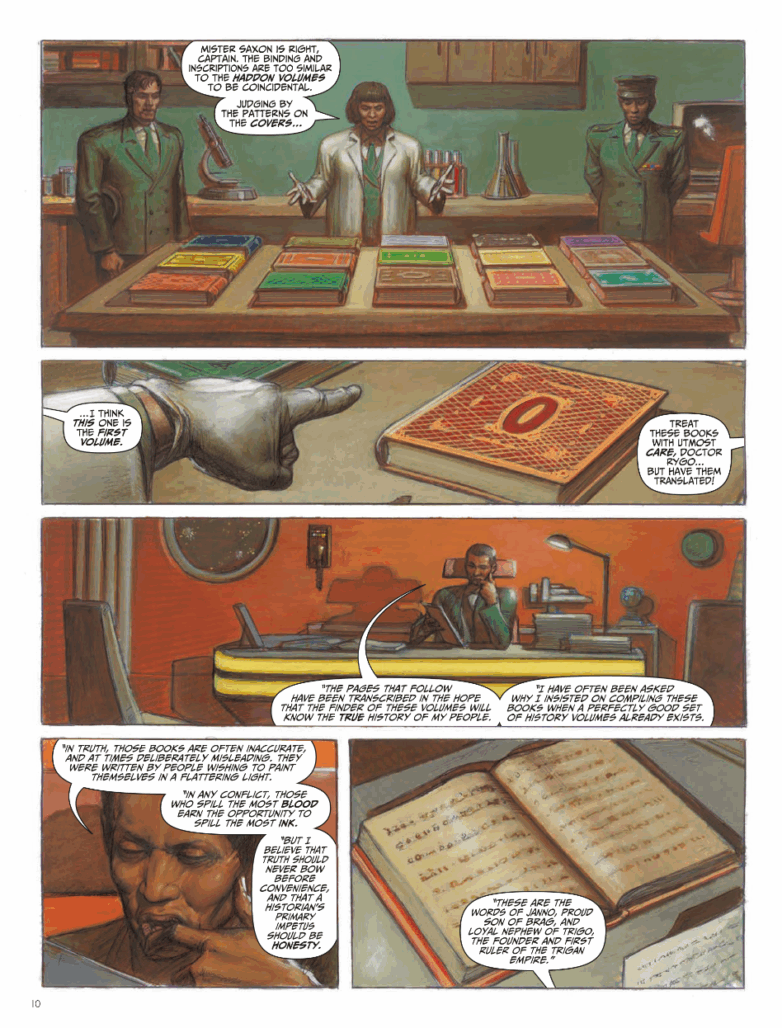 Mike Carroll: It’s really different only in the sense that a serial in 2000 AD has to be broken into five-page episodes (six pages for Judge Dredd), and each episode should ideally end on a cliff-hanger to keep the readers coming back for more, whereas with New Adventures from the Trigan Empire we can have chapters of different lengths! Woohoo! That extra elbow room is a great luxury and naturally I took full advantage of it!
That said, the limitations of an episodic tale in 2000 AD have definitely honed my writing skills, such as they are, and it’s something I’ve tried to pass on when I’m teaching upcoming writers: restrictions don’t have to be stumbling blocks… they can be stepping-stones. Or, to look at it another way, with a bit of effort and practice, we can use obstacles to climb higher and hopefully see further than we might otherwise.
2000 AD and its monthly companion Judge Dredd Megazine really are a crucible for creators: it’s tough to make it into the comics, tougher still to stay there, and it’s not uncommon to produce what you feel is an absolute masterpiece and to which the only reaction from the readers is a solitary, “It was all right.” Or sometimes nothing at all. Ouch! It can be tough, but it’s tremendous fun and hugely educational, and I’ll keep writing for Rebellion as long as they’ll have me!
The New Adventures from the Trigan Empire will begin May 20, with preorders and special editions now available on Rebellion’s webstore. Volumes I to VI of the seven-volume classic The Rise and Fall of the Trigan Empire are available now.