

Warning: This piece contains spoilers for all three acts Hollow Knight: Silksong. It also contains discussion of sexual assault, forced impregnation, and abortion within the context of the game.
Hollow Knight: Silksong barely needs an introduction. Selling a staggering 7 million copies and shutting down multiple e-commerce platforms, Silksong is the GTA 6 of indie games. The metroidvania game stars Hornet, a demigod bug that was captured and taken to the land of Pharloom. When she breaks free of her prison, she sets out to discover the identity of her captors and why they took her.
For me, Silksong was a welcome surprise. I saw the boss fights on TikTok and bought the game on impulse. By the fifth hour, I was hooked, and by the time I made it to Act 2, 20 hours later, it was solidified as my personal Game of the Year and one of my all-time favorites. So, of course I had to write about it, especially after dropping over 200 hours in it. I’m obsessed and the new DLC announcement will have me using my PTO in order to play it (thank god I use a pen name).
There aren’t as many essays on Silksong and its themes I thought there would be. There are discussions of the villains and the history of the world of Pharloom, nibbling at the edges of greater discussion. There are discussions of Grand Mother Silk being an over-bearing mother, but nowhere near enough discussion about ancestral trauma, generational curses, and the game’s female perspective.
I am fully aware that Team Cherry could have written this game’s story without thinking about all of its themes and implications. As a fiction writer myself, heaven knows that I don’t catch everything that I write. I also believe in Death of the Author (within reason, of course) so this analysis is just my assessment of the themes—motherhood, womanhood, white supremacy, and liberation—as I’ve interpreted them.
How Hollow Knight: Silksong handles motherhood

Silksong centers womanhood, framing this identity through relationships between women rather than through isolated heroism. Many characters are defined not by individual power but by familial or communal roles like the Forge Daughter, Sister Splinter, Widow and Grand Mother Silk.
This compliments Hollow Knight, which explores a father figure exploiting his children to achieve his vision. Silksong examines how a maternal figure uses her progeny to further her own goals. This shift reframes familiar power dynamics through a feminine lens, asking not only what womanhood is, but how it can reproduce systems of control as easily as it can nurture or protect. Womanhood can be loving, coercive, or exploitative, and Silksong uses different types of motherhood in order to explore this.
Through characters like the Moss Mother and the Broodmother, Silksong explores motherhood as both a natural life cycle and a site of bodily and psychological horror. The Moss Mother boss fight encapsulates the game’s themes by showing the full reproductive cycle of a species, going from Mossgrub to Mossmir to Moss Mother, emphasizing inevitability and sacrifice.
On the other hand, the Broodmother exemplifies forced, endless reproduction, her physical suffering rendered as horror. The Broodmother is found in the Slab during a quest “The Wailing Mother.” The quest is categorized as a “Grand Hunt,” meaning that whatever bug you find has to be killed. For “The Wailing Mother,” it felt like less of a tricky twist on a boss and more like a mercy killing.
Despite Hornet’s warranted disgust with the jailer flies’ existence after they kidnapped her and stole her ancestral weapon and clothing, it felt like I was setting her “free” in the same way that mothers in puppy mills finally become free of their “duties”. All flies are born from the Broodmother, charged to work the jails for a sin their ancestors committed that’s so old it has been lost to history.
This portrayal resonates with real-world experiences of bodily trauma associated with childbirth, particularly for those with wombs. This also has historical precedent in American history with the existence of breeding plantations and the rescinding of abortion rights to increase birth rates.
These are not the only examples of unwilling motherhood in Hollow Knight: Silksong. There’s also the “Witch’s Crest” questline.
In this questline, a parasite found in a cradle that cries like a human baby is forcibly inserted into Hornet’s body by someone she initially trusted. She has to go to a disgraced female doctor who was kicked out of a religious town to have it removed with special equipment. The parasite saps her strength and alters her moveset, even when mostly removed.
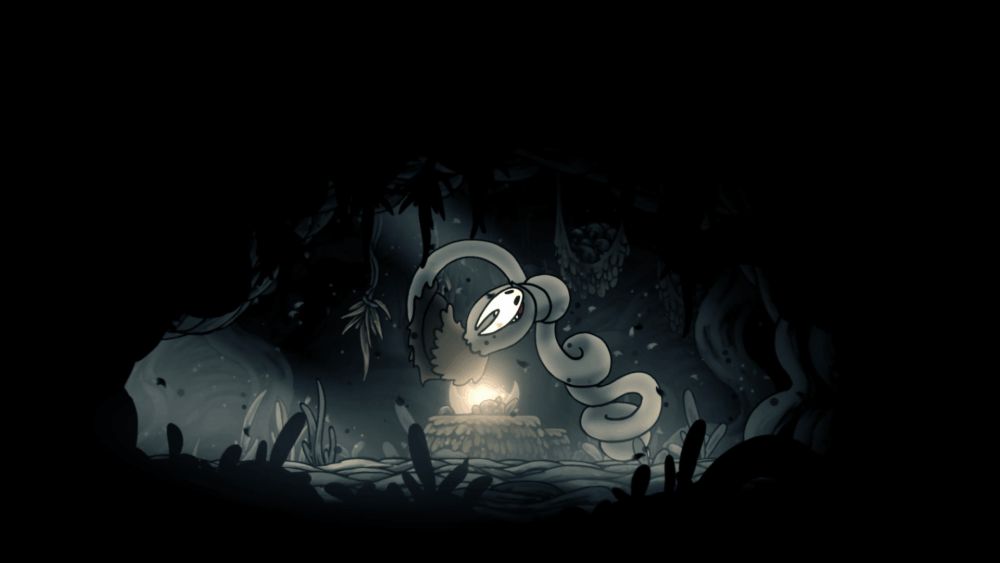
Although Hornet is a fictional bug, this story clearly depicts sexual assault and abortion. Seeing a disgraced female doctor that you can learn about through word-of-mouth is reminiscsent of the real-life Jane Collective, an underground abortion access group. At the end of the quest, when you attain a crest, is an obvious allegory for the ways a child’s genetic code can stay in a pregnant or formerly pregnant person’s body (fetal microchimerism).
In Silksong, even children can be unwilling participants in motherhood. Grand Mother Silk’s first children were the Weavers, a spider race she gave intelligence through her silk and who ultimately betrayed her in order to find freedom. Her manipulation of the Weavers mirrors real-world systems where women’s bodies and labor are used to sustain power structures rather than personal fulfillment.
Silksong‘s critique of colonialism
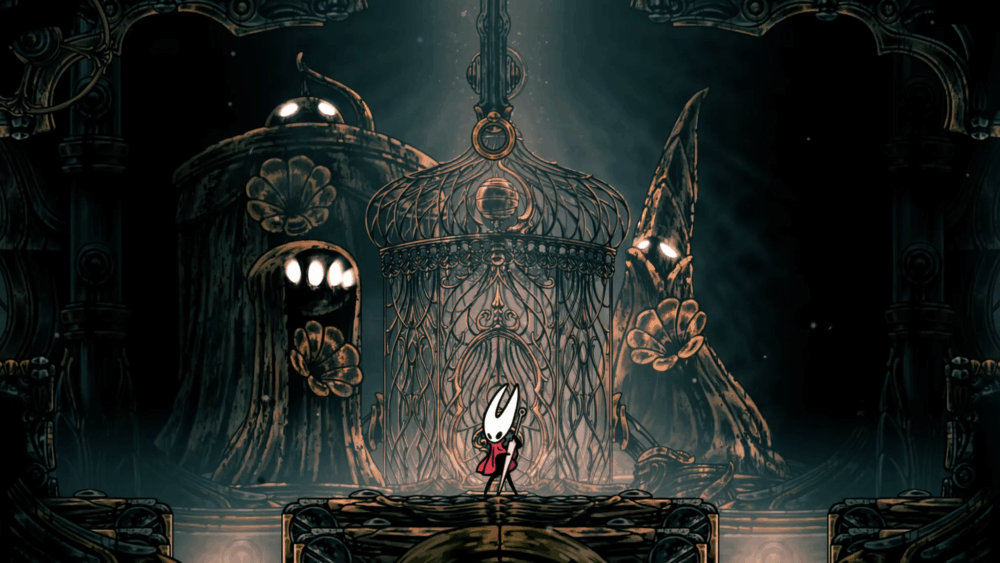
Silksong critiques white supremacy and colonialism through its depiction of Pharloom’s ruling structures. Act 2 reveals the Citadel’s supposed holiness and safety as a façade maintained through violence, control, and historical revision. Pilgrims are transformed into mindless servants via Grand Mother Silk’s thread, exposing how devotion is weaponized to sustain power, whether this is devotion to systems, or devotion to religion.
The Citadel’s three main factions—the Conductors, Architects, and Vaultkeepers—mirror colonial systems that expand territory, manufacture legitimacy, and control historical narratives. These roles illustrate how colonial powers define safety, truth, and success within frameworks designed to uphold their dominance.
This is present in explicitly in the Memorium, the Pharloom version of the British Museum. In this small area, there are collections of bugs from across Pharloom and displays of conquered or erased cultures as trophies. The Citadel mirrors real-world practices of cultural theft and historical erasure. Its exclusion of resistant cultures underscores how histories that challenge dominant power structures are destroyed through this exclusion. This is similar to how Indigenous oral traditions and languages become endangered.
As the story progresses, it becomes clearer that multiple cultures were wiped out (or nearly so) in order for the Citadel to rise in power—be it through violence like the Karak Kingdom and Verdania, through ecological destruction like Bilewater and Greymoor, or through begrudging stalemates like Shellwood and Hunter’s March (each with their own “punishments” for not capitulating to the Citadel). The Citadel also maintains power by enslaving those whose ancestors have sinned, like the aforementioned flies in the Slab.

Even Citadel residents themselves are not free from Grand Mother Silk’s haunting and rule. Those who are not considered “pure” enough are given lifelong sentences to work in the dangerous Underworks, or have their bodies used as lights in the “hospital” Whiteward if they are too sick or frail for the Underworks. Grand Mother Silk’s oppression varies by degrees, but it’s still oppression.
This is expressed literally with Hornet. Multiple times throughout Hollow Knight: Silksong, she is defined as a demigod. She was born of a loveless mating between a powerful weaver queen, Herrah the Beast, and a higher being, the Pale King, to continue the Weaver line away from Grand Mother Silk’s control and to seal away the infection during the events of Hollow Knight.
Hornet’s “birthright” to dominance is assumed by multiple bugs in the Citadel like the Vaultkeepers. The Snail Shaman masquerading as a caregiver for the pilgrims in the Citadel’s small camp Songclave flat out asks if Hornet is only trying to take down Grand Mother Silk so she can reign over all the bugs as queen instead, which Hornet denies.
In pursuit of freedom
Hollow Knight: Silksong is ultimately a story about genuine liberation rather than reforming broken systems. It critiques common liberation narratives that focus on individual transgressors or “exceptions” rather than dismantling oppressive structures themselves. True liberation requires rejecting the systems entirely, not merely disrupting them. Act 3 of Silksong exemplifies this.
In Silksong, liberation is collective, costly, and uncomfortable. At the end of Act 2, Hornet gets offered a way to defeat Grand Mother Silk, once and for all. The quest, “Silk and Song,” requires going all over the map to find three souls and a tool called a Snare Setter. There are no explanations about where the three souls are from, just that the snail shamans masquerading as pilgrims have them. It seems too simple of a task to trap Grand Mother Silk—because it is. The trap sends Grand Mother Silk and her daughter Lace into the Void, an abyssal black realm that no one can escape. However, this is not liberation. This is incarceration masquerading as liberation.
Instead of the game ending there, it continues into Act 3, in which the main objective is to undo Hornet’s mistake in trying to take an easy way out. The Void has infected the silk that the bugs are haunted from and destroyed various parts of Pharloom. All bugs that have been “black-threaded” end up doing double damage and having double the health as before. Their voices are warped and the unluckiest of them can congeal and become Void Masses.
The solution to this issue involves recalling Hornet’s own memories from before she was in Pharloom. In the Red Memory, Hornet is reminded that she has full control to do what she wants with her life by her mother, mentor, and ancestor. While her lineage is something other bugs will want to use to their own ends, it’s ultimately up to Hornet to figure out what she wants to do with the power her lineage grants her. Ultimately, she chooses to free Pharloom and let the bugs that live there make decisions for its future.
In conclusion, Silksong is a rare example of a liberation narrative through a female lens in games. Whether it was the intention of Team Cherry or not, Silksong‘s story is one for the books. Through its themes of motherhood, womanhood, white supremacy, and liberation, it weaves a story that will be dissected for years to come.
Hollow Knight: Silksong is available now for Nintendo Switch 1/2, PC, PlayStation 5, and Xbox Series X/S.