
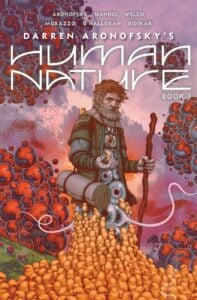
 Human Nature Book 1
Writers: Darren Aronofsky, Ari Handel, and Jeff Welch
Artist: Martin Morazzo
Colorist: Chris O’Halloran
Letterer: Aditya Bidikar
Publisher: Abrams
Publication Date: March 2026
It is worth noting that I had elected to review this book prior to Darren Aronofsky’s decision to make an entire work using AI generated content. Had this decision been made prior to Aronofsky opting to sell out what artistic integrity he had left after pilfering the works of Satoshi Kon with abandon for the sake of some abysmal project involving the Revolutionary War, I simply would not have agreed to do it. But I made my bed, so I might as well sleep in it.
Although, Aronofsky’s embrace of AI — such that the biography for Aronofsky concludes with a note that he has founded Primordial Soup, “an AI-focused film studio” — is quite ironic considering Human Nature’s supposed core target of criticism and, quoting the blurb, satire: Billionaires. There are certainly elements the book gets right: an obsession with surpassing death, a lack of empathy towards living creatures, a lot of sexual hang ups. However, the overall critique feels a tad bit weak. As if the book’s three authors — Aronofsky himself, frequent Aronofsky collaborator Ari Handel, and the rather limitedly credited Jeff Welch — don’t really have a concrete angle on the billionaire class.
Part of this may be due to the overwhelming sense one gets that this is an incomplete story. This might be obvious to the keen observer who noticed the words “Book 1” in the title, however the first part of a serialized story can still feel complete. To use one of Aronofsky’s contemporaries, Quentin Tarantino’s Kill Bill vol. 1, while setting up a second film nevertheless feels like its own film with complete arcs for its various characters. Moreover, the ending cliffhanger feels like a punch to the gut rather than a moment of perfunctory plotting.
Worse, one can easily see the stronger cliffhanger within the book. Human Nature Book 1 is split up into three sections: the relatively modern day, the zoo, and the cage. Both the modern day and zoo sections are rather strong within the context of the overall book, presenting various casts of characters who push our nominal hero, Duke, to change as a person. By contrast, the cage section feels a tad bit perfunctory, its cast of characters a tad bit flatter than those who came before. Indeed, the ending of the zoo portion would act as a stronger cliffhanger than the cage, with its ending being more ambiguous and uncertain than the cage’s “Is our hero going to die?” cliffhanger. Considering the book is framed with an elderly Duke telling the story of his adventures to the next generation, the answer is obvious and thus lacking in the uncertainty a good cliffhanger requires.
On the artistic front, Ice Cream Man’s Martín Morazzo brings his cleaner continuation of Carlos Ezquerra’s grotesque flavor. While Human Nature Book 1 lacks many of the disquieting elements that makes the best issues of Ice Cream Man sing, Morazzo nevertheless provides the right degree of unsettling to the world our characters find themselves within, be it the modern era or the alien world. Meanwhile, Aditya Bidikar acclimates himself well to science fiction, utilizing a color coordinated text box to separate the various characters. Sadly, Bidikar is not given an opportunity to show off, leaving him to do the silent heavy lifting to make the book coherent.
Overall, Human Nature Book 1 is incomplete. To give it a proper analysis would require having an ending that highlights what the overall thematic intent of the book truly is and how well it succeeds in pulling that off. Sadly, given Aronofsky’s life choices, I feel rather disinclined to put in the effort of reading such a conclusion, let alone review it.
Human Nature Book 1 is out this month via Abrams
Read more great reviews from The Beat!