
 I Am Their Silence
 I Am Their Silence
Cartoonist: Jordi Lafebre
Translator: Montana Kane
Publisher: Dark Horse Comics
Publication Date: January 2026
“I have to solve the murder. It’s just a case of gathering up the bits and putting everything back together. Then I’ll see it whole, the way it was before it was broken. I’m just frightened they’ll find me before I can finish.”
–The Mystery Play, Grant Morrison
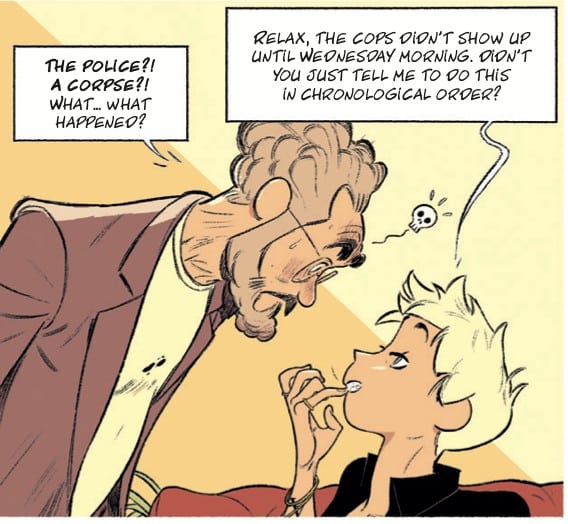
What is the point of a detective story? Is the purpose to understand the base mechanics of who, how, and why? A mere puzzle to be solved that will explain everything? Is it a study in cultures, to understand the world that a murder happened in? In the systems by which a murderer was allowed to get away with a it? Or is it, as Chandler said of Holmes, “an attitude and a few dozen lines of unforgettable dialogue.”
What then, do we make of our detectives, be they lean arrogant bastards like Sherlock Holmes, dim witted brutes blundering their way into a resolution like Mike Hammer, or complete and utter mad men like Columbo? Just what kind of person is drawn to solving mysteries that involve murders most horrid?
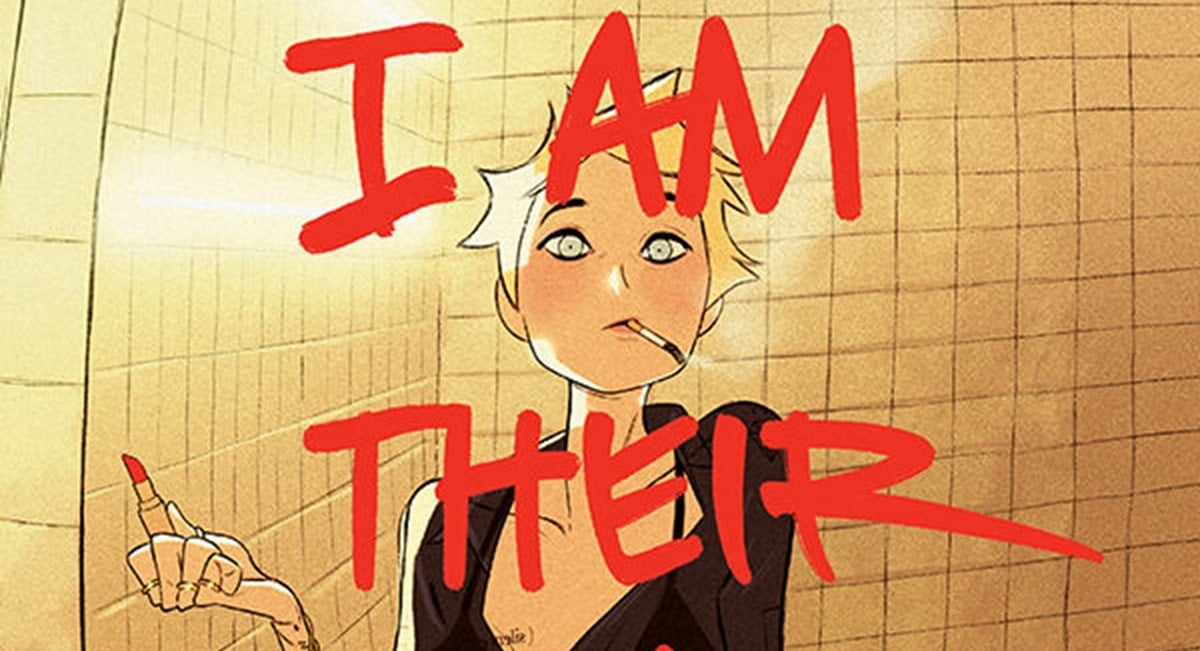
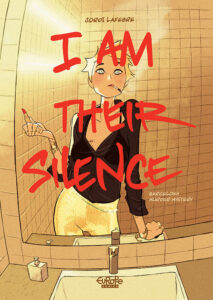
This question is at the heart of Jordi Lafebre’s I Am Their Silence. We follow Dr. Eva Rojas as she investigates the murder of a wealthy wine maker for seemingly no other reason than her own curiosity. More interestingly, however, is that this recounting of a murder mystery is not presented to us via a journal or a third person narration. Instead, these events are framed through the lens of a psychological review of Eva by a court ordered shrink.
As becomes quickly apparent to the reader, Eva has a number of neurological maladies. While the vast majority of them are presented with the obvious yet charming visual hallucinations such as burning telephones or the ghosts of her dead relatives, the most interesting method of presenting the neurodivergence is in the paneling. Lafebre structures each page of the comic (bar the five splash pages) in rows of three with two or three panels per row, with only two instances of a four panel row and one of a single panel row. What makes it interesting is that the panels never coalesce into grids until the very end, be they six or nine panels in size. This results in a sense of unease with regards to the subjective experiences of Eva.
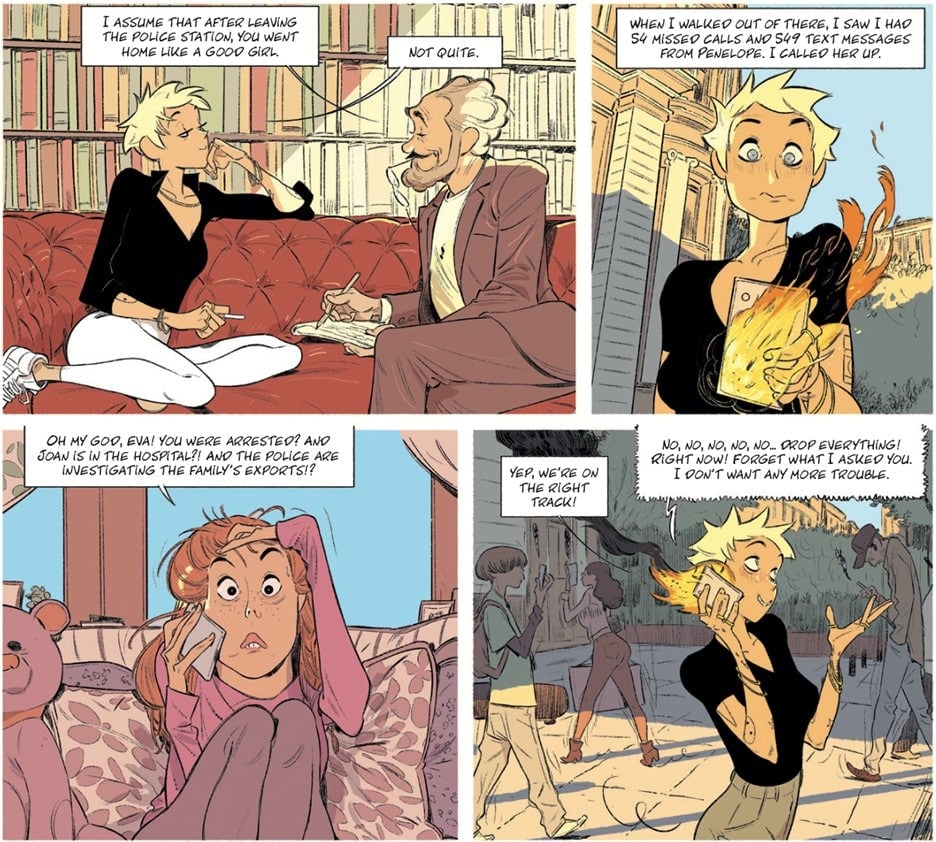
In many regards, Eva fits the bill of many traditional detective standards. She has a moral sense of justice, a distrust of authority (that more often gets her into trouble than saves her neck), and a tenacity to face off against insurmountable forces. Equally, she’s a hard drinker, libidinous (though with lines in the sand), and, at times hot tempered. What makes her interesting is the wry, almost comedic sensibility she brings to her detection. It’s not that she is a fool blundering in to the story like a Frank Drebin. Rather, Eva is framed as a character from a comedy being thrust into a dramatic murder mystery.
This is emphasized by Lafebre’s art style. While the world of Barcelona has a degree of realism to it, the characters that inhabit it are cartoons with exaggerated features. There are times when Eva’s mania has her eyes almost burst out of her skull or suspects miserable wallowing collapse their faces down to Jello. But one never gets the sense that she or any of her suspects are out of danger. One horrifying sequence in which Eva almost kills a (horrible, evil, probably should be killed) man sets itself up with a comedic solution before forcing us to look at the disturbing nature of the reality of what she has done.
What’s more, the work is just a delight to read. The dialogue (aided for English speaking audiences by translator Montana Kane) is witty and charming, it’s paced at a breakneck speed that still allows the reader time to breathe, and then there’s the heart of the matter. For all that it purports itself to be a detective story, the heart of the comic is more akin to Who’s Afraid of Virginia Woolf than Inherent Vice.
The comic builds to a simple question that can be answered quite early on if one is paying close attention. But more than the murder, it is the beating heart of the story. In some regards, when writing criticism, one has to approach it as an autopsy or an investigation. All the pieces are laid out before you to see the full picture. To express your findings to the public and let them make of it what they will.
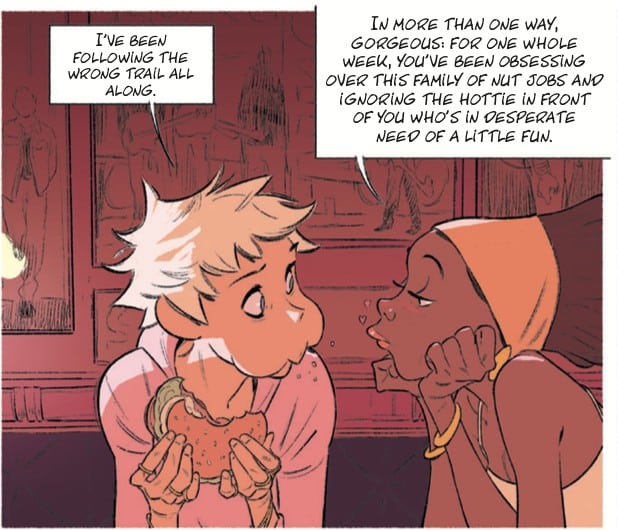
In truth, the resolution of the mystery isn’t usually the best part of them. Chandler was quite famous for writing endings that didn’t track with anything that came before. The point of a mystery, then, isn’t to solve it. Anyone can solve something. The point is to understand it. To see the whole of a thing and, if not make sense of it, then be capable of seeing it for what it truly is.
And, well, I Am Their Silence is pretty damn good.
I Am Their Silence is out this month from Dark Horse Comics.
Read more great reviews from The Beat!