
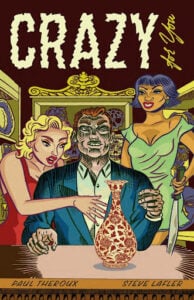
 Crazy For You
Writer: Paul Theroux
Artist: Steve Lafler
Publisher: Fantagraphics
Publication Date: March 2026
In 2021, Steve Lafler announced that he was working on comic adaptations of Paul Theroux’s writing. In an interview with The Comics Journal, he summarizes Theroux’s sensibilities as “He writes about people in a respectful way, but it’s not like he’s going out of his way to respect them… it’s just where ever he is in the world, he’s being human. He’s connecting with them.” Lafler’s perspective on Theroux is that of a humanist traveler, someone who sees the delicate and humbling aspects of our shared humanity rather than focusing on the obvious and often reductive elements of travel writing.
That sense of humanity can lead to a great deal of insight, like highlighting the transactional nature of most modern relationships. To see people as they are and essentially “reporting” on the practices that make us human and reveal the way that’s been tarnished by capitalism or just plain human cruelty. On the other hand, that approach can sometimes be too far removed from the perspective of the people being written about, becoming judgmental and leering at others that may not intentionally seem disrespectful, but certainly has that quality without proper grounding.
Lafler toes this line in Crazy for You, giving us first “Minor Watt,” a good story in line with the spirit of Theroux’s writing, and second, “Siamese Nights,” a more cliche, dehumanizing story that highlights Theroux’s limited perspective. Lafler’s style that rests somewhere between 60s adult animation and 70s underground comics is a great fit for the material, balancing the sexy and the crude, the silly and the flat out absurd. While that tension serves “Minor Watt” well, it also unfortunately brings out the worst of “Siamese Nights.”
“Minor Watt”
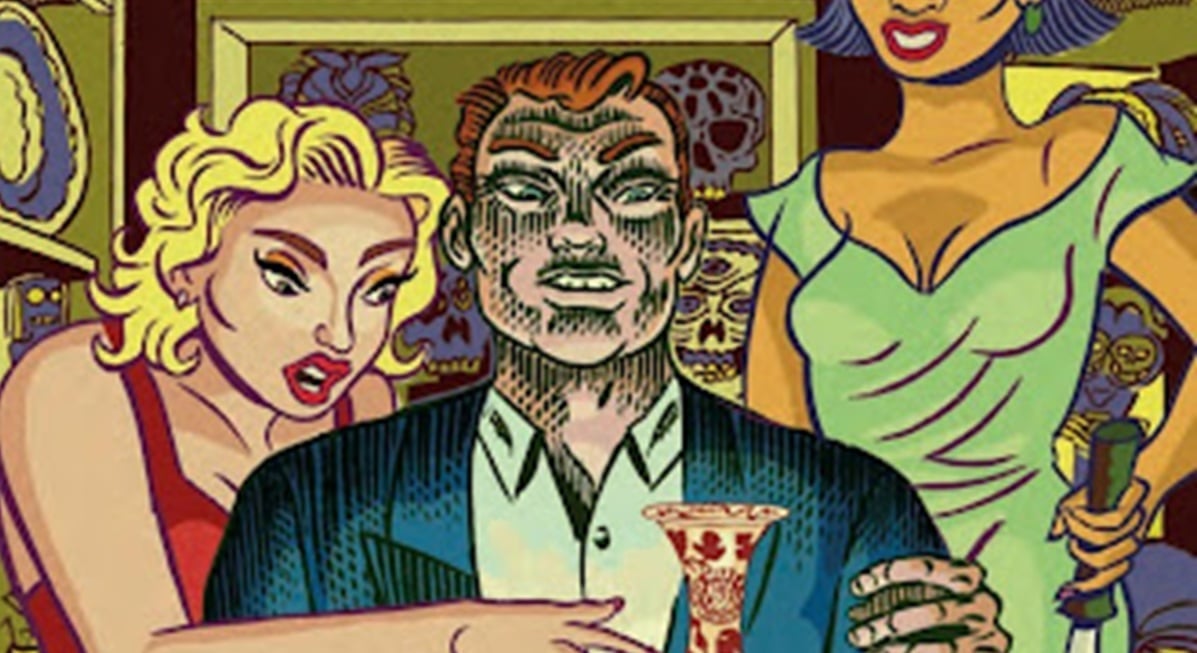
The first story follows the eponymous Minor Watt, who’s described as a rich real estate baron and art collector. Minor is in the middle of a nasty divorce where his soon-to-be ex wife is requesting possession of a priceless Ming Dynasty vase. Once the two agree to meet to exchange the vase, Minor “accidently” drops it, so that neither can take possession of it ever again. Rather than anguish over the tragedy they’ve both just witnessed, Minor laughs hysterically as he discovers the only thing better than owning all the greatest art in the world is destroying it.
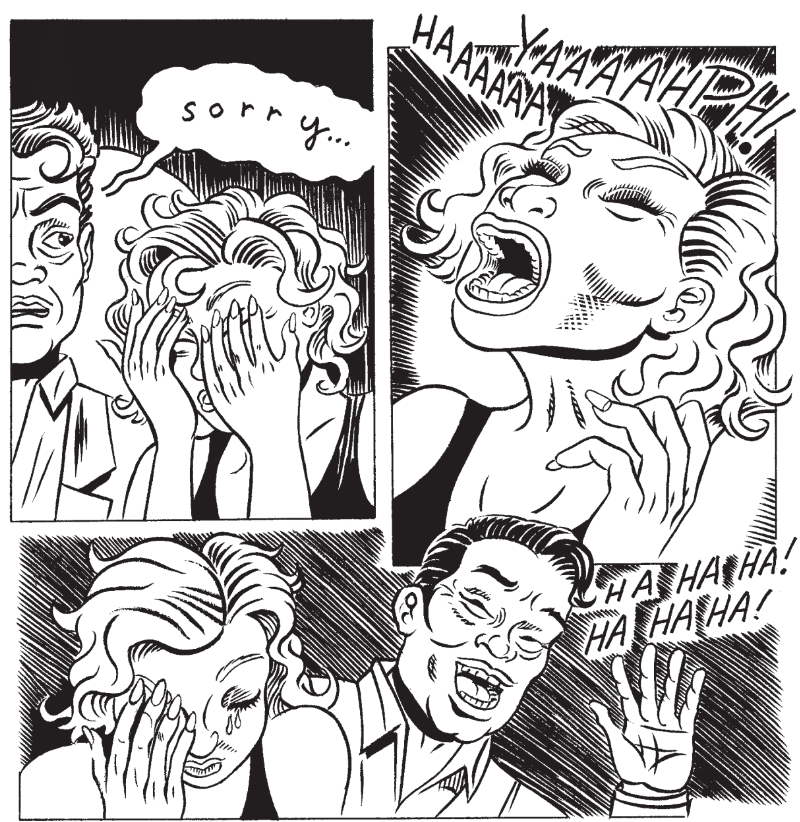
“Minor Watt” is primarily about the transactional nature of art, and how the competing views of what makes something art — whether that be its beauty, cultural significance, or usefulness — is flattened by its more base qualities of scarcity and price. Watt is at the center of the art scene throughout the book, he knows all the dealers and has a better knowledge of artists and movements than anyone he associates with. He clearly understands what he’s looking at beyond its price. Yet his engagement with all his art is merely to hoard it, to see the envy in others when he’s able to buy something at auction for far more than anyone else is able to pay, and to brag about possessing one of a kind, irreplaceable pieces.
The art world throughout “Minor Watt” mirrors his own superficial engagement with art pieces. Like Watt, everyone else is competing for the same limited works for the same reasons. When Watt begins his spree of destroying notable works, the horror in the various onlookers and guests is about the money he’s wasted, about the rare object he’s robbed everyone of possessing. No one seems to care about the work itself, its history, or what Watt has robbed the general public of one day seeing.
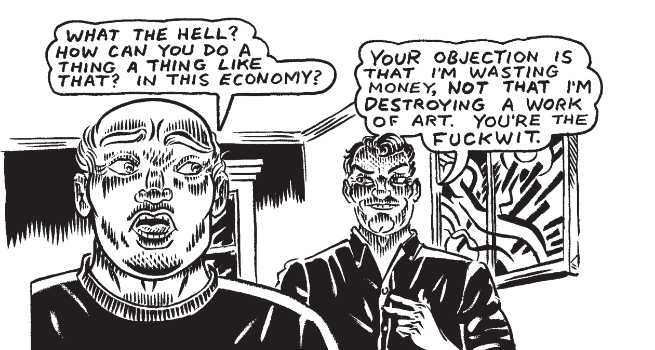
As the story progresses, Watt’s path of destruction starts to take aim at the frustrating nature of modern art movements. I’m sure many people have gone to museums and seen something like a Rauschenberg White Painting, or some installation that calls attention to its crudeness rather than its sophisticated construction. Some look at these kinds of pieces and say “I could’ve done that!” or “how is this art?” The trouble with understanding most modern art is that the concepts, theories and traditional notions of art these artists try to engage with all exist within exclusionary spaces alongside the very things they criticize. The art world is one that’s foreclosed to many by the very limited access and cost that people like Minor Watt facilitate and the tragedy is that most of the people allowed into that world don’t care to understand what they’re looking at. In that spirit, some of Watt’s destructive demonstrations bring those frustrations to the surface, like taking aim at a painting that looks like a target, or kicking holes in a Rothko square.
At one point, teens disenchanted with the modern art world start to see Minor Watt as a kind of iconoclastic performance artist, a notion Watt quickly dismisses. Watt isn’t here to reveal the tensions within institutional theories of art. He’s merely an expression of those same forces taken to their furthest extreme. Watt’s rampage doesn’t change the cultural position of art and circles he’s allowed to run in, it simply serves to remind us that the art collecting world has already destroyed art in spirit, so why not also destroy it in practice?
Watt’s story ends in really the only way that it can, not with a loss of his power or wealth, but by experiencing a public humiliation that is facilitated by the very art objects he’s contributed to destroying. Though admittedly there isn’t much satisfaction in this, with the ending feeling abrupt rather than properly ironic. Watt gets to see his power lost when the transaction finally goes the other way but that fails to reverberate throughout the larger ideas of the story and the book’s criticism of the art world. It’s a slap on the wrist, rather than a hefty dramatic irony.
That said, Lafler’s style is key to the story’s success, rendering this world of the snobby upper class as crude and disconnected from reality. One gets the sense that Lalfer enjoys seeing the devastated faces of these rich art collectors as a masterpiece is destroyed in front of them just as much as Watt himself. Lafler’s lampooning of prestige, movie stars and the idle rich in works like 1956 naturally flow into “Minor Watt” as a story about how one’s appreciation of the arts can’t be measured by its superficial coupling to status. I think Lafler’s connections to these themes are why this story largely works so well, but that perceptible personal touch is lacking with the second story.
“Siamese Nights”
The second story follows a business man named Boyd Osier on a trip to Bangkok. Boyd is inching closer to retirement and uses his work travel opportunities as a chance to draw beautiful scenes from around the world for his wife. Upon arriving, Boyd meets his immature, partying coworkers who keep asking him out for drinks. Boyd finally accepts one of these invites and runs into a beautiful trans woman named Song.
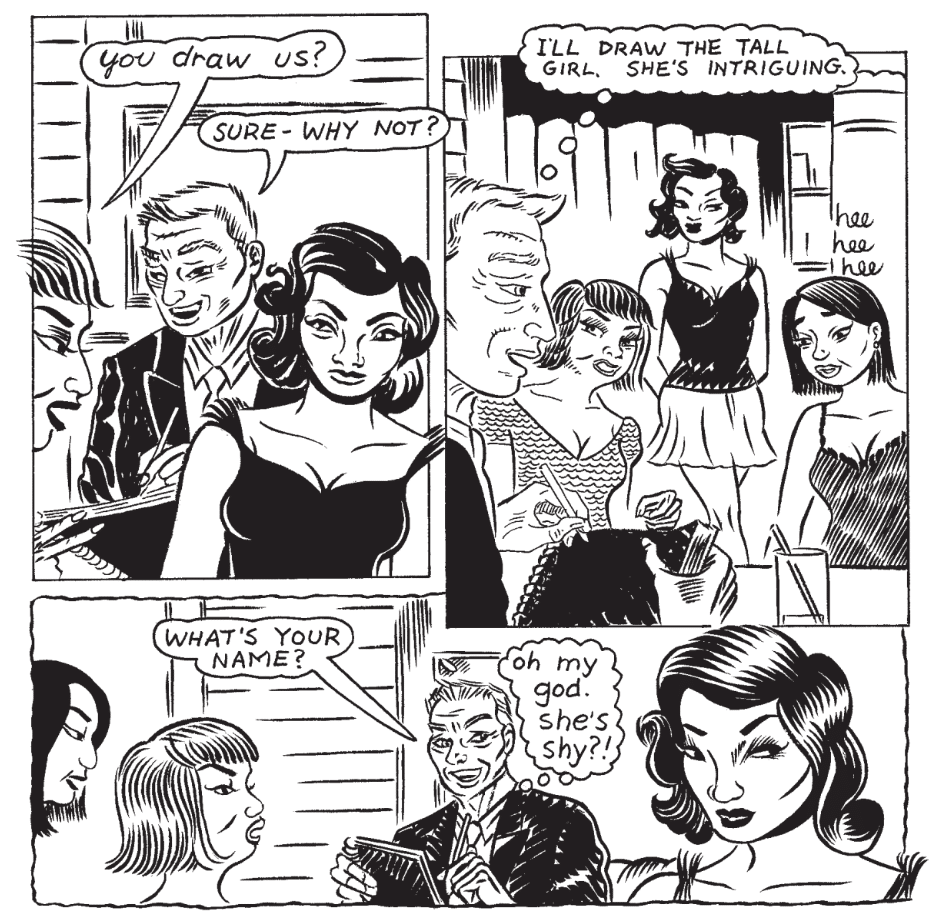
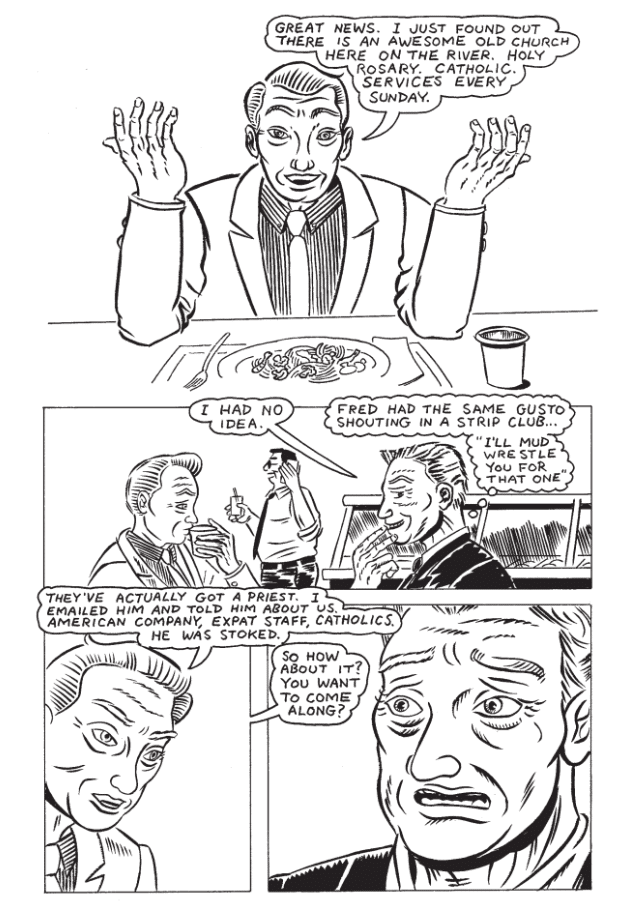
Boyd’s intrigue quickly turns into infatuation as the pair start to rendezvous every night, with Boyd even neglecting his wife and his job to be with Song. He stops drawing the various scenes of Bangkok and instead devotes all his time to having dinner with Song, buying her a phone so that they can stay in touch, and roaming throughout town to find her if she doesn’t answer. The anti-trans stigma of Boyd’s coworkers then leads to hypocritical conversations about the sanctity of family and religious devotion, all ideas in service to pulling Boyd away from Song.
Like “Minor Watt,” this is a story about possession and how quickly that can turn into a controlling obsession. Where Watt’s story was about the natural consequence of a transactional relationship with art, Boyd’s story is about repressed desire that expresses itself as a need for the same kind of destructive control. His inner thoughts are constantly filled with self-doubt and denial, playing out the competing impulses of his love for Song and honoring his obligations to his job and wife. In that way, Boyd is a far more sympathetic character than Watt, though that doesn’t mean his story is more compelling.
“Siamese Nights” is primarily a story of sexual repression and the ascetic quality of the daily American grind. At first Boyd’s life seems like it’s all coming together, between his wife and working towards a retirement that will finally set him free to do what he wants. But once in Bangkok, he realizes that so much of himself had been denied, that the constraints of his “normal” life forced him to never explore the depths of his own desire. Now that he’s lived a whole life before seeing himself for what he is, that touch of danger and excitement hits him with all the decades of repression all at once. Desire becomes obsession, and his life rather than being freed ends up in a new system of control.
The trouble with this, however, is that the vehicle to explore transgression and repression is in the form of an Asian trans woman. “Siamese Nights” falls into the classic trap of treating Asian characters as “exoitic” and “otherworldly,” and couples that with transness as synonymous with sexual deviance. Together, Boyd’s breaking of taboos throws Song under the bus, rendering her as nothing more than an object that builds off decades of dehumanizing depictions of Asian women and trans women.
One could argue, that’s the point. That perhaps the repression under capitalism makes objects of us all, makes any transgression a form of oppression. Like “Minor Watt,” we are not breaking from a cycle of exploitation, we are merely arriving at the natural conclusion of what life looks like when you’ve internalized these evils for so long. And while an element of that is clearly in the comic, Boyd’s perspective and struggle become its own oppressive force that makes this caricature of a trans woman stuck in a transactional world far too stereotypical to simply ignore. These are holdovers from Theroux’s text, to be sure, but unlike “Minor Watt” it’s Lafler’s style that heightens lust and obsession in a way that makes our perspective of Bangkok leery and judgemental rather than sympathetic. Song and Boyd don’t read like co-conspirators making the best out of a capitalist world, Song rather is simply Body’s vehicle to unlock his own repression in a way that builds off sexual and racial stigmas the story doesn’t address.
Taken together, “Minor Watt” and “Siamese Nights” read like two ends of the spectrum for Lafler, one that evokes his roots as a rebellious underground artist, and the other that reflects back on a life that is defined by the daily grind to make ends meet. In the interview referenced above, Lafler describes himself as “part used car salesman, part stand up comedian.” One end of this is explicitly linked to the transactional aspect of art, but the other can be joyous, freeing, formless. After years of work, Lafler is able to take these two parts of himself to tell a story about the dangers of both extremes, that to be an artist is to sign up for a part time job as a used car salesman and if you aren’t lucky that’s all you’ll ever be.
Crazy for You is ultimately a mixed bag. I like “Minor Watt” a great deal, and I like how both stories serve as a cautionary tale on artists and Lafler’s work at large. But they are limited by Theroux’s source text. The observations are good, but not so good that they make up for the shortcomings in “Siamese Nights.” If you’re interested in Lafler’s work, there are better, more formally interesting places to go like the aforementioned 1956. I think “Minor Watt” is worth the price of admission, but after that there’s plenty of other comics by Lafler and short stories by Theroux worth reading.
Crazy For You is out this month via Fantagraphics
Read more great reviews from The Beat!