
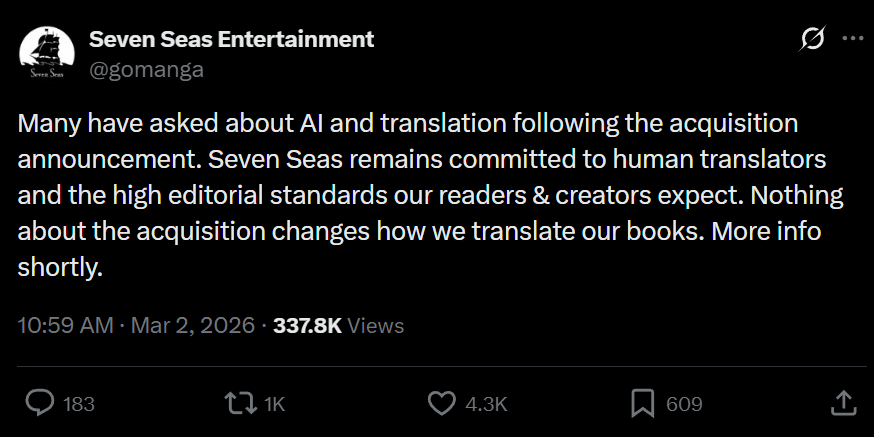
In response to the public outcries against the use of AI in its translations, Seven Seas Entertainment publicly posted on X (formerly Twitter) that it “remains committed to human translators.” Public comments exploded at the manga publisher’s recent acquisition by Japanese eBook distributor, Media Do. Many doubt the sincere attempt to provide transparency to its readers, with one user stating, “you don’t get to decide anymore.”
A day after Media Do made the surprise announcement of the 100% purchase of Seven Seas’ outstanding membership interests, the company released an English translated version of its initial notice on under Investor Relations on its site. There, it explains its reasoning and objectives for purchasing Seven Seas. The rationale includes the exponential growth potential of “overseas sales of the Japanese content industry,” which surpasses “the export values of the steel and semiconductor industries.”
Media Do explains Seven Seas’ is “the No. 1 independent publisher in the North American manga market and holds an overwhelming position in terms of the diversity and comprehensiveness of its Japanese content.” In addition, it prizes the manga company’s strong eBook and physical distribution network, which Media Do acknowledges “the single greatest barrier to the overseas expansion of Japanese content.”
Within Media Do’s previously released Medium-Term Management Plan (FYE 2/26 – FYE 2/30) on April 14, 2025, the deck extrapolates on its development of the “MDTS” (MediaDo Translation System), an AI-assisted translation system “to enable large-scale, multilingual translation.” The plan is to integrate the tool and “build a system that maximizes the use of human resources such as translators” to shorten the time for multi-language translation.
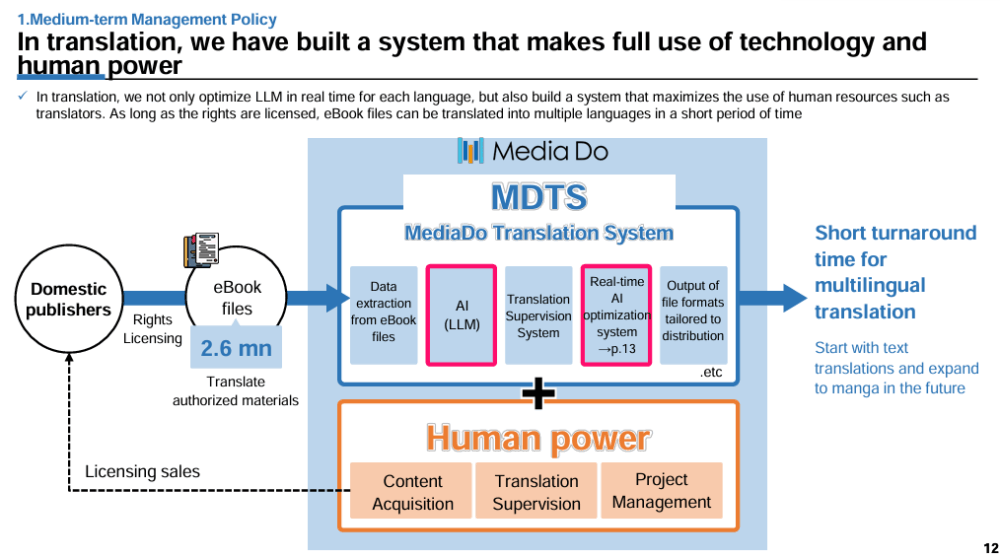
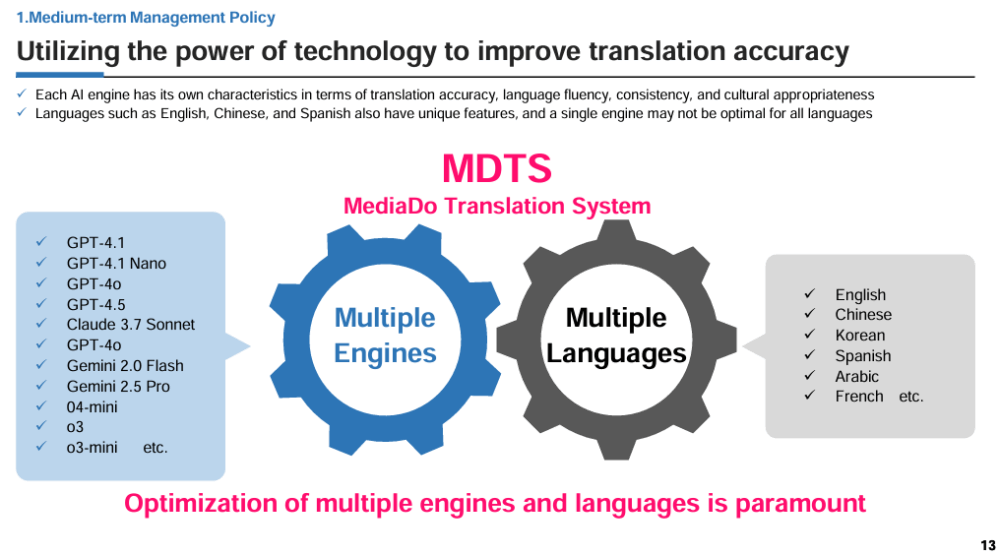
However, it specifies the “human power” portion of equation is specifically on “content acquisition, translation supervision, and project management.” It can be inferred that the human touch to the MDTS system seemingly doesn’t involve direct translation by a human being. The MDTS engine is powered by a mix of multiple engines such as GPT, Claude, Gemini.
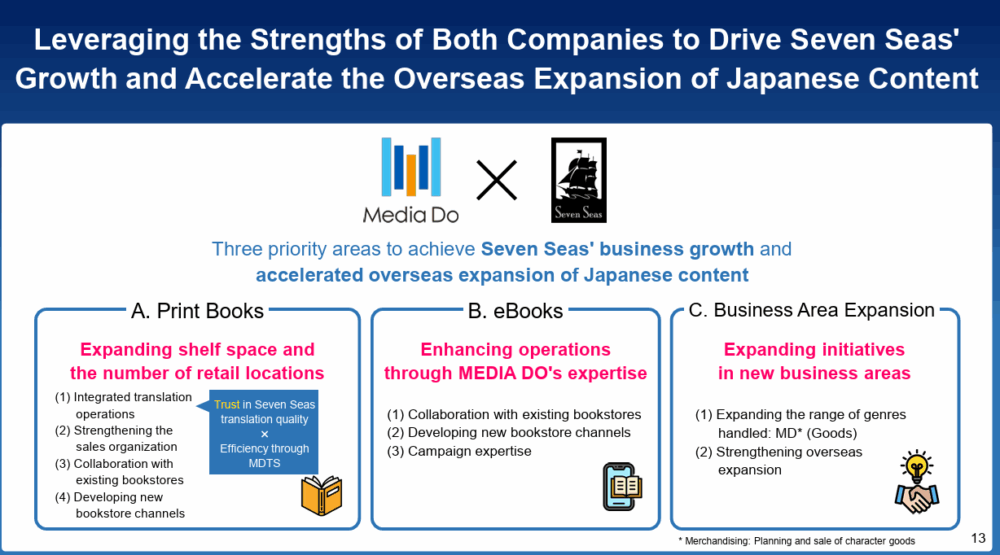
Inside the supplementary material released on March 2, 2026, Media Do states Seven Seas’ sales comprise of 83% print books and 17% eBooks. By leveraging Seven Seas’ domestic market strength, Media Do outlines that the #1 priority under Print Books is “integrated translation operations,” which combines “trust in Seven Seas translation quality” and “efficiency through MDTS.” How Media Do plans to convince consumer goodwill in trust in the manga company’s translation quality is yet to be seen. As mentioned in the previous paragraph, there appears to be no human involvement in the MDTS translation tool as it comprises of multiple AI engines.
Given the disconnect between Seven Seas’ messaging at Citrus Con 2026 and the sudden public acquisition announcements and subsequent materials, longtime fans are unhappy and pessimistic about the future of the company. Online discussion is still hung up on the potential future of translation by AI as fans feel betrayed. It will take more than words to rebuild that broken trust.