

I’m a little late with my ComicsPRO wrap up. The event was very tiring and I took some time off to recover from Toy Fair and ComicsPRO being back to back, and now it’s two weeks later. But as the most important business conference of the year for the comics industry, there are still a few things I want to point out.
First, I would direct you to David Harper’s far more timely and wall-to-wall coverage of the event (subscription required but it’s $5 for the luvva….)
Overview of the event
Winners and Losers
More news and notes
A podcast recorded AT ComicsPRO with David, myself and Christina Merkler of Lunar.
Harper found the event a very positive one, as most do, and here’s some of what he wrote:
To better underline just how robust the positivity was, it took until Saturday afternoon, the final day of the event, to hear a genuine complaint. While it almost made up for the lack of other grievances thanks to its white hot intensity and highly focused nature, it was also fairly minor in the grand scheme of things and ultimately led to a production conversation, to say nothing of how it was overshadowed by the otherwise endless waves of positivity.
You could even sense that attending creators were encouraged, as most I talked to felt buoyed by the potential of this moment despite the recent hardships many have had when it comes to selling their own comics. They could have been dour in the face of those challenges, but instead they embraced the energy of the event and tried their best to build on the moment, just like everyone else.
While one might think that this is reflective of what these conferences are typically like, I can assure you that that is simply not the case. This was my second ComicsPRO, and while my previous visit was a good while back — it was the 2018 edition held in Portland, Oregon — it was productive but nowhere near as cheerful or optimistic. That was a different time, a different direct market, and a different environment altogether.
My own wrap-up can be found at Publisher’s Weekly: At ComicsPRO 2026, the Comics Industry Proves Its Resilience.
One of the major points of my PW piece – and something that was touched on in the podcast with Merkler – is a major “We did it!” moment for me. There have always been book publishers at comics retailer events, but at ComicsPRO ‘26, they were really all in on reaching the comics shop market. As I wrote:
The strength of the direct market, it seems, is enticing book publishers to find new ways to reach comics shops. At the conference, Lunar Distribution announced that they would become a wholesale distributor for manga from Yen Press and Viz Media (distributed by Hachette Book Group and Simon & Schuster, respectively). While details were scarce, the move would make both publishers more visible to comics shop owners.
And getting in front of more direct market retailers is a very good thing, according to Abrams ComicsArts director of marketing and publicity Jacqueline Cohen. Following a move to Lunar, Abrams’s line of graphic novels had a sales boom in 2025, Cohen said.
“When we got our front list in front of retailers, it made a big difference,” she told PW. “It was a significant enough amount that our CEO realized how important the comics market is.”
Kodansha, which is distributed by PRH, had similar results, as reported in a piece at ICv2:
While overall manga sales went up about 10% last year, Kodansha Comics’ sales grew three times faster, and 2025 was Kodansha’s best year of all time in comic shops, Ben Applegate, who heads up the Kodansha USA publishing team at Penguin Random House, told attendees at the ComicsPRO Annual Meeting. “Every year, we’ve spent more time and money strengthening our relationships with comic shops, because that investment has always paid off,” he said.
I had to step away for the Kodansha presentations (more on that below) so I missed this nugget!
The Lunar/Yen/Viz team-up also deserves a bit of clarification. As we discussed in the podcast, Merkler mentioned carrying Viz and Yen in her own Lunar presentation, which perplexed the audience because Viz is distributed by Simon & Schuster and Yen by Hachette. However, like most mainstream distributors, they offer products via wholesale – just as Diamond was able to carry Marvel comics as a wholesaler, Lunar will be able to carry Viz and Yen as a wholesale sub-distributor.
It’s so simple, obvious and additive. Lunar still needs to have a bigger warehouse to carry more products, but this is their eventual goal.
And once again, this is because being carried in the smaller Lunar catalog gives these products more visibility and gives retailers more of a chance to order them, as Abrams’ Cohen explained.
As I’ve said in podcasts and written here dozens of times, if you went to a book publisher and said “Would you like your products to be sold to a network of 2000 indie bookstores on a non returnable basis?” they’d be racing towards it faster than my cat when I shake the kibble bag.
We have a perfect virtuous storm here. Comics shops enjoyed a gangbusters 2025 thanks to new readers lured by Absolute, Energon and other strong titles. All those profits gave them the stability to order MORE new (to them) products like manga and mainstream graphic novels. And those brought in new readers. And so on and so on. Everything worked! And (she said hesitantly) seems to be continuing to work.
PRH has been playing the long game along similar lines. Back when they jumped into carrying Marvel during Covid, we all asked, WHY would the world’s largest trade publisher get into distributing comics periodicals, a messy, niche product line? Why, to sell their products to a network of 2000 indie bookstores on a non returnable basis, of course.
This is all very much a post-Previews world. Yes, yes, we all have nostalgic thoughts about Diamond’s 400 page monster of a catalog, but as a sales tool….it was not that effective. It was a tedious, labyrinthine chore to go through for readers and retailers alike.
Both Lunar and PRH have smaller, most focused catalogs – when a retailer gets to the end of one they have some energy left to try some new things. That didn’t happen with Previews.
I haven’t talked to any retailers directly about this, but the biggest complaint about the end of Diamond was that ordering from multiple distributors was more of a time sink for time starved shop owners. But maybe…going through more smaller catalogs instead of one huge, unwieldy catalog ends up being a smaller task overall? Like I said, just advancing a theory here, so I welcome corrections.
And what of the third player in the game, Universal Distribution? They are making their own moves, and promoting Free Comics Book Day, but the feedback I got at ComicsPRO was that they are rolling out slowly. Basically, they are a relatively new player and retailers are just getting to know them. That said, Universal seems to be in this for the long haul, and three strong distributors is better than two strong distributors. We will never have a monopoly again.
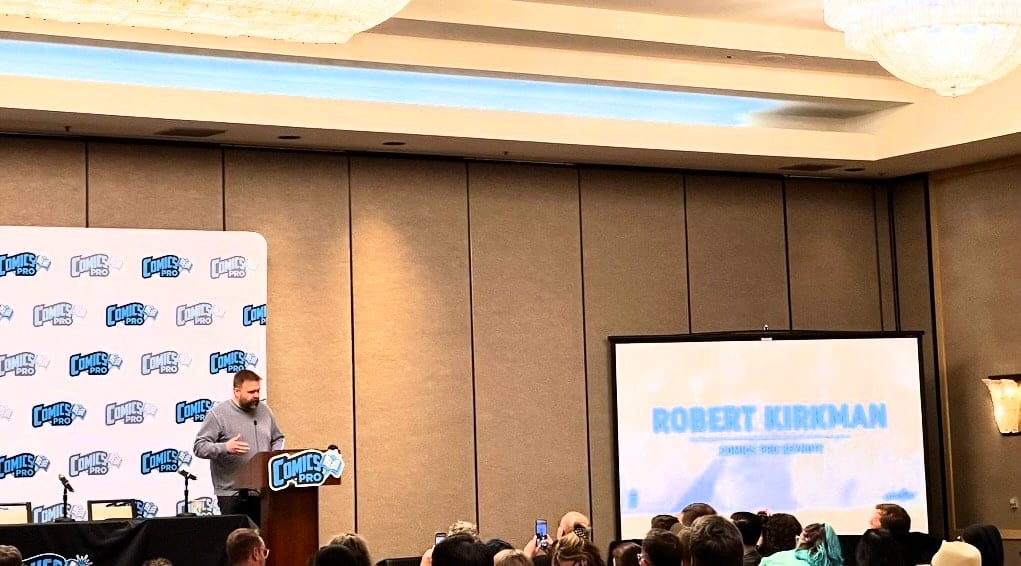
All of this is good stuff, but there is still a mystery piece in the game: Marvel. And it’s not just me saying it. David Gabriel, Marvel’s Senior Vice President – Sales and Marketing, came for his presentation and hung around afterwards talking to all kinds of folks, but left the next day and Marvel did not participate in the two days of roundtables which are the most valuable part of the conference. Reviews of his presentation were mixed – some retailers thought it was fine, another told me it was “the worst presentation I’ve seen.” I talked about this more on PW’s More to Come podcast, but at a time when most publishers are bringing out all kinds of creators and projects, Marvel is standing pat.
As the #1 comic book publisher in the direct market, I guess you could say they could afford to essentially phone it in – it’s been shown time and again that retailers will order Marvel comics in steady numbers no matter what they are actually publishing. But as I must have said on all the podcasts I participated in, a reënergized, risk-taking Marvel Comics would lift even more boats even higher. They seem to be licensing out their most daring and noteworthy projects – Alex Ross Marvel multiverse graphic novel anyone? – with little room left in their main line to try new things. The MCU is tired, Marvel Comics are tired….but they are still #1.
Anyway, there was so much more that happened, and so many great books announced. Tiny Onion, Oni, Ignition, 2000 AD, Yen, Boom, Dark Horse, IDW, Skybound – everyone had something to bring to the picnic. One thing I noticed about the presentations that differed from past Diamond retailer conferences I attended (dozens of them): instead of stressing terms and promotions like returnability, POS racks, discounts, shipping and so on, it was mostly “Hey we have some great books coming out and here they are!” – with a few variant covers and blind bags thrown in, to be sure. It was enough to stress great content to retailers who have customers hungry for more, and that’s a very healthy situation. My Beat team did an AMAZING job of covering most of the announcements, and you can follow along with my live posting at the #comicspro26 hashtag on BlueSky. And that brings me to my final point.
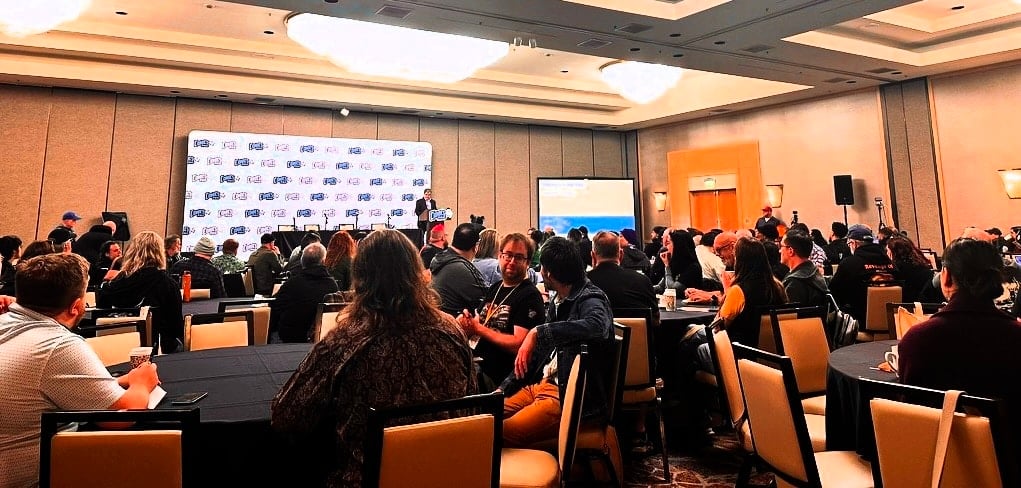
ComicsPRO has grown a lot and might keep growing. It’s gone from basically twoand a half days to a full, jam packed four days. People arrived Tuesday night so they wouldn’t miss a full day of seminars, meet-ups and events on Wednesday. The previous two times I attended, Wednesday was mostly a day for arrival. But no more. Likewise, Saturday was booked solid. It was a marathon like SDCC and NYCC! I had to take breaks and even a nap at one point. Even hitting all the parties took a lot of work.
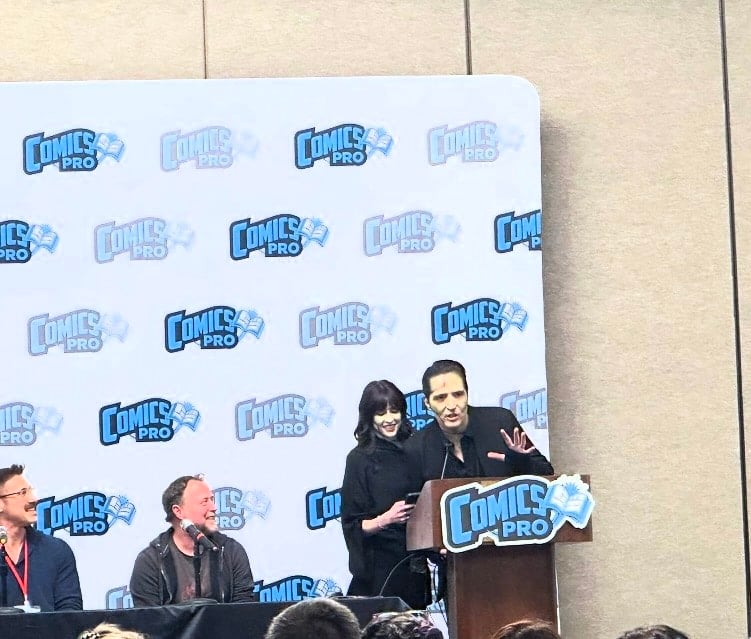
This is all positive and for younger more energetic folks than I (which is most of the retailers who attended) eminently doable. But ComicsPRO is definitely having growing pains, as related to me by both president Joe Murray and executive director Marco Davanzo. The Glendale Hilton, as David Harper noted, is far from a luxury hotel, and even last year the show had already outgrown it. (I would like to note that the food is very good for hotel food.) With more and more professionals attending, there were even worries that not everyone would be able to get into the main room for presentations – my own reserved seat in the back of the room meant all my photos sucked. I heard some talk of adding a fifth day but I think keeping it at a tight four is the best option, possibly with more overlapping events. A lot of the panels and presentations are livestreamed, so getting more people to attend virtually is definitely a goal.
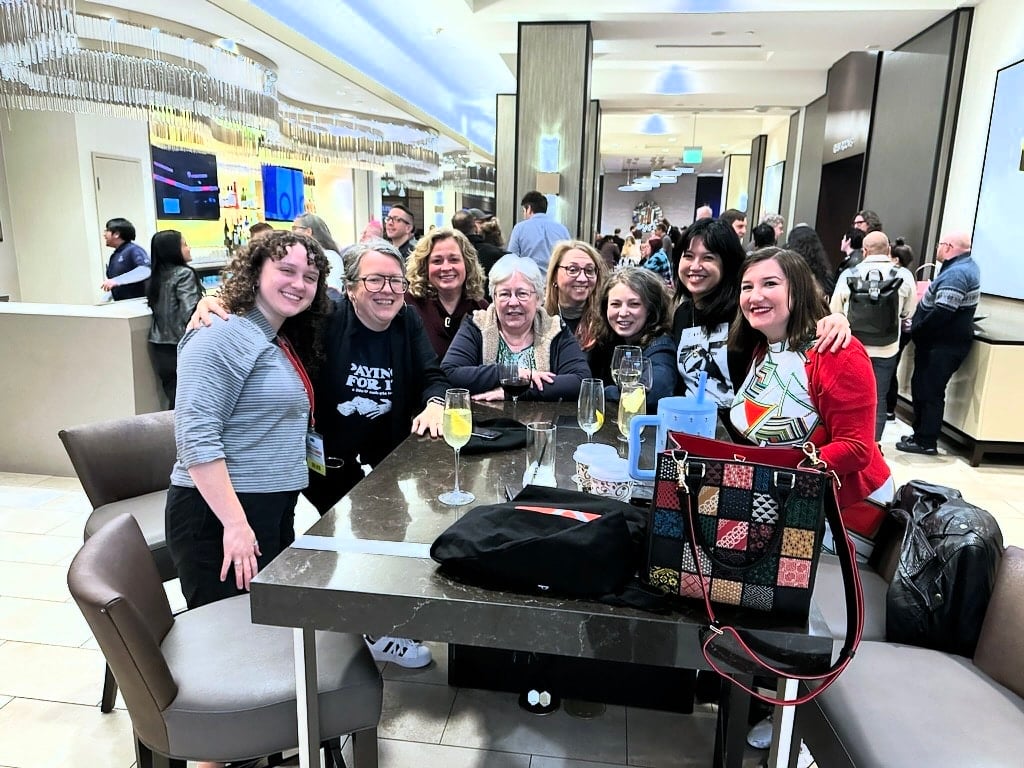
Still, the beauty of ComicsPRO is that so many of the people who make a difference are in the same room, from the data crunchers to the big publisher reps to the consultants and creators. As others have noted, it was impossible to walk across the lobby without stopping for as many fascinating conversations your brain could hold.
Where will ComicsPRO be held next year? I heard no solid answers – maybe even back in Glendale, maybe on the East Coast, maybe in some fairly random cities I heard thrown around.
Whatever the setting, it’ll be another important, inspiring event.
The world is getting more uncertain and frightening every day. But comics are doing okay. And that’s a very good thing. It’s something we need to hold on to.
Big thanks to Oni Press for sponsoring our coverage, and to the ComicsPRO board for putting on a stellar event.


“My report is better late than never”
Hei-di! fists on hips, shaking my head disapprovingly
Future ComicsPro in New Orleans! That would be a Good Time.
Lovely to hear this, Heidi! Good news is hard to come by these days. I’m happy Comics seem to be thriving amidst this difficult time.
Comments are closed.