
With more people reading manga and Webtoons (aka vertical scroll comics) than ever before, Beat’s Bizarre Adventure gives three writers an opportunity each week to recommend some of their favorite books and series from Japan, Korea, and elsewhere. This week we have middle school assassins, all-powerful witch queens, and, of course, we ponder the orb.
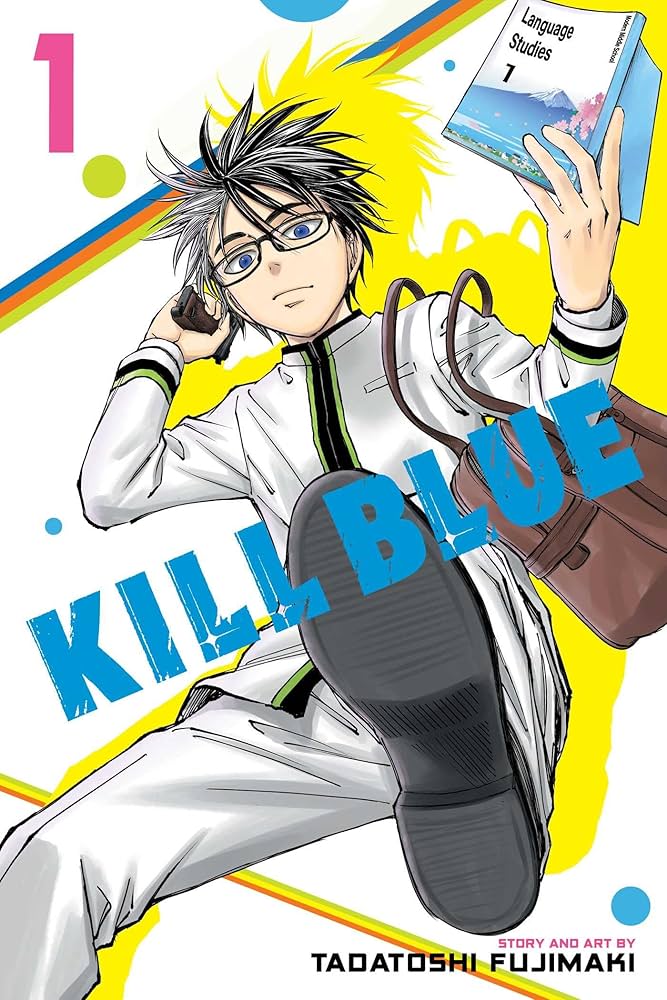
Kill Blue
Writer/Artist: Tadatoshi Fujimaki
Translation: Casey Loe
Lettering: Steve Dutro
Publisher: VIZ
The creator of Kuroko’s Basketball returns with a fresh story, where a famed assassin starts over in the body of a middle school student.
At the heart of Kill Blue is Jūzō Ōgami, a legendary 40-year-old assassin with a spotless record—until his world flips upside down. After a sting from a mysterious wasp, Jūzō wakes up in the body of his 13-year-old self. Suddenly assigned to infiltrate a middle school, he must navigate awkward classes, quirky classmates, and lurking killers, all while working to reclaim the life he lost. What follows is a fast-paced blend of action, dark comedy, and pure adolescent chaos.
Kill Blue is a manga by Tadatoshi Fujimaki, serialized in Weekly Shōnen Jump from April 2023 to September 2025. The series blends slick action, quick-witted comedy, and the delightful chaos of middle school life. An anime adaptation by Cue is slated for release in 2026.
The manga series strikes a balance between playful comedy and sharp action. At times it evokes the intensity of my beloved Katekyo Hitman Reborn! One drawback is the sometimes uneven merging of its two core worlds. While hitman series like Sakamoto Days seamlessly fuse ordinary daily life with high-stakes assassin conflicts, Kill Blue separates its school and action arcs too distinctly, making the transitions feel less cohesive. Even so, the overall execution remains engaging and accessible, making it an enjoyable read.
Overall, Kill Blue dips into multiple genres—action, school life, comedy, light romance, and even sports—without feeling disjointed. Fujimaki blends these elements into a smooth reading experience for a wide audience. Younger readers will enjoy the energetic school setting and fast-paced storytelling. At the same time, the manga’s premise (a seasoned adult assassin forced to relive adolescence) adds a layer of appeal for slightly older audiences who enjoy narratives about revisiting youth from a new perspective. — Ilgın Side Soysal

LunaSomnia
Writer/Artist: Oniri Boy
Platform: WEBTOON CANVAS
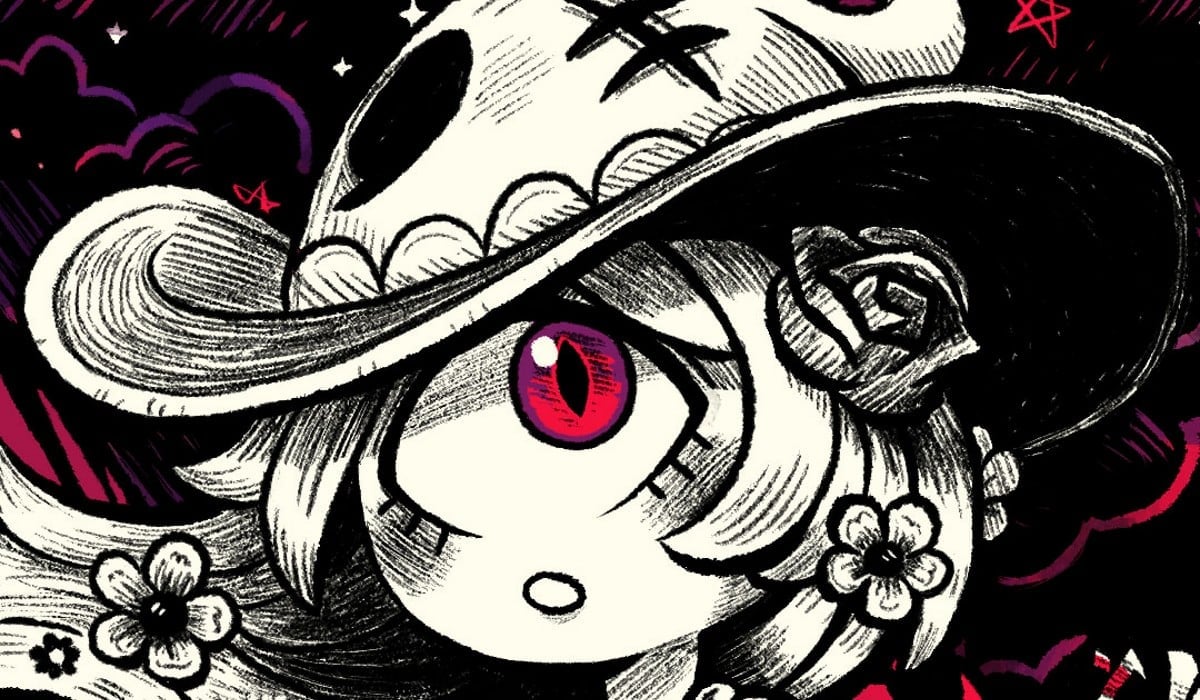
God, I love CANVAS! I keep discovering so many unique and interesting stories there. This week’s pick, LunaSomnia by Oniri Boy, came to me thanks to Aventale’s creator Kyuare sharing it on X. The series takes place in an alternate 17th century Earth ruled by Lilith, the all-powerful queen of the witches. The heroine Lucerna embarks on a quest to find God’s Chosen One to put an end to Lilith’s rule. But other witches also seek the Chosen One for their own dark motives.
The series began publication on March 18th, 2024, with each episode illustrated via black and white art reminiscent of Legend of Zelda: The Wind Waker and The Owl House. Character silhouettes are heavily stylized and do not adhere strictly to human proportions. The author uses hatching techniques to add detail and depth similar to that of Medieval art. Despite the use of black and white, scenes are always legible; for instance, the first episode set at night uses white lineart against a black background to create foliage and scenery. This contrasts with the characters in the foreground illustrated in white with black.
From the handful of episodes I have read, it is a crime that this story has only over 500 subscribers a year after publication. It might not fit into the broader genres and demographics WEBTOON is known for. But this is a hidden gem that should be read by more folks who want something different from the usual stories on the platform. Also, the heroine Lucerna is a cyclops, which I hardly ever see in media.
You can read the over 16 episodes including a bonus spinoff episode for free right now on WEBTOON CANVAS. If you wish to support the artist, you can follow Oniri Boy on X/Twitter as well as on their Instagram. Hell, buy them a coffee on ko-fi if you’re feeling generous. Until next time, keep on reading, birb nerds! — Justin Guerrero
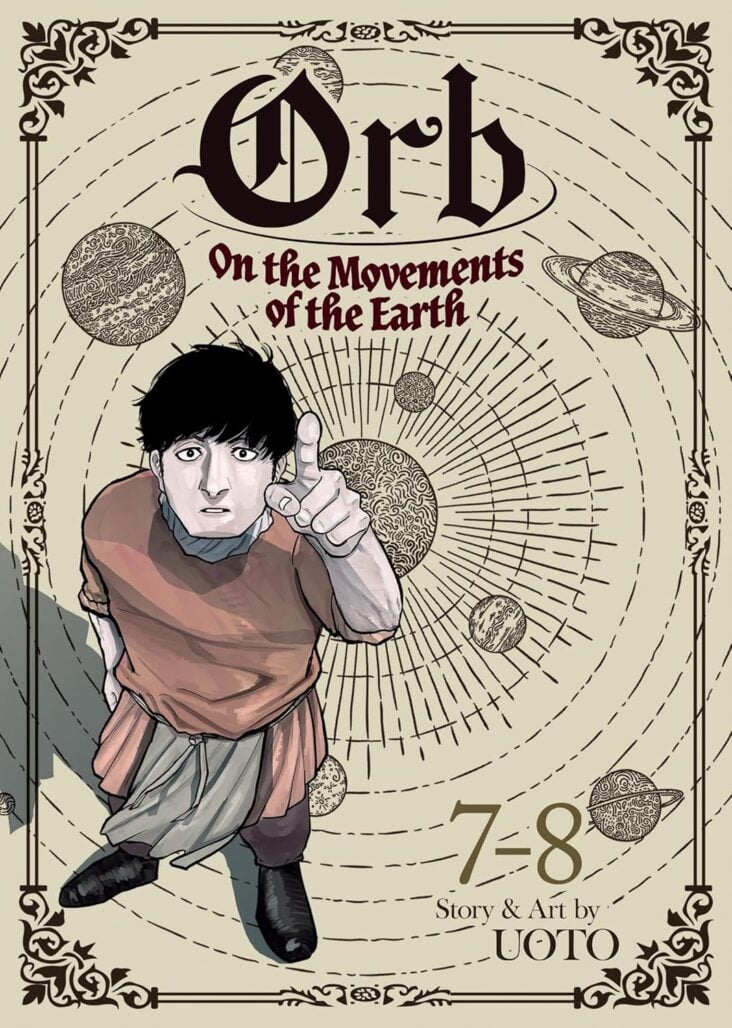
Orb: On the Movements of the Earth
Writer/Artist: Uoto
Translator: Daniel Komen
Adaptation: Molly Tanzer
Lettering: Phil Christie
Publisher: Seven Seas
“Hey, wait a minute,” you might say. “Didn’t you review Orb: On the Movements of the Earth back in 2023?” Well, ever since seeing the excellent anime film 100 Meters this year (which was based on an earlier Uoto manga) I’ve wanted to return and ponder the Orb once again. Since then I’ve finished the series and have a better sense of Uoto’s priorities as a storyteller.
Orb’s first story arc, a simple tale of science and religion, made me think at first that Uoto was most interested in absolutes–good versus evil, knowledge versus ignorance. 100 Meters, though, convinced me that he had more on his mind. That film only starts as a sports story about kids training to run the fastest. What comes after, when the kids grow up and develop their own ideas about running, is the most important part.
Orb as a series is similarly very curious about what kind of person would spend their lives chasing an idea. Uoto uses his comic’s rotating cast of highwaymen, scholars, capitalists and priests as mouthpieces for different points of view. Yet he’s clearly just as interested in the characters as characters, depicting how they warp under pressure. There are no purely rational scientists in this story. Everybody is contradictory, a little bit broken by the world in which they live. Heliocentrism is an imperfect science shaped by imperfect hands.
My favorite part of the story is the third arc, which covers a revolutionary movement for heliocentrism where the “true believers” all disagree on fundamental things. But it’s the fourth and final arc, anticlimactic as it is, that cements Uoto’s talent for me. After seven volumes of making the reader cheer for heliocentrism’s survival, he asks: what if the pursuit of science really made everything worse? It’s such a perverse move that I have to respect it. — Adam Wescott
Follow Beat’s Bizarre Adventure to get weekly manga and webtoon recommendations!