
With more people reading manga and Webtoons (aka vertical scroll comics) than ever before, Beat’s Bizarre Adventure gives three writers an opportunity each week to recommend some of their favorite books and series from Japan, Korea, and elsewhere. This week we have a yuri sketchbook, high school shenanigans, and, of course, avatars.
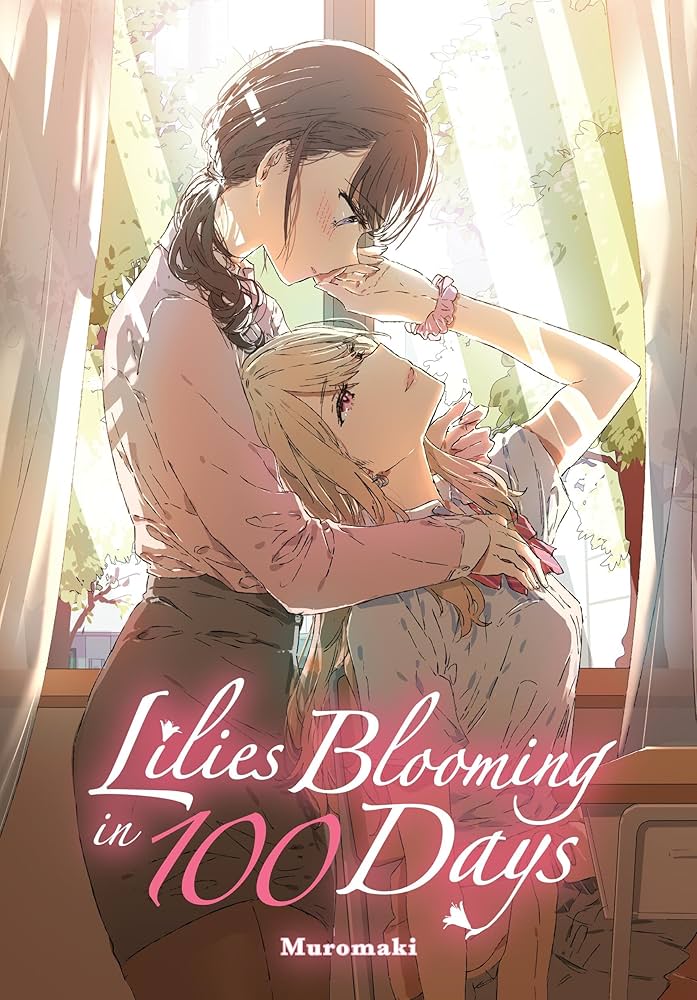
Lilies Blooming in 100 Days
Writer/Artist: Muromaki
Translation: Jenny McKeon
Lettering: Alexis Eckerman
Publisher: Yen Press
Lilies Blooming in 100 Days is an interesting licensing choice in and of itself, and quite different from the usual works we recommend weekly. Rather than a coherent volume with a plot structure and continuous character arc, it reads like Muromaki‘s sketchbook.
Every “chapter”, or “day” as they are labeled, focuses on a trope/dynamic and a circumstance. While there are recurring characters, they are sporadic rather than continuous. One page, for example, is dedicated to high school friends being “gal pals” and practicing kissing as gal pals do. In the next panel, the mother is bringing snacks, catching the girls mid-action. Another page is dedicated to two all-girls high school students sandwiching their teacher in between for after-school “curriculars”. From cooking to gaming, from getting handsy in public to visiting a festival, Muromaki draws their characters in all kinds of situations.
While some couples are at the same or similar age, there are also minor/adult and cousin relationships that play into intimate care and roles, or height being reversed as they age. Some of these situations are cute, others are titillating; the latter had my heart racing! At this time when “risky” works in the romance genre face constant backlash under the blanket statement “fiction affects reality,” we have seen publishers favoring “politically correct” and “acceptable” works. I appreciate that Yen Press chose to license this book that depicts socially taboo relationships..
Muromaki’s linework is light and fleeting, but detailed, and the color palettes are soft. The volume is available as a paperback, but unlike the usual manga volume, it’s full-color. Muromaki’s character designs are quite similar to the ones you’d see in a usual slice-of-life series and could be categorized as moe. I wouldn’t say they were bad, but personally, I would love to see more visual diversity in yuri manga licensed in English.
To sum up my part of this week’s adventure, I recommend this single-volume comic collection to all romance genre lovers, especially the ones who’d be interested in owning a copy of this interesting collection that is neither fully a comic nor fully an artbook. While I wish the author expanded on any one of the book’s scenarios further, I also found it refreshing to see so many beloved romance tropes collected in one volume! A big thank you to Yen Press for sending me an advance reading copy in exchange for an honest review. — Merve Giray
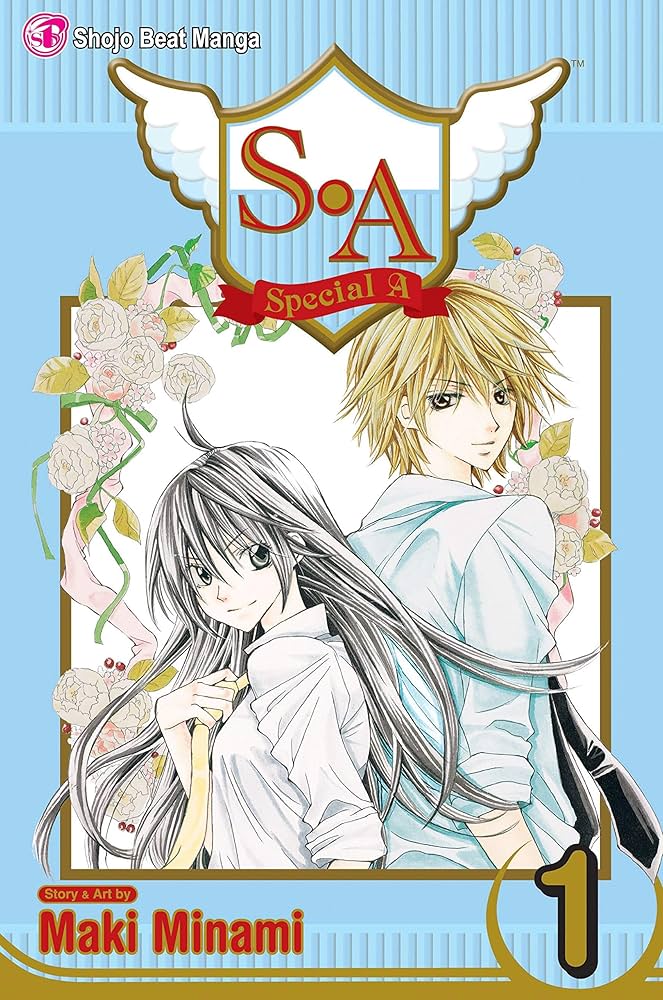
S.A
Writer/Artist: Maki Minami
Adaptation: Amanda Hubbard
Design: Izumi Hirayama
Editing: Nancy Thistlethwaite
Touch-up Art and Lettering: Rina Mapa
Publisher: VIZ
Second place sucks. It especially sucks when you keep coming in second place to the same person for years. That’s the story of Hikari Hanazono, who has made it her life’s mission to beat her childhood friend and nemesis Kei Takishima. She’s so determined to come out on top that she attends the same elite school as Kei and participates in the same activities in the hopes that she might finally beat him. The top seven students at this elite school are placed in a special class called Special A. Unbeknownst to Hikari, though, Kei has had a crush on her since they were kids. He’s even confessed to her on several occasions only for her to misinterpret it every time.
S.A came out at a time when I was really into romantic comedies. Kei’s failed attempts to confess his love for Hikari made me bust my gut laughing. Hikari was also unlike the female leads I’ve read in other romance stories, who are usually super delicate and require saving from their romantic interest. While Hikari still falls into the trope of being the naive, optimistic protagonist who always sees the good in people, she is able to stand on her own two feet when the time calls for it.
Rereading this slow-burn story for Beat’s Bizarre Adventure, I was frustrated by how oblivious Hikari was to Kei’s affections. Luckily, the extended cast of Special A classmates offered a reprieve whenever I found progress between the main characters to be too slow. I enjoyed how diverse these other students were, as well as how they all had different personalities and challenges in their lives despite being lauded as the smartest of their school.
The manga has its flaws, namely with poor Hikari always coming in second to seemingly flawless and perfect Kei. But despite its overabundance of cliches, S.A is a lighthearted read that will simultaneously put a smile on your face and make you pound the table in frustration. — Hilary Leung
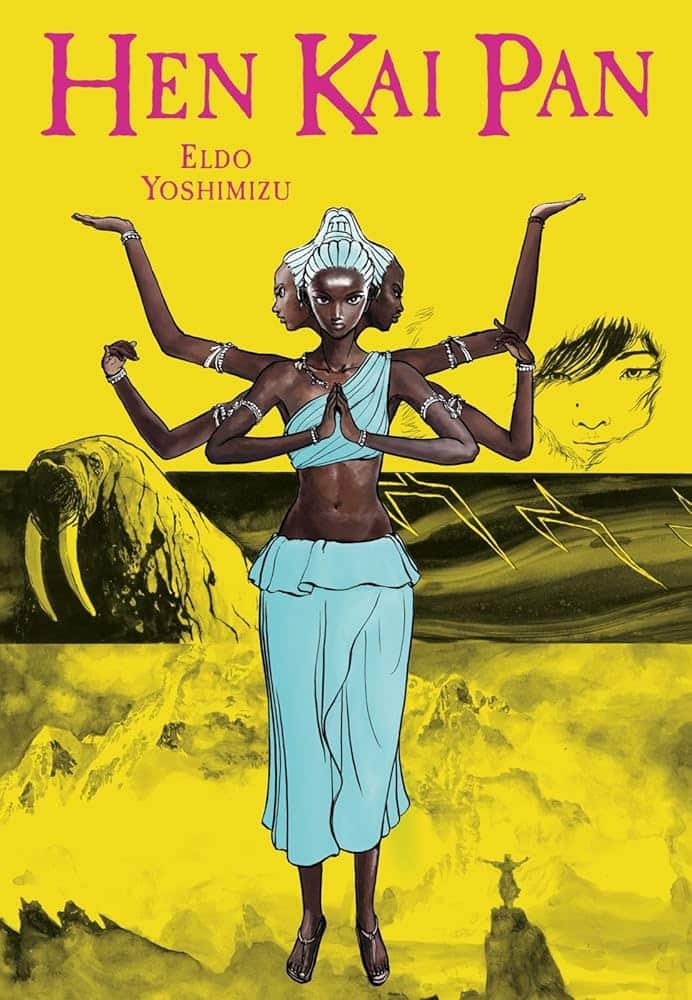
Hen Kai Pan
Writer/Artist: Eldo Yoshimizu
Translation: Matoko Tamamuro
Lettering: Lauren Bowes
Editing: Phoebe Hedges
Publisher: Titan Comics
Eldo Yoshimizu is an artist and sculptor. Having seen some of his other works, especially his contemporary pieces, he has an incredible eye for design. That shines brilliantly in his work Hen Kai Pan, which leans hard into majestic cosmic imagery as well as scenery from around the world.
The story follows Asura, a human chosen by the gods to do their bidding on Earth. One god, Nila, decides that all life on Earth must be exterminated. She uses Asura to accelerate that process. Other gods in the mix have their own ideas, though, and must work together to stop Nila from interfering with their divine judgement.
Hen Kai Pan is a quick read. Its greatest strength is Yoshimizu’s gorgeous double page spreads of animals and the environment; even destruction looks beautiful when drawn with his pen. I also like the book’s exploration of Cosmotheism. Yoshimizu establishes avatars representing different populations of Earth that oversee parts of the world.
There is a version of Cosmotheism that, in our reality, is connected to the concept of white supremacy. Though that’s not the kind of Cosmotheism being explored here, I do find it interesting that the villain is linked, physically and somewhat geographically, to those who historically espouse such evil ideology.
Where I found Hen Kai Pan frustrating is in the dialogue. Perhaps it’s the fault of the translation; since I read this in English, I don’t know how the dialogue flows in Japanese. But I found myself thinking that the dialogue felt too literal and not very natural. I can very clearly see that a human is attributed to the work, and it feels like it, but I do wish the dialogue had been punched up.
Another part that felt underdeveloped was the question of humanity’s sins. As readers, we know how terrible humanity can be because we see what’s happening in the world all the time. Within the story, though, it’s a beat that depends on your past knowledge rather than being explored within the book itself .
Hen Kai Pan is still worth experiencing for its art alone. It’s an ambitious tale about humanity’s follies with a pro-nature stance. Yoshimizu gives us hope at the end that humanity can redeem itself, even if it must start over first. — Derrick Crow
Follow Beat’s Bizarre Adventure to get weekly manga and webtoon recommendations!