

Roughly half of British adults believe comics are the domain of children, according to a survey conducted by UK-based international analytics firm YouGov.
According to the YouGov report:
“In recent years, there’s been growing discussion of people ‘kidulting’, whereby people maintain hobbies or interests they held as children long into adulthood…For some, this is mere childishness; for others, these things were never solely for children in the first place, so why give them up. But where do Britons draw the line? A new YouGov poll identifies which ‘kidult’ activities and interests the public see as more for children and which it’s okay for adults and children to equally enjoy.”
It adds:
“On many other of the hobbies and activities polled, Britons are more divided. Lego, for instance, splits the public 49% to 48% over whether it’s primarily for children or is equally for children and adults. While just over half of Britons (51-53%) see watching cartoons or reading comic books as being more for children, more than four in ten (41-44%) see them as being as much for adults.”
The survey asked a representative panel of 2,000 UK adults from across the political spectrum a series of randomised questions about their perspective on a selection of “kidult” activities as part of wider polling on general public attitudes. Kidult activities questioned included reading comic books, playing videogames, Dungeons & Dragons, Doctor Who, Star Wars, wearing costumes, birthday parties, and playing recreational sport (interestingly ‘recreational reading’ was not included).
1,084 panellists were asked their view on “comic books”. 11% considered them entirely for kids and another 40% said they were “mostly for children”. 41% said they were for kids and adults equally with a surprising 4% suggesting they were “mostly” or “entirely” for adults. This means that around 51% think comics are largely the domain of children while 41% believe they are for everyone.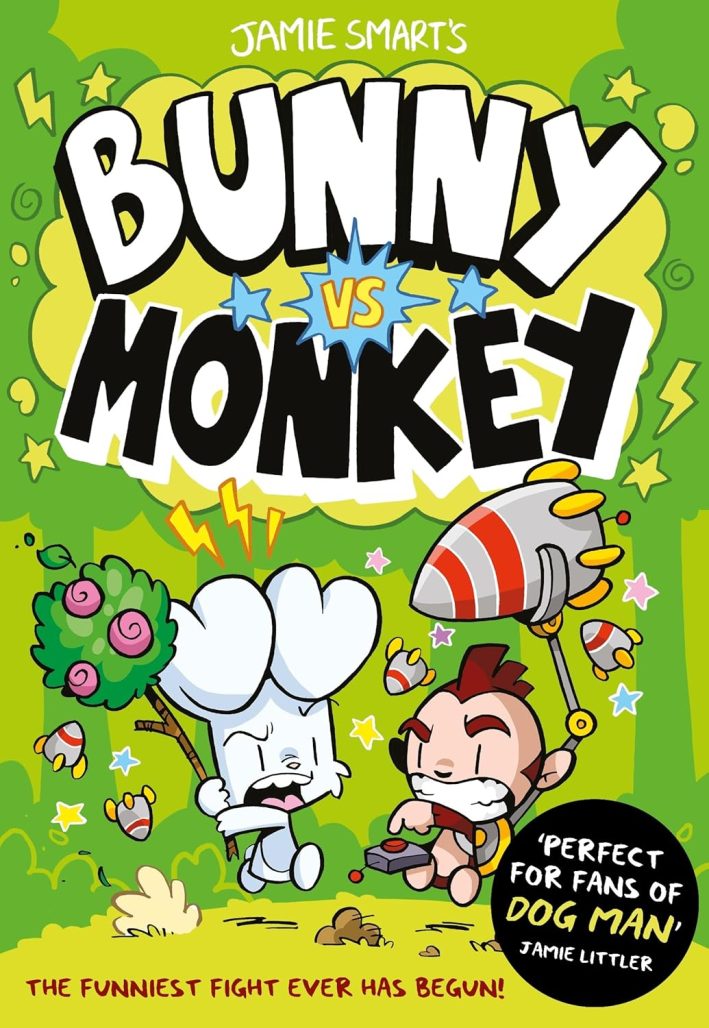
Comics in the UK have their own history with a thriving newsstand market of kids weekly anthology comics up to the 1980s – and today experiencing a major resurgeance in popularity via manga and kids/YA graphic novels like Jamie Smart‘s Bunny Vs Monkey, Dav Pilkey‘s Dog Man, and Alice Oseman‘s Heartstopper flying off the shelves. The kids graphic novel market was among the biggest growers in the UK book trade last year. Graphic novels for adults and the literary set in the UK have been steadily gaining steam since the 1980s but comparatively lack the sales or cultural cachet of those for kids.
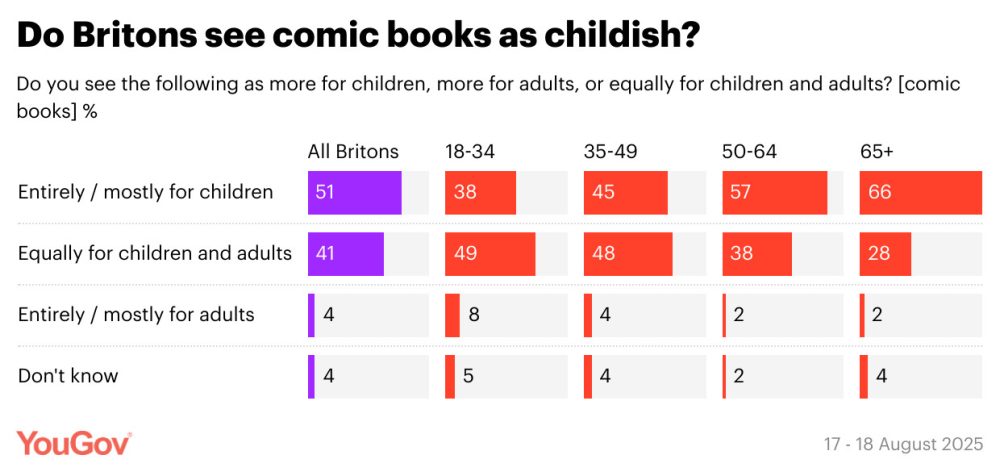
The survey also broke down the results by age group and political affiliation with those in younger age groups less inclined to consider comics as mostly/exclusively the domain of children (38% of 18-34 year olds; 45% of 35-49 year olds). 66% of those in the 65+ age bracket believed comic books were entirely/mostly for kids.
Looking at the political data, less than 50% of those that voted for Left-leaning parties believed comics were exclusively for kids. Those that voted for the most Left-leaning party at the 2024 British General Election (Green Party) being most strongly in the “comics are for everybody” camp – with 63% saying “comics were equally for adults and children” against 37% considering them mostly for children. The most Right-wing participants (those who voted for Reform UK in 2024) said comics were mostly for children by 61%, with 30% believing they were equally enjoyed by kids and adults.
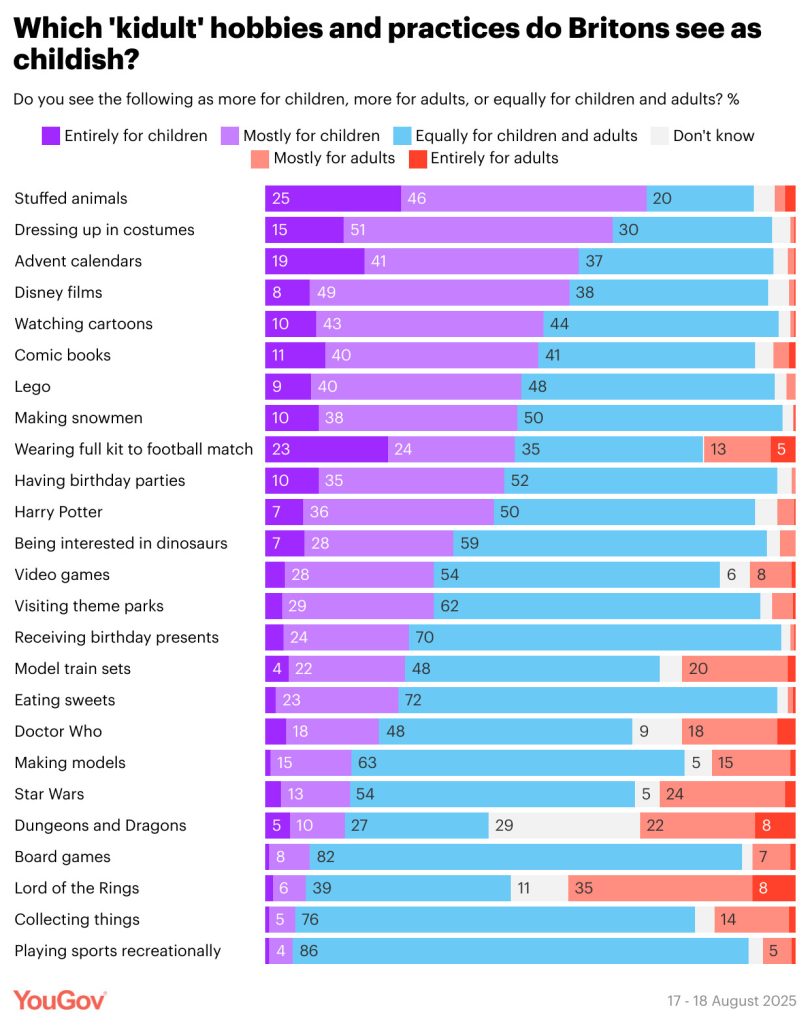
For comparison with other activities, recreational sport was the most heavily accepted (86%) by Brits as an activity for everyone, followed by board games (82%), and “collecting things” (76%). At the other end of the spectrum stuffed animals (NB: cuddly toys, not taxidermy) were 71% considered mostly or exclusively for children.
On the broader chart comics sat between Lego (49%) and watching cartoons (53%). Video games seemed the more acceptable “kidult” activity with 54% saying they were for kids and adults equally (32% suggesting they were mostly for kids). 45% of Brits considered birthday parties to be mostly for kids – but 70% considered receiving birthday presents as fine for all.
Leaving aside the starting point of framing things from the perspective of “kidult”, there are some flaws in the question “comic books” as the realm of comics has become somewhat more fragmentary in recent years. Many consider “graphic novels” and “manga” (and even webtoons) as being something else entirely. Plus it would have been nice to get an idea of public attitudes to recreational reading in the “kidult” questions but – we hope – it is similar to recreational sporting activity, sitting in the 80%+ margin. It would also be interesting seeing a similar survey conducted in the US.









This Brit tells everyone he can that comics are for everyone, it’s a medium not a genre!
Comments are closed.